
Skiff ace to foiler guru
Thursday October 8th 2009, Author: James Boyd, Location: United Kingdom
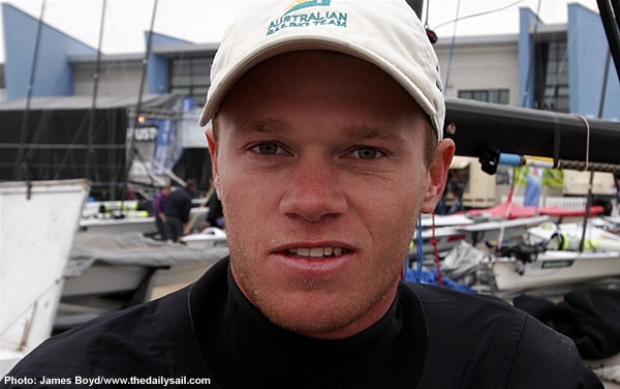
Australia is decidedly a force to be reckoned at present within Olympic sailing and one of their most talented of their number is certainly 49er helm Nathan Outteridge. Just 23 years old, Outteridge has already won the last two World Championships in the Olympic skiff and was favourite going into Beijing last year, only to see victory slip between his fingers. Otherwise in addition to his 49er success, between 2002 and 2004 Outteridge won three consecutive gold medals at the ISAF Youth World Championships, the only other person ever to have achieved this being New Zealand legend, Chris Dickson. Few would question that he is one of the world’s best sailors of his generation.
“We were sitting top three for the whole event and were third in the medal race,” says Outteridge of what happened at the Games last year. “We were leading the medal race and capsized 300m from the finish line. So we went from gold, to silver to bronze to fifth all in about a minute. We had one capsize with the kite up and another capsize when we were out of medal contention. You spend four years preparing for a light wind regatta and it all gets decided on a really windy race with people capsizing everywhere. We are obviously making up for it at the moment and we’ll just keep it going I guess.”
And making up for it he is. Since the Games Outteridge has teamed up with a new crew in the form of Ian Jensen. In fact the duo sailed together in the 420 and won a Youth Worlds together. “We were thinking about it when I was getting to the 49er, but Ian was still in year 10 at school - he was a couple of years younger than me - so he just went on and finished school and I started sailing with Ben and then after the Olympics were over I decided to go back to sailing with Ian again. It’s been good.”

Meanwhile his old crew Ben Austin started this year sailing with Darren Bundock, until the Tornado ace injured his knee. “Ben and I had sailed for a while and I could see it wasn’t working out as best as it could,” explains Outteridge. “He is a physio so he has gone back to working.”
For Outteridge the change seems to be working. This year they have competed at the Holland Regatta, the 49er Worlds and then Skandia Sail for Gold, and won all of them. Outteridge seems particularly at home in the shifty, blowing off the land conditions they encountered in Weymouth. “We like a bit more wind because we are used to sailing in wind at home and the shifty conditions that we are getting off the headland [in Weymouth] is pretty similar to what we get at home, because most of our sailing is either on lakes or in harbours where there is a fair amount of disturbance from the land,” he told us after that regatta.
“I am from Lake Macquarie, just north of Sydney, but I am doing a fair bit of sailing in Sydney as well. But what we haven’t done in the 49er is actually to sail in the ocean that much, so one thing we were working on here [Weymouth] was just to get used to the swell. Luckily it wasn’t that windy when we were out there and we had that windy day inside, otherwise it would have been really interesting…”
Outteridge claims that part of his success this year has been the amount of training he put in with Ben Austin prior to the Games starting to pay off, particularly in terms of their handling of the 49er. “In the last years I was very inexperienced, still capsizing when it was windy and stuff like that. So we are working that out. And sailing with Ian now is like a new fresh experience for us and it just brings the enjoyment back into the whole program. It gives you more of a spark and a reason to go sailing, otherwise it gets routine. I think also part of it is down to the new rigs – they are have it more even. Before a lot of the guys had good rigs and they’d deteriorate really quickly and because everyone has got new equipment the boat speeds are all pretty similar now. Before we might have been off the pace every now and then, but now we are on the pace all the time, so it makes it easier too.”
The new rig has also allowed crew weights to increase and Outteridge claims they are sailing 5kg heavier than they were before and he thinks this may increase yet more over the course of this Olympic cycle.
Back to the boats and the top 49er sailors are all looking forward to changing into new gear this autumn – the result of a fresh batch of 49er moulds being built (replacing the previous 12 year old ones). Outteridge has a new boat on order for the Worlds coming up in the Bahamas in January. Aside from being more evenly matched, the new boats have improved wing attachments. “Otherwise they’ll be exactly the same, a bit stiffer but more importantly they will be more even,” says Outteridge of the new boats. “There is a difference in the shapes of the hulls at the moment. They are tiny little things which perhaps only 5% of the fleet pick up on, but the idea is to make them exactly the same.”
So having won the World Championship this year, Outteridge is clearly still on fire in the 49er, but is there a danger he might peak too soon with three years left to go before the next Games? “It doesn’t bother me at all. It is nice to win and do well. The trick is how to maintain it and stop people catching us over the next three years. I guess there will come a time when people start beating us, but the difference between us and them is very small at the moment. We only won the Worlds by a few points. The racing is always close out there. We just seem to be getting it right at the right times at the moment.”
In terms of the number of races he will do over the next couple of seasons this will be dictated by how they get on at the Worlds in January as this in turn will dictate their funding – worst results = less funding = less sailing. As he points out “while you are doing well, you might as well keep sailing and keep the funding.” He will definitely be back for Skandia Sail for Gold in 2010 in order to spend more time in the 2012 Olympic venue and then of course he will be ramping up towards the multi-class World Championship in Perth in 2011.
As to why Australian Olympic sailors are doing so well at present, one element of it is the formation of the Australian Sailing Team he reckons. “It has come on quite well in uniting everyone together. That happened after the Athens Games, when we didn’t win any medals. They decided to do it a bit more like the Brits and get some team sponsors and make it more viable for people to do it. The biggest problem in Australia is trying to develop depth. It is so expensive travelling to Europe – you can do as much sailing at home as you want but until you go to Europe you are not going to be able to prove yourself. We had seven 49ers at the Worlds and we might have five at the next worlds and then they are back in Australia again and we might get 30 or something for that.”

Things that fly
Aside from his success in the 49er, Outteridge this year has been making powerful in roads into the foiling Moth class, something that has turned into a full-on passion for him.
“After the Games I was looking for something else to do that was fun and I got approached by Rohan Veal to come and sail one of the Bladeriders. So I took it for a sail and went down to do the Nationals in Geelong, because there were all the top guys there and ended up winning the event.”
Another reason for getting into the Moth was that the Worlds in 2011 will be held at Belmont on Lake MacQuarie where he heralds from.
Following the Aussie Nations, Bladerider asked him to sail one of their boats at the Worlds this year in Gorge where, among the now dominant Mach 2s, he finished second and he and Moth pioneer Rohan Veal were the only two Bladerider sailors in the top five. “At the moment I am going to work out what I have to do for the next Worlds. I am hooked and I have a few more guys from Australia getting into the boats - I have convinced [Laser Olympic sailor] Tom Slingsby to buy one and a few others.”
“It is really good fun. It is really physical, you have to hike hard and I’ve learned a lot about high performance sailing and the foils – it’s all a new thing. The fact that you are zipping around the course doing 25 knots downwind is pretty cool. After the Games I was hanging out by myself a bit at home and I could take it down, rig up, put it on my shoulder, take it down to the water and you don’t have to call someone to say ‘let’s go now’. So it is easy that way.”
In terms of how he learned to go foiling, Outteridge admits he spent hours studying the techniques of other foiling Moth sailors from video on YouTube. Through this he has now mastered the foiling gybe and even the more elusive foiling tack.
“By the time we got to the Worlds, Bora and I and a couple of the other guys were doing foiling tacks where the hull would just touch and keep going. If you do it perfectly you keep the hull out of the water, but if you get it wrong it is basically a capsize. So I spent a full six months solidly practicing tacks, because I knew the Gorge was going to be a skinny venue with lot of shifts and it was going to be pretty important.”
In addition to this, having large cajones is essential to doing well in the Moth. “I think also just having the guts to send it really fast is important. They are developing the foils and a lot of it is how the wand works with the centreboard and while we were at the worlds, Bora [Gulari, the 2009 World Champion] brought out this new trickery, so you could adjust the ride height of the boat while sailing. So the wand controls the height of the boat according to the flap movement, but he could adjust the pusher between the wand and the flap so he could change the range. He could sail really high and then when he wanted to go downwind or going through chop he could pull a rope and just drop the boat down a bit so the wand was still working in the same ratio as the flap, but you could just change the height of the boat.” Cunning.
He continues: “If there is chop you want to go lower, because what happens is that the foil can come out of the water, so you want to be as high as possible but keeping that in the water all the time. When you are going upwind you are normally about 6 inches lower than when you are going downwind just because of the speed. So he [Bora] comes around the bottom mark, pulls a bit of string goes a bit higher and goes a bit faster. So I have to get one of those now! I think there will be a lot more development between now and Belmont.”
Aside from Olympic 49ering and his Moth sailing, Outteridge is also dabbling in big boats and this year has been racing on the Farr 40 Estate Master, ninth at the Worlds this year in Porto Cervo. As with the Moth Worlds, so the Farr 40s are heading down under in 2011 when the Worlds return to Sydney. “So I am getting all fired up for that. Yachting isn’t as much fun as skiff sailing, but that is where the money is at the end of the day.”
Most Read
Most Commented
Comments
Businesses
Pro businesses
-
United Kingdom
-
-
France
-
Editor's choice
Member blogs
-
 Ned Collier Wakefield: MOD70 round BarbadosWell that was intense. 12 hard fought for seconds for the win. In idyllic conditions, Tony Lawsons MOD ...
 -
 Mini Transat leg 2 reportThe second leg of the Mini Transat started on 31st October, just over a month after ...
 -
Leg 1 reportI’ve been working towards the Mini Transat now for three years. In 2013 I was part ...
Business blogs
-
 The Island Sailing Club in Cowes, Isle of Wight, is delighted that Prince Michael of Kent ...
 -
Peta Stuart-Hunt chats with the 25 year-old British solo sailor Lizzy Foreman before she sets sail ...
-
The 2015 Student Yachting World Cup (SYWoC), an ISAF-recognised event hosted and run by students for ...
Editor's Choice
All time favourites...
-
 Three legs down into Ian Walker’s
 -
 Winning all but two races at
 -
 For the first time in its
Latest Comments
Add a comment - Members log in