
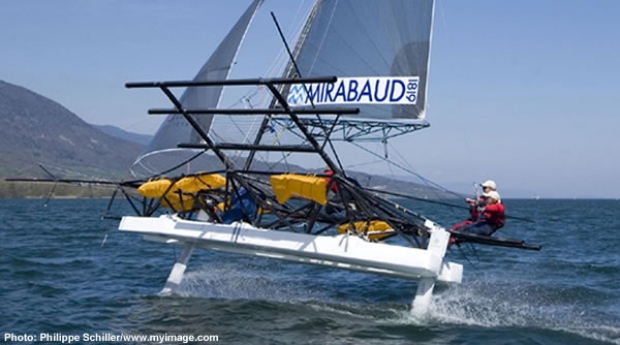
Foiler v non-foiler
Friday July 4th 2008, Author: James Boyd, Location: United Kingdom
Last weekend Thomas Jundt, of foiling 18ft skiff and most recently Mirabaud LX fame, went to the 18ft Skiff Europeans in Six-Fours, France to line up his foiling 18 against the rest of the 18 fleet. Despite his boat being illegal due to it having foils - which are firmly banned in the 18ft Skiff rules - Jundt was told he could attend the event and compete in his own separate class.
Unfortunately, Jundt was only able to compete over the first two days of the event and so was hoping for reasonable winds during last Saturday and the Sunday. Sadly this wind did not materialise and made life particularly frustrating for the foiling Swiss. “For us it was a big mission to get there and quite complicated,” Jundt told TheDailySail. “It was a pity to drive eight hours and find the same wind conditions as at home.”
It was not just the wind that Jundt felt was was difficult, he also found he was not necessarily made to feel welcome by the whole fleet. “We also got the impression people did not like that we came, especially the English speakers,” he comments. “It was not anything aggressive but we felt they ignored us a bit and it did not leave a very nice impression.” To some extent this reaction is to be understood. The 18ft Skiff fleet have made it clear they do not want to go down the hydrofoil route and some might have felt his Jundt's presence out on the water could affect the overall results.
It is interesting to note, that Jundt believes it was the English speakers who he felt were the least interested. Typically the big 18ft Skiff sailing countries are Australia, the USA and Great Britain. As is often the case with this type of development the 'old guard' seem to be the most opposed to it. “Some of the French and Germans were quite excited and came over wanting to see how the boat was doing,” Jundt comments. With this reaction we wondered whether he had considered forming a European-based breakaway class that allowed foils, but Jundt is clear this is not something he wants to do. “[The class] has made it clear they do not want the development. Our purpose is not to annoy people. I do not think there is ever likely to be a fleet of them built up. So we are going to put the 18 aside and learn to sail the LX properly,” he says.
Although Jundt reiterates that he will now leave the foiling 18 concept alone, we were still interested to hear whether he feels there is a performance benefit in attaching foils to the boat. The first thing Jundt says is that at the event, they wanted to try and stay out of the way of fleet as much as possible and wanted to use the experience the check their height and speed relative to the rest of the fleet. So in every sense they were not really competing. “So, the first race we started late and crossed on port behind everybody and just followed. We were quite happy because we discovered we can make the same height and tacking angle and go a bit faster upwind, if we can fly of course,” he continues. This is very important as one of the big worries in switching to foils is that the boat has to be sail impracticaly low upwind in order to go fast enough to get the boat to take-off. If Jundt's boat really can keep roughly the same angle on the foils upwind as the non foiling boats then this is a very good thing indeed for the future of foiling.
Downwind Jundt says when the boat is foiling they are able to sail at roughly the same depth as the rest of the fleet and once again they seemed to be going slightly quicker. In fact, in one race on Sunday when the conditions were suitable for foiling they started last and were up inside the top ten by the downwind. Unfortunately as Jundt freely admits their crew-work is a long way from perfect and the team had to drop out of the race after wrapping their gennaker around a set of spreaders on a gybe.
Of course all of this is very encouraging and Jundt says, following the weekends sailing, he is sure if you took two identical boats and crews and put foils on one, that one would be significantly faster. “After one leeward mark going back upwind, we came out of the mark and sailed over two 18 footers very easily. That was in the moment of about five or six minutes where the wind was a little bit better. If we can have two fully trapezing crew and we fly it is just faster and we make the same height,” he comments.
However, with the boat needing around seven knots for foiling it is important to understand how the boat goes when it is not foiling. “[Upwind] when not flying in around five to seven knots, we were surprised that we did not lose too much,” Jundt comments though downwind is a slightly different story. The main problem off wind is to foil the team had to develop a very small, very flat gennaker due to the apparent winds being generated. This means their spinnaker is more like a large flat jib of just 20sqm whereas the rest of the 18 fleet have big, full asymmetrics at around 60sqm. Clearly in the light winds this is going to make a significant difference. “Downwind as we do not have the spinnaker and only have the big flat 20sqm one when we are not flying we just can't go downwind and the big asymmetric kites just destroy you,” Jundt confirms. Due to this Jundt and his team had to drop out of the final race on Sunday as they simply could not get downwind with anything approaching decent VMG.
So with no chance, in Jundts view, of a foiling 18ft Skiff class developing and the boat now being put behind him, Jundt's focus is firmly on his latest foiling creation, the Mirabaud LX (see our article here). His most recent outing at the 18ft Skiff Europeans seems only to have firmed his conviction that the LX is the way to go. “One interesting thing is that we have not really sailed the 18 since the beginning of the year. So when we put he foils back on the 18 we realised that the LX flies much better so I was happy to realise that our development is going in the right direction,” he explains.
With the main focus for his LX foiler, the Bol D'or, now over Jundt will be spending the coming months continuing to sail his new boat in the hopes of taking a Lake Geneva record. “The main thing now is to continue to fine-tune [the LX] for this blue ribbon record which is the Bol D'or race course, all the way down the lake and back, and we will take a shot at the record. You have to sail the course during the day and other than that it can be done at anytime,” he concludes.
So good news and bad news from Jundt's 18ft Skiff adventure. It seems it will be a long, long time until we are likely to see a fleet of 18 footers foiling around together. It is understandable that the majority of the 18ft Skiff fleet are not keen on the idea, it would mean a major and costly overhaul for all boats. However, we are encouraged that Jundt clearly believes the boat is quicker on foils than off them. It also seems to us that there is enough interest in this project that we may well see some more big three man foilers hitting the water.
Most Read
Most Commented
Comments
Businesses

Pro businesses
Editor's choice
Member blogs
-
 Ned Collier Wakefield: MOD70 round BarbadosWell that was intense. 12 hard fought for seconds for the win. In idyllic conditions, Tony Lawsons MOD ...
 -
 Mini Transat leg 2 reportThe second leg of the Mini Transat started on 31st October, just over a month after ...
 -
Leg 1 reportI’ve been working towards the Mini Transat now for three years. In 2013 I was part ...
Business blogs
-
 The Island Sailing Club in Cowes, Isle of Wight, is delighted that Prince Michael of Kent ...
 -
Peta Stuart-Hunt chats with the 25 year-old British solo sailor Lizzy Foreman before she sets sail ...
-
The 2015 Student Yachting World Cup (SYWoC), an ISAF-recognised event hosted and run by students for ...
Editor's Choice
All time favourites...
-
 Three legs down into Ian Walker’s
 -
 Winning all but two races at
 -
 For the first time in its
Latest Comments
Add a comment - Members log in