
Rigging for two
Wednesday January 10th 2007, Author: Toby Heppell, Location: United Kingdom
This article follows on from two previous rig articles. Single spreader fractional rigs,
here, and high performance skiff rigs,
here.
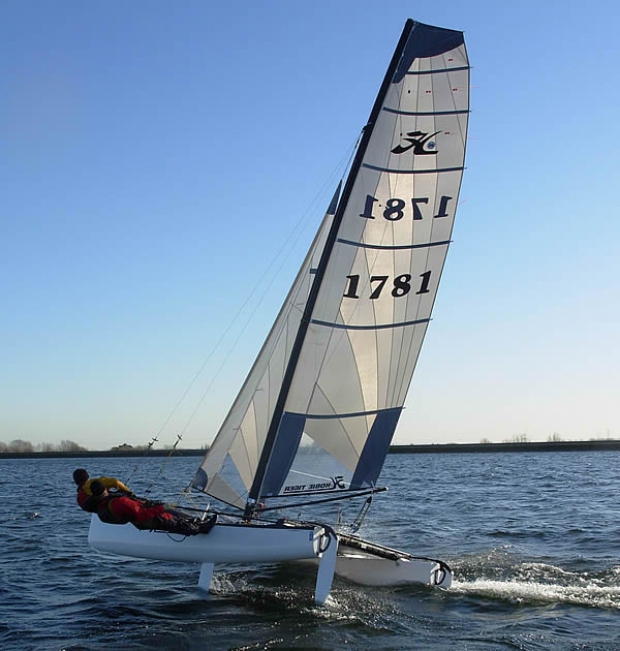
In the world of dinghy sailing there are a great number of different factions. One that has always been particularly set apart from all others are catamarans. Aside from all their obvious physical differences to monohulls the way a catamaran's rig is set up is very different to how it is done on most monohulls.
Many modern day catamarans have very tall slightly wing-profile masts and these require a different set of tweaking rules to those we are used to on typical dinghy rigs. There are of course a vast number of similarities between the two types of boat do exist where some of the basic rules are the same.
One common theme when tuning any rig is to try and make the rig work for the two people sailing the boat. This means each partnership will have a slightly different rig setting depending on their weight and their strength etc. As a general rule as wind increases and you begin to become overpowered you are trying to lose power while keeping drag to an absolute minimum. To do this lighter/weaker crews will obviously want a rig that begins to de-power for them at an early stage in a highly efficient way, as they will be spending more of their time de-powering.
Due to their physical nature cats have a slightly different shroud set up to monohulls. Specifically as catamarans have two hulls joined together by cross beams their ability to take high loads at the shroud base is limited, although their shroud base is wider. Also because they are often fitted with a wing-profile rotating mast having shrouds under great load going to the sides of the boat would significantly limit the amount the mast is able to rotate. Due to this many cats have a system for putting pre-bend into the mast using diamonds - these start at the base of the mast, go out to a set off spreaders and then come in and join the mast further up at the hounds. The shrouds then are used simply to hold up the mast under significantly less tension than they would normally be.
In terms of set-up the first thing to think about with cat rigs are the spreaders. This is a fairly sensitive control and the only real way to get to grips with what the best setting for your team is, is to go out, practice and adjust your settings accordingly. However, this does not mean there is no base rule to follow or to get you started off. As with many rigs the concept is simple - the heavier you are the less spreader rake you will need. This forces less deflection into the shrouds and so causes less mast bend, leaving the whole rig significantly more powered up.
The next thing to look at is the tension in the diamonds. As with most sets of wire that go through spreaders these also influence mast bend in a significant way. Much more than the spreaders, however, the diamonds are used to control mast bend to suit conditions as opposed to controlling mast bend for the weight of the team. Although spreaders can be used for controlling the mast to suit conditions, the diamonds are an easier, quicker and more effective way of doing this. Essentially as the wind begins to increase the diamonds need to be ‘wound on’ or tightened to induce more mast bend and de-power the main. Normally this tension is measured with a loose gauge or similar making it possible to adjust and accurately measure on the water.
Another control that is fairly unique to the catamaran world is the mast rotation (see pic below where spreaders show the amount of mast rotation). This can be controlled in a number of different ways although typically it is with a rope controlled mast spanner, but the effect is the same no matter what system employed. The idea of mast rotating, particularly when used in conjunction with a wing-profile spar, is to improve laminar flow over the mainsail, thereby increasing the 'thrust' generated by the sail. In many ways it works in conjunction with and has similar effects to the Cunningham, which pulls the flow over the mainsail forward making the sail deeper.

The complication in all these controls, as ever, lies in their all having a significant effect on one another. This makes giving any specific rules for adjustment tricky but there are some obvious guidelines to follow. In the most basic sense all of these different rig adjustment techniques offer a different way of either powering up or de-powering the rig. However, they are of varying degrees of difficulty to adjust when out on the water which makes the process for adjusting them relatively specific. Firstly as we have discussed spreader angle is set largely for crew weight and, these being the most difficult things to adjust, should be left alone most of the time. Tension in the diamonds, although possible to adjust on the water is still not easy and so are probably to be set up at the start of each day and then left for the course of the all races unless there is a significant change in the conditions. This leaves Cunningham and mast rotation as your major power/de-powering devices on the water.
Once you have this order sorted it is relatively easy to find the correct setting for you in whatever conditions you are sailing in. If you are over powered you can pull on a little bit of Cunningham and then pull in a little less mast rotation to de-power the main by flattening it and forcing more twist into the sail. If you end up pulling both of these controls onto max or very close to max and find you are still overpowered then you need to increase diamond tension for those conditions which will, in turn allow you to ease the mast rotation back out and let off a little bit of Cunningham. This process can be continued until you have up too about 40 pounds of pressure, as read on a Loos gauge, at which point the spreaders need to have a greater angle of deflection as the tension on the diamonds is becoming too great.
Although all of the mast bend work is done by the diamonds and other controls the mast clearly still needs shrouds that go from the mast to the side of each hull. As mentioned above it is important this tension is not too great, however, it is also worth considering this rig tension is also the only thing keeping the mast up. Typically in lighter winds rig tension should be just firm enough to keep the shrouds straight and not floppy when the boat is onshore with no load on it. With this sort of set-up, upwind the leeward shroud will most likely be slack but this is nothing to worry about as long as the mast is not drooping too far to leeward and so losing power. Part of the reason for rig tension remaining relatively slack is due to mast rotation. Downwind particularly when there is more pressure on the leeward shroud the mast rotation increases the tension on it, by keeping the shroud tension light this over-rotation does not load up the rig tension too much.
With the fully battened, particularly rigid sails used on most cats it is more than possible to use the rigidity of battens to control how powered up the rig is. Specifically the top few battens on square topped mainsails such as those used on the Tornado can be more flexible for lighter crews allowing more rig reaction. Conversely heavy crews can use thicker, less bendy battens to prevent the top of the sail from twisting off too much and de-powering early on.
Although setting up a catamaran rig will present some new concepts to those not used to them, many of the same ideas still very much apply. The essentials are all exactly the same, as wind increases de-powering is achieved through bending the mast and flattening the main. Really the only difference with most catamarans and most monohulls is the rotating mast which is a relatively easy concept to get to grips with.
Most Read
Most Commented
Comments
Businesses


Pro businesses
Editor's choice
Member blogs
-
 Ned Collier Wakefield: MOD70 round BarbadosWell that was intense. 12 hard fought for seconds for the win. In idyllic conditions, Tony Lawsons MOD ...
 -
 Mini Transat leg 2 reportThe second leg of the Mini Transat started on 31st October, just over a month after ...
 -
Leg 1 reportI’ve been working towards the Mini Transat now for three years. In 2013 I was part ...
Business blogs
-
 The Island Sailing Club in Cowes, Isle of Wight, is delighted that Prince Michael of Kent ...
 -
Peta Stuart-Hunt chats with the 25 year-old British solo sailor Lizzy Foreman before she sets sail ...
-
The 2015 Student Yachting World Cup (SYWoC), an ISAF-recognised event hosted and run by students for ...
Editor's Choice
All time favourites...
-
 Three legs down into Ian Walker’s
 -
 Winning all but two races at
 -
 For the first time in its
Latest Comments
Add a comment - Members log in