
Under the bonnet
Wednesday September 5th 2007, Author: Toby Heppell, Location: United Kingdom
The International 14 is one of the best known and oldest dinghy development classes in existence at present. Despite almost 100 years of constant development the class continues to evolve on a regular basis, sometimes in a major way and at others in smaller, more subtle refinements.
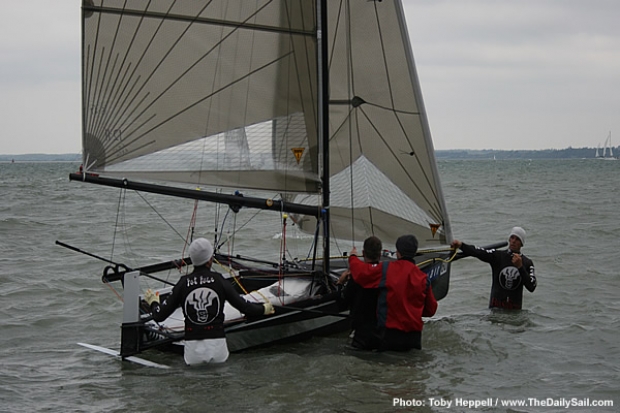
This year at the International 14 P.O.W. Week, the class’ effective UK National Championships, a number of new boats were out, displaying some of the latest ideas and thinking. One such new boat out on the water belonged to past World Champion, Rob Greenhalgh, sailing at this event with his brother Peter.
Greenhalgh’s new International 14 had hit the water just three days before the event. “Like any of these things we would like it to have been launched a few months ago but we have just been to busy with other stuff,” Greenhalgh explained to TheDailySail. Not only is this a brand new boat for Greenhalgh it also marks the return, to some extent, of Richard Woof of RMW Marine who did much of the final work on the boat. The boat comprises a Bieker 5 hull but Woof and RMW built the decks and finished it off. The mast is Selden, while the rigging is PBO, the sails by RMW.

Although the boat is new this year Greenhalgh says they have actually tried not to do anything too radical on it. “We went for evolution rather than revolution really with it,” although he adds the foils are unique to the 14 class. “They are designed by Jamie Kerr and they are brilliant foils.” Unfortunately these foils are clearly still not entirely perfect as Greenhalgh managed to break his rudder, although this occurred when conditions were particularly rough and the Greenhalgh brothers had gone sailing after racing had been cancelled for the day due to high winds and big waves.
With Greenhalgh trying to limit the innovation - there is actually little to see on the boat that is not available on most other new 14s - it does represent a solid, well thought out design that will be reliable and has already proved quick out of the box with the Greenhalghs winning the Prince of Wales Cup. However there are also a number of interesting developments that have happened over the last couple of years that have been incorporated into this boat. One such idea is the W-shaped self tacking jib track, which allows for a bigger footed jib to squeeze past the mast during tacks.

With Greenhalgh’s time being split between several campaigns, it has not been possible for him to focus primarily on the International 14. With innovations taking time to get right he clearly has not got the time to work up a revolutionary new boat. “Pete and I will do a fair bit more in this, however, we have to get the 18ft skiff on the water this season as well, so there is plenty to do,” he admits. In addition to these other commitments Greenhalgh also believes there are not a great many changes afoot at the moment in the 14 class generally and is unsure of exactly where the class might go in the foreseeable future. “I think it is all a bit quiet at the moment in terms of big changes. They are great boats right now and are quite hard to sail. It certainly keeps you on your toes I guess. Perhaps the next step is for people to go a little wider with them. There has been some talk of that.” This counters the general trend over recent years for boats to get narrower and narrower.
Although Greenhalgh’s new 14 is impressive and very pretty - left bare, black and carbon - it was not the most ‘pimped ride’ in the class at P.O.W. Another new boat on display last week was that of Hyde CEO, Mike Lennon. Lennon’s new boat is, like most of the new International 14s, a Bieker 5 hull built by Composite Craft. However, this new boat is more than just another international 14. It has, simply, some of the most impressive specs we have seen on a boat of this size.
A while ago we heard that some of the 14s sailing from Itchenor had been fitting depth sounders to warn when the depth is lower than two metres to prevent them going aground and dangering the long thin and expensive daggerboards the boats have. This use of electronics is something usually not seen in dinghy classes as it is usually banned. As this is the case any mention of electronics on dinghies piqued our interest and, encouraged by a number of other 14 sailors, we wandered over to have a look at Lennon’s boat and see what else he had on it.

Above: Note the hatch for acess to the spinnaker sock.
The first thing you notice about Lennon’s 14 is the fact that it has an effective crew deck that runs from front to back, raising the floor by a significant margin, compared to many other 14s. As we stood looking at this boat we realised there was something wrong that we could not quite put our finger on… Finally after staring at the boat we realised there was no spinnaker sock. As the International 14s carry very big spinnakers for the size of boat the sock usually goes all the way to the back of the boat from where it comes down in the foredeck and is very obvious sitting in the middle of the boat. Lennon’s very neat solution to this spinnaker sock getting in the way, as it sits in the middle of the boat, is simply to put it out of the way, under the deck. Clearly this will provide some access problems, however, Lennon has solved this by adding a small hatch at the aft end of the boat where the sock stops, allowing the sock and spinnaker downhaul, etc, to be accessed.
This way of hiding the spinnaker sock is a concept that one sees time and again on Lennon’s boat with almost all lines and ropes disappearing into the deck and reappearing where they are most handy. What all this does is give the appearance of a clutter free boat - much like the 49er - with a clean high deck enabling both helm and crew to run across the boat without impediment. However, at the same time it also allows for a boat with a massive amount of adjustment and rope.

Above: Having a peek under Lennon's foredeck.
Practically everything is tweakable on Lennon’s boat: The shrouds, lowers and caps are all adjustable from the middle of the boat, as is the forestay. This of course means that he has total control of the rig. Not only this but, as all controls are split under the floor, the entire rig is adjustable from the trapeze on either tack.

Above: Greenhalgh's shroud set-up. Note non adjustable lowers.
In sailing there are many different types of sailors but one of the most staunchly held concepts by some is KISS (Keep It Simple Stupid). We asked Lennon if he was concerned that he might be overcomplicating matters and forcing himself to have his head in the boat as opposed to looking at the bigger picture. “No, it is not really a worry,” he explains. “Because the boat is so intense to sail you don’t really play with those things when racing. However, we do adjust them between races and I felt if you adjust one thing then everything else will need adjustment, so why not be able to do the whole rig. It is no use having adjustable shrouds without an adjustable forestay for example.” This is a relatively obvious point, but not all 14 sailors go for full adjustment on everything. In particular we noticed Greenhalgh’s new 14 does not have adjustable lowers like Lennon’s. “We are fairly adjustable, but we have not gone really far with it. We have as much as we need I think,” commented Greenhalgh on his set-up.

Above: Solar panel on the foredeck, Tacticks by the mast an hugely adjustable jib.
As well as having a fully adjustable rig Lennon do indeed have a number of electronic gismos on his boat. What is of specific interest is that instead of opting for speed from a GPS unit Lennon has opted for a small impellor in front of his centreboard case to give an accurate speed reading through the water rather over the land. This is wired to a Tacktick electronic screen at the front of the mast giving him speed and direction readouts. All of this is powered by a small solar panel fitted to the foredeck, giving the boat a very Gucci look.

Above: Displaying the impellor just forward of the plate case.
As with Greenhalgh’s boat perhaps what is most exciting about Lennon’s 14 are the foils he uses. Originally when the T-foil rudders first came out the horizontal foils were short and very wide, attaching to the side of the vertical foil. The horizontal foil then dropped to the bottom of the rudder with the Beikers favouring a small trimmable flap in the trailing edge of horizontal foil while the rudders on the Morrison designs could be inclined in their entirety. The latest rudders have very wide, very skinny horizontal foils on them and these have been slowly working their way forward. The latest designs have them attached to the front of the vertical foil. “Really we would want them just sitting on the front of the rudder, but structurally that is not possible. These ones are as far forward as we can currently go without them sheering off,” Lennon explains. The reason these foils are moving further forward is to give them a greater effect, and so allow designers to reduce the size of the wing and therefore reduce drag. Other developments in these foils have been to reduce the thickness of the foil section from around 26mm to around 16mm, once again creating a significant drag reduction. Finally the wings on the rudder have a large amount of flex in them. “As you go through waves and the boat pitches the wings flex on the rudder so they are not being dragged up and down through the water, it helps reduce tip vortices,” Lennon explained.
Below: Wide, skinny wings on the rudder foil.

Elsewhere there are any number of cute little ideas on this 14. In particular we liked the inverted gnav which frees up space in the cockpit and, as Lennon points out, reduces the forced mast bend low down with the loads being reversed. We also liked the fully adjustable clew on the jib allowing the slot to be perfectly trimmed; again this can be done from the wire.
Below: Inverted Gnav

Although development is far from racing ahead it is reassuring that developments are still continuing in the 14 class. How many boats we will see with the sort of adjustment Lennon has opted for remains to be seen, as does the next design step, but this class certainly has enough change afoot to be going on with.
Most Read
Most Commented
Comments
Businesses

Pro businesses
-
France
-
Italy
-
United Kingdom
-
Editor's choice
Member blogs
-
 Ned Collier Wakefield: MOD70 round BarbadosWell that was intense. 12 hard fought for seconds for the win. In idyllic conditions, Tony Lawsons MOD ...
 -
 Mini Transat leg 2 reportThe second leg of the Mini Transat started on 31st October, just over a month after ...
 -
Leg 1 reportI’ve been working towards the Mini Transat now for three years. In 2013 I was part ...
Business blogs
-
 The Island Sailing Club in Cowes, Isle of Wight, is delighted that Prince Michael of Kent ...
 -
Peta Stuart-Hunt chats with the 25 year-old British solo sailor Lizzy Foreman before she sets sail ...
-
The 2015 Student Yachting World Cup (SYWoC), an ISAF-recognised event hosted and run by students for ...
Editor's Choice
All time favourites...
-
 Three legs down into Ian Walker’s
 -
 Winning all but two races at
 -
 For the first time in its
Latest Comments
Add a comment - Members log in