
Standing at the crossroads
Friday March 23rd 2007, Author: Toby Heppell, Location: United Kingdom
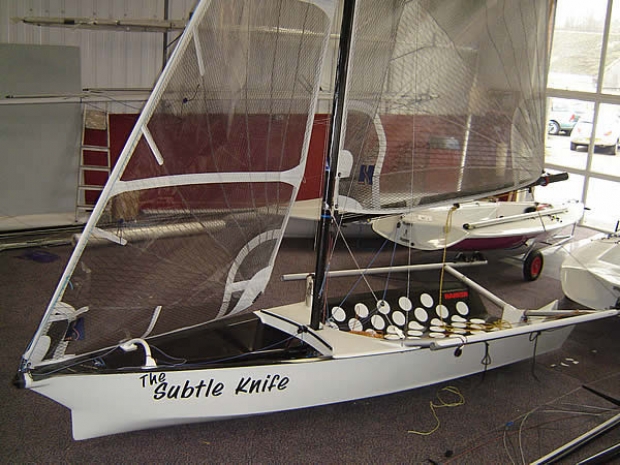
With the announced intention of two of-the-shelf production boats both heading to Hyeres for the ISAF Olympic Observation Trials, this year could well be a turning point for the traditionally small Cherub class.
Obviously this is the big news for the class this year but there are other things going on that point to a rosy future for the Cherubs. Traditionally the class has a long history in the UK and Australia but is a relative unknown outside these two countries. Recently, though, the French have been taking a renewed interest in this lightweight skiff and boats are beginning to sell there regularly. “This year we have had two new boats in the UK so far and three new boats in France,” explains Cherub sailor and publicity officer Lucy Lee. “The French fleet has absolutely taken off over the last few years, they are really very keen. They like the development and self build aspect of the boat.”
Lee explains this season, as well as selling new boats to the French, a number of secondhand hulls have also been sent across the channel. In addition to this two moulds have been sent over for the French to start building boats themselves. The first of these is a Slug design mould. This won the nationals in 2006 and it is from this that the Cherub Daemon is subtly adapted The other has a slightly older but more forgiving shape to provide an entry boat into the class. This is certainly a great step forward for the Cherubs. Of course aside from this French interest the big news is definitely the new production Cherubs in the form of the Daemon and the GT60 (see the respective articles here and here) even though they will not technically go to the trials as a part of the Cherub class. “If they were successful then that would become a separate class association, but because both boats are Cherubs they will be able to sail in our class. That means we will be lucky enough to have an off the shelf production boat that can be sailed in a development class and modified if wanted,” states Lee.
Recently we have spoken about the Daemon Cherub feeling more a part of the Cherub class association than the GT60 and this comes across strongly from Lee who sounds distinctly hesitant when discussing the latter. “The GT60 off-the-shelf is not a Cherub and no-one has even seen one yet,” she comments. “We will be very excited to see one and obviously it is great for us to have a name like Bieker designing a Cherub and we are interested to see it, from our point of view at the moment we feel it is a case of more Cherub news later this year, when we see one.”

Above: The Cherub Daemon
Certainly this point of view is understandable.The GT60 has been developed in the utmost secrecy so some within the class association appear to be frustrated with it and the added complication of the boat not being a Cherub (although there is an easy modification making it one) does not seem to help matters at all. Still it is only weeks now until the Observation Trials when the GT60 will finally be unveiled and presumably the class can start to make some definite decisions as to how they feel about the boat then.
All this secrecy and the world of professional boat building is a far cry from stereotype of the Cherub sailor. Traditionally, in this county at least, the boats are for the most part home builds by enthusiastic amateurs but this is not entirely the case. “We have always had builders but they have always been people you have to commission and there has not been an off-the-shelf option for many years, since the 1970s in fact,” explains Lee.
This raises an interesting question of whether two new professionally built, designed and sold boats will change the ethos of the class. So often in this type of class they develop a very passionate and vocal following who are not keen to see the boat change into what they see as a different beast. “I think in the past and to a certain extent still now the class attracts those with design ideas of their own, because of the size of it and the way the rule set works it is very amenable to home building,” comments Lee. “I do not think we are going to lose the attraction to those people. I am hoping though that through the new builders, and specifically Hartley, we are going to attract people who like the class, want to sail a lighter high performance boat but who don’t want to build their own. I feel like in a way it is a return to past form, with very up to date modern boats. I really think it is a very exciting time, a crossroads almost.”
The question of how many new people to the class these two new boats may draw is a difficult one for a variety of reasons. Clearly the Cherub class is getting a significant amount of publicity from the boats going to the ISAF Trials, but it is hard to quantify what this means in actual terms. Currently neither boat is on the market so any person interested in buying one will either have to wait some time or purchase a second hand, one-off hull. There is also the difficulty of trying to understand who will be willing to pay a relatively large amount of money for a new boat in a class that is currently so small and quirky. “I simply do not know how many people we may attract over the course of the next few years. We have had a lot of interest recently but we will just have to wait and se how many people actually come along,” confides Lee.

Above: An experimental foiling Cherub
Although it is hard to get a handle on the extent of new sign-ups given latest developments, , the type of person who this might be is easier to see. Typically the boat has attracted a number of mixed and lightweight teams and it is reasonable to assume this will stay much the same. If either production Cherub were selected as an Olympic boat there would obviously be more female teams. However, even in the existing female Olympic classes there are relatively few of these, so it is unlikely the Cherub class would be dominated by all-female crews. “I really hope that more couples want to sail the boat,” says Lee. “It is still a development class so people who like one design racing would probably prefer something like the RS800. Certainly, though, at the sort of price the boats will be available and with the ease of being able to buy something straight off the shelf I really hope we are going to appeal to couples and lighter pairs of blokes. Perhaps the sort of people who would have bought an RS800 or an International 14 will consider it.”
There is still some obvious trepidation from the class about the ramifications of Olympic selection, were it to happen. Although the publicity will be good for them, given the selected boat would have to be a separate one design class there is a possibility of its popularity fully upstaging the existing Cherub class. When asked straight out whether Olympic selection for one of the boats would be a good thing for the Cherub Lee is understandably cagey. “I think it would be a really good thing for sailing if one got selected. I think it is a simple, sensational women’s doublehanded boat. It is light, responsive and I think sailors will enjoy that. As a development class we will continue to develop and do our own thing whatever happens. I think it would be good for the class, but mostly because it is bringing small, high performance boats to the forefront of the people’s minds,” she says.
On a final note we mentioned at the start of this article there are two main Cherub classes, one in the UK and one in Australia. These two classes are different with the UK Cherub class being twin wire with bigger rigs and the Australian class single wire with smaller rigs. It will be interesting to see if either the Daemon or the GT60 were selected for an Olympic spot whether these two classes may combine again, to form a more global presence. “In Australia the Cherub is part of a package that includes a big skiff circuit with the 12ft, 16ft and 18ft Skiffs where it is more of a stepping stone. Here in the UK it is more of a destination high performance class for adults. I think the classes are unlikely to reunite, but you never know what might happen in the future,” confirms Lee.
No matter what happens by the end of this year the Cherub class is suddenly going to find itself with two relatively cheap, professionally built, extremely well publicised boats available to the general public for purchase. It seems very likely this is going to change the class in some way whether it be simply a few more sailors or a huge global following. The question, then is not will the class change but how much?
Most Read
Most Commented
Comments
Businesses

Pro businesses
-
Italy
-
France
-
France
-
Netherlands
Editor's choice
Member blogs
-
 Ned Collier Wakefield: MOD70 round BarbadosWell that was intense. 12 hard fought for seconds for the win. In idyllic conditions, Tony Lawsons MOD ...
 -
 Mini Transat leg 2 reportThe second leg of the Mini Transat started on 31st October, just over a month after ...
 -
Leg 1 reportI’ve been working towards the Mini Transat now for three years. In 2013 I was part ...
Business blogs
-
 The Island Sailing Club in Cowes, Isle of Wight, is delighted that Prince Michael of Kent ...
 -
Peta Stuart-Hunt chats with the 25 year-old British solo sailor Lizzy Foreman before she sets sail ...
-
The 2015 Student Yachting World Cup (SYWoC), an ISAF-recognised event hosted and run by students for ...
Editor's Choice
All time favourites...
-
 Three legs down into Ian Walker’s
 -
 Winning all but two races at
 -
 For the first time in its
Latest Comments
Add a comment - Members log in