
Drumming up support
Thursday May 4th 2006, Author: Norman Wijker, Location: United Kingdom
Was there ever such an esoteric class of sailing catamaran as the C class? It is still at the forefront of sailing technology after 40 years, yet is still largely unknown, even to keen sailors
The C class is one of four categories of catamaran developed by the IYRU in the 1960s, labelled A, B, C and D. Today only the A class has any significant following. The Tornado was designed as a B class (though no longer conforms to B class rules) and the D class never took off at all.
| IYRU classes |
A
|
B
|
C
|
D
|
| Length (ft) |
18
|
20
|
25
|
No limit
|
| Beam (ft) |
7.5
|
10
|
14
|
No limit
|
| Sail area (sq.ft) |
150
|
235
|
300
|
500
|
The C class however did enjoy many years of success, thanks in the main to one event, the International Catamaran Challenge Trophy (ICCT), which quickly became better known as the 'Little America's Cup' (LAC). This unofficial moniker was applied because of the fact that the course copied the Americas' Cup course and that the racing was arranged on a match-racing format.
Classes A-D are all development classes. The A class is a highly active class but the simple class rules from the 1960s have been updated and made more restrictive, perhaps to prevent some of the symptoms of the C-Class infecting it. These symptoms may be listed as a heavy emphasis on design, a tendancy for costs to rise to chase the performance enhancements and these have perhaps led to a position nowadays where the C-Class club is one of the most exclusive club in the world of sailing.
The position of the A class followers is understandable, but should the C-Class followers adopt the same rationale?
As team Leader of Team Invictus, I would say an emphatic NO. There has to be a class of boat that we can truly call a development class. This means that the only constraints are a box rule (length, beam and sail area). This minimisation of constraints allows designers to innovate. Sometimes this innovation is a disaster, but in true Darwinian fashion, these ideas go the way of the dinosaurs. The C-Class is now the ONLY class that can truly claim to offer a box rule with no additional constraints on foils, sails, weight etc, and this is what makes them such an exciting class to be involved with.
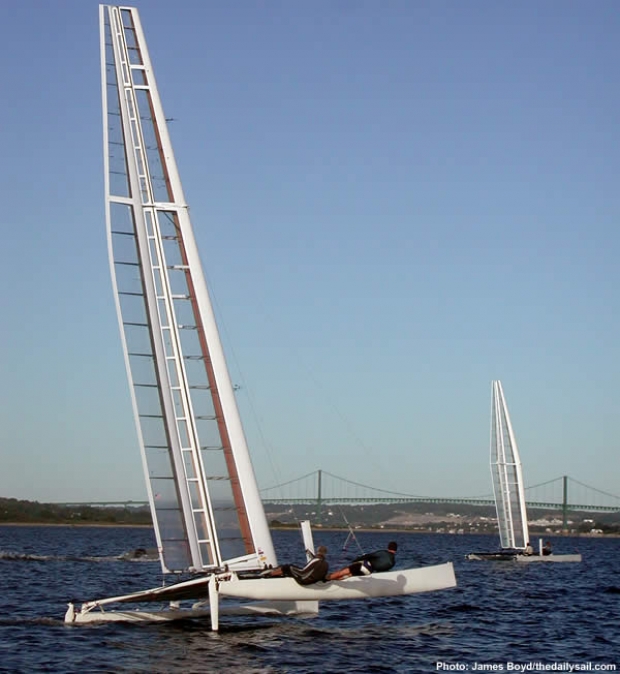
Today’s C-Class catamaran is best exemplified by the victors at the last Little Americas Cup, Steve Clark's Cogito. This is a boat that has benefited from a design evolution that stretches back to the 1970s. Cogito weighs just 176kg, and is thus lighter than the two crew that sail her, yet at 14 feet wide and with a 300sqft articulating wingsail rig she is one powerful machine.
In 10 knots of wind she will sail at 22 knots through the water. Think about it! In 10knots of wind, most other high performance cats will manage perhaps 12 knots if they are lucky, windsurfers will be plodding around at maybe 6 knots, and keelboats will be doing about 4 knots. Most beach cats will never reach 22 knots in any wind speed.
This phenomenal performance comes from two reasons, one is that at such a lightweight the boat hardly touches the water and consequently has very little drag, and secondly, the wingsail is a highly efficient propulsive device, far more efficient than even the best cut traditional sail.
And just because the wing looks like a light aircraft wing does not mean that is cannot be tuned like a conventional sail. Cogito's wing can adjust both camber and twist. The only thing it cannot do is reef!
Sailing downwind is where the aircraft-style flaps come into their own. With the slot the airflow remains attached to a very high lift co-efficient. Tacking downwind the flow remains attached and the apparent wind is always coming over the bow. A well executed gybe will be un-dramatic, as the apparent wind does not pass around the stern, but passes over the bow, the wind speed dropping such that all goes quiet as the boat passes through dead downwind.
There is no class of sailing like it - it is half way between cat sailing and ice yachting, so why is it teetering on the edge of extinction? It is certainly not lack of interest.
Team Invictus got involved back in 2002, challenging Sea Cliff YC of NY (trustees of the ICCT). SCYC decided that the event was not receiving the required level of participation and abandoned the C-Class format in favour of F18 HTs. This decision brought many people out of the woodwork and when Steve Clark initiated a new trophy for C-Class catamarans, the support on the chat lines and forums was considerable, and many were releived that these special boats will still be seen.
The new trophy is called the International C-class Catamaran Challenge (ICCC). It is hoped that this event will revive the fortunes of the class.
The new event has changed a few key issues. The series is no longer exclusively a match race series. The first rounds will be fleet races, with only the finals taking part as match races.
The event winners get to take the trophy home until the next event, but they will not necessarily host the next event. This will be decided by the C-Class association and will take in the home nations of those competing.
The C-Class club is still small, but it is a totally open club. All members welcome anyone to look around the boats. Steve Clark and Duncan Maclane will show anyone around Cogito, and the same goes for Team Invictus. Clark and MacLane have even gone as far as to publish all the technical data about Cogito to encourage others to have a crack at them. The ICCC is a new event, and we therefore needs new challengers. There have been soundings from a number of people, but as always, sponsorship, the lifeblood of sport, is the issue. It is a chicken and egg situation. The sponsors look for high profile events, and the event can only get high profile with a significant fleet and some big name challengers.
The next ICCC will take place in Toronto in Sept 2007 at the Royal Canadian Yacht Club . Represented will be the USA, Canada and UK, with possible entry from Australia. The next event will come to the UK in 2008 or 2009 where it is hoped that new challengers will come forward. Team Invictus recognise the difficulty in raising a challenge and are therefore offering either a full platform to be built or use of moulds, leaving only a wingsail to manufacture.
New challengers are encouraged to contact either Norman Wijker or Steve Clark. You may also contact them to feed comment.
Team Invictus website gives a short history of the event, it is hoped that a new website covering the C class catamaran and the ICCC will be set up soon. If anyone has any historical data, anecdotes, pictures or whatever, please contact Norman Wijker.
Remember, there is nothing else out there that offers constraint free design challenges, where else will you see development of the ultimate rig, ALL other classes ban this level of development. It is this complete freedom that has led to the C class remaining
THE FASTEST COURSE RACING SAILING BOAT IN THE WORLD
Norman.Wijker@team-invictus.co.uk
www.team-invictus.co.uk
To see video of Steve Clarke demonstrating how Cogito 's wing works - click here .
To see video of Cogito sailing - click here .
Most Read
Most Commented
Comments
Businesses
Pro businesses
-
-
-
France
-
United Kingdom
Editor's choice
Member blogs
-
 Ned Collier Wakefield: MOD70 round BarbadosWell that was intense. 12 hard fought for seconds for the win. In idyllic conditions, Tony Lawsons MOD ...
 -
 Mini Transat leg 2 reportThe second leg of the Mini Transat started on 31st October, just over a month after ...
 -
Leg 1 reportI’ve been working towards the Mini Transat now for three years. In 2013 I was part ...
Business blogs
-
 The Island Sailing Club in Cowes, Isle of Wight, is delighted that Prince Michael of Kent ...
 -
Peta Stuart-Hunt chats with the 25 year-old British solo sailor Lizzy Foreman before she sets sail ...
-
The 2015 Student Yachting World Cup (SYWoC), an ISAF-recognised event hosted and run by students for ...
Editor's Choice
All time favourites...
-
 Three legs down into Ian Walker’s
 -
 Winning all but two races at
 -
 For the first time in its
Latest Comments
Add a comment - Members log in