
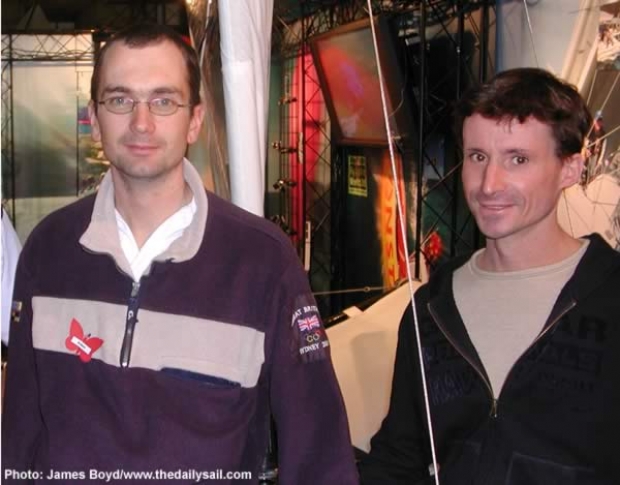
Adam May (left) with Linton Jenkins
Forward thinking
Thursday March 30th 2006, Author: Toby Heppell, Location: United Kingdom
Although highly active in building new foiling International Moths, as we covered in
yesterday’s article, Linton Jenkins also has a number of different projects currently underway.
Contrary to the views expressed in our article on the class published last month, Jenkins is one of a number of people in the UK who believes the Merlin Rocket needs to develop. Personally he has, over some years, been pursuing various different ideas to achieve this.
Starting with the idea that goes back the furthest, Jenkins has for a long time has had a rotating wing mast on the drawing board for the Merlin Rocket. The first of these wingmasts was actually built by Jenkins just over five years ago but development had to be stopped due to a lack of funding. He has recently been looking at the mast again and is now at the stage of re-trialling it and thinking about ways to modify it.
One of the perceived problems with wing masts is they behave differently to a regular mast and it is hard to recreate the usual bend characteristics. Jenkins does not think this is a problem with his mast for the Merlin Rocket. “My mast is a pre-bendable wing mast which is very important as it gives you all the advantages of being able to bend the rig and flick it to windward because it rotates. This means you get a really good mast profile with a leech that immediately stands up,” he explains. As well as these advantages the mast is significantly slimmer than a regular mast and this adds a speed edge as well. In addition to all these advantages being able to use the rotation of the mast to harden the leech means people sailing with this mast would have to use a lot less kicker tension and so avoid forcing bend in the lower section.
The mast is actually legal within the current class rules and Jenkins says he could have legally made it even bigger. The reason that he did not do this is at a certain size it suddenly becomes very difficult to control as the power tends to switch on and off. For this reason the mast has been kept to a relatively small 75-78mm section.
Jenkins raced with his original wingmast and he says it seemed to be very quick. The problem five years ago was the sails were too deep to work properly, and he did not have the money to fund the development of a new suit himself. “If we could have developed a flatter sail the boat would have been very quick,” he explains. “We had a couple of races at Chichester where the boat just lit up and we flew through the fleet but it was only ever a couple of races. The whole venture needed more time and money than I could give it.”
Returning to his Merlin Rocket wing mast project has given him some ideas for the International Moth. At the moment he is working on a wing mast for the Mistress and this he is hoping to sail with at the International Moth World Championships later this year.
Wing masts are not the only things currently in development for the Merlin Rocket in Jenkins’ warehouse in Portland. He has recently been playing with the idea of a winged centre plate which is effectively a ¾ size centre plate with a trim tab on the trailing edge to take it up to normal size. “Will Rayleigh will be trialling it this winter and we are very keen on it," continues Jenkins. "He has raced it and done no worse with it but he also has not done much better. I think he will do better with it once he has settled down with it a bit." In theory the centre plate should make the boat much quicker upwind as it forces more lift into the foil and allows the boat to sail higher than those without it, although there is presumably some increased drag. The adjustment system for the tab is currently very simple: the tab is connected to a rod going up to the top of the centre board which has a handle on the top of it. When a sailor tacks the boat they just rotate the handle and effectively ‘tack’ the centre plate.
In addition to these developments, Jenkins is intending to try out a Moth T-foil rudder on the Merlin Rocket to see how it goes. If the testing goes well he may make a rudder with foils on it specifically for the Merlin. Also this winter - if there is time in his ever more demanding schedule - he would like to make a completely new Merlin hull.
Besides the Merlin Rockets and International Moths Jenkins is working on another boat, one that has the potential to be very interesting indeed.
Too heavy for a Moth?
One of the problems that the builders of foiling Moths face is people being too big for the boat - the average optimum weight for an International Moth is around 72kgs. Jenkins is currently on a mission to get more people foiling and thinks he has found a way to do it. “We were getting so many people saying, well if the Moth was bigger and had a trapeze and a bigger sail I would give it a go. We started thinking about building a boat that would do the job but when we actually looked at it there was a boat that fitted the bill perfectly: the RS600,” he explains.
The RS600 lends itself to foiling particularly well - it has the rotating mast, it is a small low windage hull and the rudder/centre board separation is about right. One of the major advantages in using a class that has been around for a while is there are many boats already available, so the possibility of fleet racing in decent numbers is very much there. “I think the class is pretty much dead except for maybe 20 active people, so there are literally hundreds of boats around. You could buy a boat and foil package for about £3,000 and have the best fun that you have ever had with sailing,” Jenkins enthuses.
The current plan it to sell a package for around £1500 that you can retro-fit to an RS600 at home relatively easily. The foiling kit will consist of: A new rudder gantry, a new rudder, a new dagger board and a plug for it to fit into and a side mounted wand system like the Moths have - except for the Mistress III.
And how likely is this likely to come to pass? Jenkins says they have already fitted a foil system to an RS600 and have had it out foiling on Portland harbour for some time. “We first had it properly foiling in August 2005,” he explains. “We put Sam Pascoe (International Moth sailor) in it with a foil set up and straight away he was off around Portland harbour. That was basically a Moth package on an RS600.” Although the Moth gear is enough to get the RS600 ‘flying’ it is not as simple as Jenkins just selling Moth foils to anyone with an RS600. One of the problems faced with a foiling boat for heavier people is that it induces a lot more load on the foils themselves. “When the boat is up quite high and you round up then obviously if you have someone who is 90kgs standing on the side the Moth foils will snap,” says Jenkins. “But so far we have proved that the boat will foil and foil well. The next stage is to develop a foil that is designed specifically for the RS600.”
The plan is to increase the size of the foils to increase the strength of them but this also has a useful side effect in creating more stability as you are sailing on a larger area. Apparently even with the Moth foils the RS600 is easier to sail than Moth because of the trapeze, so making it more stable will mean that there will be a larger potential market for those who will realistically be able to give the foiling RS600 a go. The reason for this is simple; when a boat is up on its foils, fore and aft balance becomes very important. In the Moth this means a lot of time is spent shuffling forward and backwards on the wings whereas on a trapeze it is a simple case of stepping up and down the wing.
Jenkins is not yet able to confirm when the foiling package for the RS600 will be available to purchase as he wants to make sure that everything is just right before he begins producing them. “I want to have it fully tested before I sell any,” he explains. “I want them to be able to handle a lot of bumps and crashes before they break. The last thing you want is to be doing 24 knots and have the foils break on you.” Although he is cagey about an actual date, Jenkins thinks that the package could be ready towards the end of this year.
All this talk of foiling trapeze boats does beg the question exactly how far could this technology be taken? “In about six years time I think that the whole set up will be down to such a fine art that it will be easy to sail. As soon as you do that you enter into two man boats, and away you go. I think we will see a two person class built for foiling although people might try them for a while in International 14s etc,” says Jenkins. With this in mind it is possible to imagine a world not too far from now where all the high performance boats are high performance foilers. Jenkins is clearly a convert and as he says; “Foiling is the only way of getting a boat to go quick, get it out of the water, end of story.”
Most Read
Most Commented
Comments
Businesses

Pro businesses
-
United Kingdom
-
United Kingdom
-
France
-
France
Editor's choice
Member blogs
-
 Ned Collier Wakefield: MOD70 round BarbadosWell that was intense. 12 hard fought for seconds for the win. In idyllic conditions, Tony Lawsons MOD ...
 -
 Mini Transat leg 2 reportThe second leg of the Mini Transat started on 31st October, just over a month after ...
 -
Leg 1 reportI’ve been working towards the Mini Transat now for three years. In 2013 I was part ...
Business blogs
-
 The Island Sailing Club in Cowes, Isle of Wight, is delighted that Prince Michael of Kent ...
 -
Peta Stuart-Hunt chats with the 25 year-old British solo sailor Lizzy Foreman before she sets sail ...
-
The 2015 Student Yachting World Cup (SYWoC), an ISAF-recognised event hosted and run by students for ...
Editor's Choice
All time favourites...
-
 Three legs down into Ian Walker’s
 -
 Winning all but two races at
 -
 For the first time in its
Latest Comments
Add a comment - Members log in