
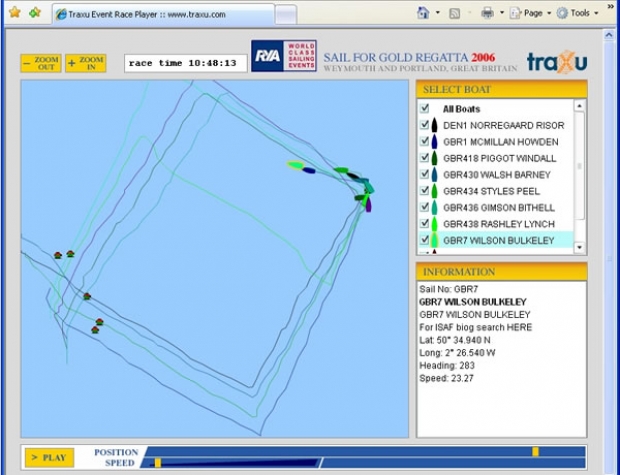
Up the middle, clearly not the done thing in the Tornado fleet
Tracking the changes
Wednesday October 18th 2006, Author: Toby Heppell, Location: United Kingdom
A number of you may well have logged onto the RYA website this weekend to catch the medal races live and online at the Sail For Gold regatta. For those who didn't the service was delivering highly accurate traces for all the boats racing, along with live commentary from the water. However, this spectating side of the technology is just the tip of the iceburg, as we discovered.
GPS tracking technology is not new to the keelboat racing world, nor is it brand new to the dinghy world, where it is increasingly being touted as the next big thing to transform the running and watching of events, not just for coaching and training where it is mostly used at the moment. One company who are determined to push the technology away from Olympic coaching and training and towards the spectating and event management end are Hampshire - based company, Traxu.
Last weekend Traxu were at the Weymouth and Portland Sailing academy for the Sail For Gold Regatta. There they were introducing competitors, sponsors and race officials to the potential uses of tracking technology. Although they were working with the organisers of Sail For Gold this year their role was more of an experimental and demonstration one, to show what is achievable with this sort of technology. “This weekend we are just using it to engage people so they can see what it is like. It is not being used for OCS or anything really big. It is being used for media and sponsors to get a feel for how many people want to watch. We know what number this is because we can manage the hits we get on the website, enabling us to give real feedback to sponsors, etc,” explains Mark Richards, Director of Traxu.
The technology behind Traxu is tried and tested in the sailing world: their tracking was used during Skandia Cowes Week this year. Generally they take the position from a small on board GPS unit and this is then transmitted over the cellular phone network by GPRS. They also have the ability to transmit the data by use of a local wireless network or even by satellite if GPRS is unavailable. These last two methods are more costly and typically not used.

Although the demonstration in Weymouth was on a low scale, Traxu believe the potential uses of tracking technology are very wide, not only boosting media and spectator appeal, but also the day to day running of events. “In the sailing environment as I understand it, using the tracking as an aid to a race officer seems to make a lot of sense. However, at the moment I think there are perhaps a few barriers to replacing a race officer altogether.” explains Richards. “We have got OCS detection notification on our units, built in. The devices have a buzzer or light attachment so if you are using it for OCS at high accuracy then the race officer can have a screen that gives him a snap shot at the gun showing, for example, seven boats over. He can still make his decision this one is only a third of a boatlength over, deselect it, leave the six that are well over, hit the notify button and all those boats at the same time get that information and have the ability to act on it,” he continues. This de-selection of boats is of course unlikely but serves as a useful indication of how the technology can help race officers to do their job well as opposed to being replaced.
This speculation about tracking use in rules situations - such as OCS but potentially in a variety of different rule infringement situations - raises a number of issues as to how accurate and reliable it can be. It is hard to believe the average sailor would be happy about a machine calling them over the line, especially if there is any doubt about the machines’ ability to do so accurately. “Our equipment is taking a boat position every five seconds and transmitting that position every five seconds. This transmission is then going direct, without filtering, to the website which refreshes every seven seconds to make it useable for people with potentially poor internet connections. In terms of what the service can do: it can take GPS positions ten times per second and by differentiating via other stations based on the shore or satellite differentiation, which is relatively recent, we can get accuracy down to just two centimetres,” Richards says. Land-based ‘differential GPS’ relies on an on board GPS receiver comparing its position with two or three differential transmitters based ashore. The exact position of these land-based transmitters is known and they are each fitted with a GPS receiver. As their exact position is known, they are able to compare their GPS-derived position with their actual position, work out the error and transmit this ‘offset’ figure by radio to the GPS receivers on board boats on the race course. 2cm accuracy should certainly convince sailors the equipment is accurate enough to become an integral tool among the race officer’s equipment.
It is worth noting that although Richards says they are able to get accuracy of 2cm they were using their devices on base settings at Sail For Gold, giving them an accuracy closer to 3-5m. This is easier and cheaper to do and provides accurate enough data for online or shore based spectating. It is also important to point out that although 2cm of accuracy is the stated figure this is unlikely to always be the case. Even using differential GPS the error in the position fix can still be as much as 2m.
Something much talked in the GPS world is Galileo, a European satellite navigation system which should be fully civilian controlled and should improve accuracy of GPS units throughout Europe. “The Galileo system will enable a type of differentiation based on the different types of satellites themselves. That will not necessarily make us any more accurate as the 2cm is derived from variations on three or more points based around your sailing area,” explains Richards. “Simply, if we put - for instance - a receiving station on a known trig point in the Weymouth area, that particular station can reference all the visible satellite positions and build in an error correction against the satellite picture. Given you are then using, for example, 20 or more devices that are all the same, the relative accuracies of one device to another are very high.”

Although Galileo may not make the system significantly more accurate, when used in the UK its accuracy is further limited by our own legislation. “We are using UK-approved equipment. If we were in the US it could be more accurate in for example the radio network used to transmit data,” explains Richards “In the US they are allowed to set up frequencies that carry more data which is something we are not allowed to do in the UK,”
Richards believes tracking is the way forward for a number of sports but specifically for sailing. This view is reflected by ISAF who are supposedly looking to include tracking in all of their directly affiliated events in the near future. Evidently they have started to implement this already, as Richards says they have asked for tracking to be used in some way at Cascais for the ISAF Olympic Classes World Championships in late 2007. The team at Cascais are apparently still deciding how far they will go with this technology and which company will be managing it for them.
If this goes ahead sailboat tracking could become big business. “Alongside tracking, Traxu is able to include video and audio feeds - we have audio feeds this weekend at Sail for Gold,” Richard says. “You then have a virtual arena that can attract thousands of people – we attracted several thousand when we did Cowes week which was a great surprise. We also have a pay-per-view option that adds another revenue channel as well as giving more exposure for sponsors.”
With this circle of demand it is easy to imagine a significant amount of people wanting to get involved with tracking technology as it filters down from the higher end of our sport. “You have the governing body saying ‘we want more people to see our sport’ and then you have coaches, sponsors and the general public. If there is a way to make it more affordable it will not be too long until you find your local winter series and spring series being covered because it becomes economic to do it,” comments Richards.
As this technology is adopted by a wider variety of sports it will inevitably change the way many of them operate. Richards explains: “With relevance only to sailing, when you say to a lot of competitors we are now accurate to 2cm so we can use it for OCS some might say, ‘one of my skills is starting and you are going to take away that skill because we are now all starting under the same advantage or disadvantage.’ So the competitor mentality will definitely change. Some others will say ‘I am very happy; I will be smarter and faster and start in the right place.”
While its effects could be felt by all competitors, the arguments may not stop there. The technology can also be used to monitor wind direction and oscillations. Some race officers may feel this detracts from their job and is unreliable without significant human input.
The crux of whether tracking is only a useful spectating device, which it no doubt is, or whether it can play a more significant role in the running of sailing events will come down to its accuracy. While many companies claim a certain level of accuracy, until they can prove accuracy down to the nearest centimetre, absolutely guaranteed time and again in the widest variety of situations, it is unlikely to be a viable tool for use in the running of events. It would only take one incorrect OCS call for every future OCS call to be protested due to the technology being potentially unreliable.
Did you view the racing at the weekend? What did you think? Will this technology become an i ntegral part of our sport? Send your thoughts to: yourviews@thedailysail.com
You can find more out about Traxu on their website .
Most Read
Most Commented
Comments
Businesses

Pro businesses
-
-
United Kingdom
-
-
Italy
Editor's choice
Member blogs
-
 Ned Collier Wakefield: MOD70 round BarbadosWell that was intense. 12 hard fought for seconds for the win. In idyllic conditions, Tony Lawsons MOD ...
 -
 Mini Transat leg 2 reportThe second leg of the Mini Transat started on 31st October, just over a month after ...
 -
Leg 1 reportI’ve been working towards the Mini Transat now for three years. In 2013 I was part ...
Business blogs
-
 The Island Sailing Club in Cowes, Isle of Wight, is delighted that Prince Michael of Kent ...
 -
Peta Stuart-Hunt chats with the 25 year-old British solo sailor Lizzy Foreman before she sets sail ...
-
The 2015 Student Yachting World Cup (SYWoC), an ISAF-recognised event hosted and run by students for ...
Editor's Choice
All time favourites...
-
 Three legs down into Ian Walker’s
 -
 Winning all but two races at
 -
 For the first time in its
Latest Comments
Add a comment - Members log in