
Buck for your bang!
Friday October 20th 2006, Author: Toby Heppell, Location: United Kingdom
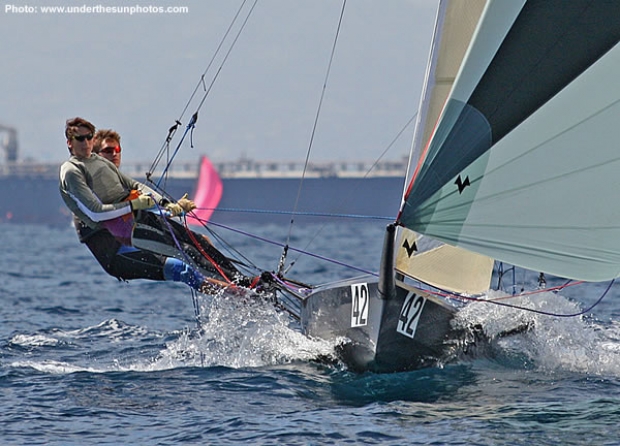
Typically development classes are seen as expensive classes to be a part of due to the ever evolving nature of the boats and rigs. Nowhere in the dinghy world is this perception more widely accepted than in the International 14 class. When this year Archie Massey and George Nurton won POW week and proved to be lighting quick at both this event and during the lighter days at the subsequent World Championship there was much speculation to exactly what had gone into building their new boat.
As with Howie Hamlin’s World Championship winning boat (see our interview with him here) Nurton and Massey’s boat is based on a modified Beiker 5 hull, which they consider to be the fastest of the presently available hull shapes. “We did a make few little modifications, although most of them purely aesthetic to be honest, to make them look prettier. We did also work on a few little things we thought might help,” explains Nurton. “I guess the big difference we made on our boats compared to the standard Beiker 5 is we widened the shroud base.” Nurton explains that the International 14 carries a significant amount of rig tension but with such a narrow hull they have a relatively small fore-triangle to take the load on. By moving the shroud base out and aft a small amount, there is less compression in the rig lower down. In turn, this prevents the mainsail from collapsing quite so easily. “It seems to have made quite a bit of difference and I think Paul Beiker seems to like it and will probably do it on all the new boats,” confirms Nurton.

In addition to this slight adjustment to the shroud positions the profile of the stem was modified a small amount to suit their needs better. Other than this the boat was almost exactly as every other Beiker 5 in existence, with a simple deck added to it and some simple aesthetic and personal taste modifications.
Although this is a high tech, no-holds-barred International 14 it seems as though the boat has rather humble beginnings. “When we started building the boat we were trying to do it completely on the cheap in the backyard,” explains Nurton. But this is no normal backyard project. “It was Tom Green’s backyard and his backyard involves his dad’s Green Marine works. So we basically had the best boat builder in the world building it for us for not very much money. Unfortunately we ran out of time there and ended up employing the guys at Composite Craft to do a lot of the work on the boats as well,” he admits.
Although much of the work was carried out cheaply and as Nurton says they got a very good deal from Composite Craft the boat did still cost a significant amount of money. “Because we had to build the moulds and everything else we are looking at close to £20,000 which sounds a lot but the end product is just absolutely fantastic. Also these are seriously high quality, all prepreg and Nomex boats. The hulls are stiffer than anything else I’ve sailed and I expect them to be just as competitive in five years time, both for hull shape and construction. You could spend that money in two years sailing a 470. Few boats are so exciting and controllable through such a large wind range, so you get a lot of bang for your buck,” he concludes.
Nurton believes it is not necessary to spend this amount of money on a boat to be competitive in it. “The thing is - you can get a really good boat for not too much money. The last boat we had, before this new one, we bought off some Aussies for £7,000. We came third at the Worlds straight away, then, we came second at the Europeans last year with it and then sold it for £4000. So there are some very cheap, very good boats around, but extremely good boats cost a little more.”
If this seems a lot of money there has been further speculation within the fleet as to how much the boats sailed by Howie Hamlin and Shark Kahn at the World Championships cost. “There is always so much gossip and speculation about how much money everything costs in this class,” comments Nurton “Certainly there was a lot of money behind Howie’s boat and I am sure they spent a lot of that money on the boats. I would like to say though they did not win because they spent more they won because they are great sailors and they put together the better programme and they trained properly.”.

So far Nurton has been pleased with the speed of their boat and says in the light weather they are “embarrassingly quick.” However, they did seem to be off the pace a little in the windier weather. “You can see, if you followed the Worlds, we were not as quick in the breeze, but it actually turned out we were still pretty quick it’s just we were just upside down more often than not due to a total lack of practice in those conditions. It was only when it got above 20 knots that we realised we did not have any settings for that weather because we had not practiced in those conditions,” he explains. “At the Worlds Archie and I and some of the boats with similar sorts of rigs were flat wiring in eight knots of breeze which you do not get in many classes. Obviously being able to hold it up to 20 knots is pretty good but I think we might be able to extend that envelope a little further.”
One of the ways in which they could have extended their speed at the World Championships was through their rig set up. Currently the boat is set up very simply, much like a 49er with little rig adjustment at all but Nurton wonders whether this was their best idea. ”Interestingly the rig I put on the new boat everything is locked, even the caps. We just let it be and de-powered with the kicker and everything else. I don’t think you need to adjust the rig as much as some people do. The sails can get enough grunt in them when they are eased anyway and they seem to go pretty quick so I just leave it well alone.” The theory is to go with a simple boat where the focus is on the sailing not on tweaking controls. Nurton says as it turned out with the Worlds being in LA, it was the one place where it would have been nice to have a raking rig because the breeze tended to start very light and always built a bit - sometimes quite a lot. “If I were doing it again I might have thought about putting a raking rig on but I would not want it for ordinary European conditions.”
Nurton is planning on trading some of their light wind performance off in favour of picking up a little more heavy air performance. This he is hoping to achieve through a change in sail design, leaving the hull completely alone. “I have been talking to Dick Batt who made our sails,” – Nurton says he is a believer in having a local sailmaker – “and we just want to encourage it to twist off more. At the moment we are encouraging it to de-power through mast bend rather than leech twist,” he explains. “The problem we all have at the moment is the mast tries to bend and then you lose mid-leech and you actually get a tightening of the upper leech, which in turn causes flogging in the upper mainsail.” Nurton goes on to explain the boats who were faster in the breeze at the World Championships - Hamlin and Kahn - both had extremely square topped mainsails, designed to blade out in much the same way a windsurfer sail does as opposed to de-powering through mast bend.
In addition to the difference in rigs between the top boats at the World Championships there was also another difference. Gybing centreboards have been the centre of debate within a variety of classes, including the International 14, for many years. “We are not using gybing centreboards, theoretically I have never believed they work. People claim they generate more lift but that has got to be total rubbish because lift is related entirely to the amount of leverage you are creating so the only way to generate more lift is to create more leverage. However, Trevor Bayliss - who came second at the worlds and set up the programme for the top three boats and I believe everything he says - thinks they gave him a very slight advantage in the lighter stuff,” says Nurton. Evidently Bayliss believes having a gybing centreboard enables a sailor to put the sail plan very slightly more into the wind enabling them to generate more power in the light weather, therefore allowing them to set their boats up for windier weather making them fast in both conditions.
The biggest argument Nurton has against gybing centreboards is not whether they work or not but is more to do with whether it is good for the class as a whole to adopt them. “I don’t think many people really want them as they are too expensive to put into the boats and they do not make the boats anymore fun. There are currently thoughts of trying to ban them but we will have to wait and see,” he says. “Having said that Paul Beiker has worked out a really nice way of doing it that is not too complicated, but I still think it is not necessary to have and people can better spend their money elsewhere.”
£20,000 is certainly a great deal of money for any 14ft boat and we shudder to think how much the cost might have gone up were Tom Green’s dad’s services not all but free. Certainly one of these boats represents a lot of buck for your bang, but the secondhand market does seem quite reasonable, so it does not have to cost this much. Dinghy sailing needs classes like the International 14 to push the design boundaries and as long as there are people willing to pay - why shouldn’t they?
Most Read
Most Commented
Comments
Businesses

Pro businesses
-
France
-
United Kingdom
-
-
Editor's choice
Member blogs
-
 Ned Collier Wakefield: MOD70 round BarbadosWell that was intense. 12 hard fought for seconds for the win. In idyllic conditions, Tony Lawsons MOD ...
 -
 Mini Transat leg 2 reportThe second leg of the Mini Transat started on 31st October, just over a month after ...
 -
Leg 1 reportI’ve been working towards the Mini Transat now for three years. In 2013 I was part ...
Business blogs
-
 The Island Sailing Club in Cowes, Isle of Wight, is delighted that Prince Michael of Kent ...
 -
Peta Stuart-Hunt chats with the 25 year-old British solo sailor Lizzy Foreman before she sets sail ...
-
The 2015 Student Yachting World Cup (SYWoC), an ISAF-recognised event hosted and run by students for ...
Editor's Choice
All time favourites...
-
 Three legs down into Ian Walker’s
 -
 Winning all but two races at
 -
 For the first time in its
Latest Comments
Add a comment - Members log in