
Aces high
Tuesday August 1st 2006, Author: James Boyd, Location: none selected
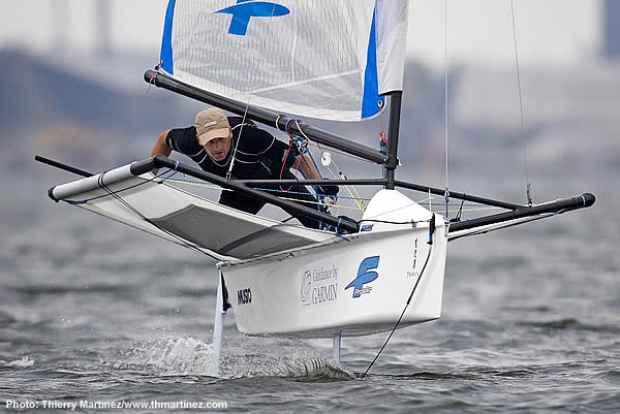
A class still fully in ascendancy is the International Moth. The introduction of twin T-foils to the boat giving it the ability literally to fly has resulted in the Moth consistently getting on magazine front covers more than any other dinghy class. While a handful of sailors still make up the forefront of the class, at last week's World Championship in Horsens, Denmark, an impressive 24 of the 32 boats competing were foilers and the top 15 finishers were all 'high riders'. The class is set to get a further shot in the arm with the arrival of the Bladerider, a mass-produced foiling Moth built in China (the prototype was sailing at Horsens - see pages two and three for pics) and it will be interesting to see how the degree of take-up of this boat.
What would make the most significant difference to the future of the class is if foiler Moths are adopted as an Olympic discipline. As if to lend credence to these rumours ISAF President Goran Pedersson visited Horsens to check out the class first hand last week. Under the current scheme there is no obvious boat for the Moth to replace and it seems equally unlikely that the International Olympic Committee would allow sailing to add a further class. What seems more possible is that after a wind-less regatta in Qingdao, the sailing side of the Games proving about as interesting as watching paint dry, the IOC will put pressure on ISAF to get their house in order.
"It sounds like the ISAF is very interested," says Australia foiler guru Rohan Veal. "We were talking to them and they said they would help in any way they can to get it at least considered."

New World Champion - Simon Payne
Aside from the obvious visual excitement of seeing a fleet of air-borne sailors sizzling around an Olympic race track on foils, Veal cites last week's light weather World Championship as being the perfect example for why the Moth should be adopted: its versatility. "The most wind we saw was 15 knots and it was mostly 5-10 but then we are still flying around the course - our top speed recorded was 25 knots, mine was 21. And it is still exciting to watch: even if you are way back you can still make up ground, and get back up to the front and the lead is changing all the time. So even for someone who knows nothing about sailing it is really exciting and I don’t think it is something that other events or classes could offer."
Fortunately when Petersson visited there was breeze and Adam May feels they put on a good show. Obviously if the Moth was adopted the first opportunity for it to be included in the Olympic line-up would be in Weymouth in 2012. Hurrah! Production of the Bladerider now being imminent, should have the effect of substantially increasing the 30 or so boats per annum available from the smaller manufacterers in the UK and Australia, with 100s rolling off the production line per annum.
Another potential criticism of the Moth as a potential Olympic canditate is that it is too fringy but one imagines that this was the exact same view of the same stick-in-the-muds when the Tornado catamaran or even the sailboard were first introduced.
While it could be argued that competition has been limited in events up until now, the World Championship last week was tight. "It really good racing, the top five or so boats have been really close - one mistake and you are out the back" says Adam May, himself a one time Olympic Tornado sailor. "Each event we do is getting more competitive with more foilers and the skill level increasing." While Veal has been known to win races by several minutes even at events this year in Australia, at the Worlds the lead finishers would often be just seconds apart (in one race Veal and Payne had just 3 seconds separating them at the finish).
What seems to be make the difference been the good and not-so-good foilers at present is downwind ability. In Horsens numerous people were first to reach the weather mark, but it was always on the runs that the top four or five came to the fore.
"I have been working a lot on my downwind technique especially when the waves get up," says Veal. "It is really critical. Yesterday [Friday] I was something like 20th around the top mark and I was third around the bottom mark, so it is certainly possible to make up a lot of ground downwind because it is just open field, you gybe and try and sail as low and fast as possible."
So how does he manage it? "A little bit is to do with equipment and settings, but most of it is technique," says Veal. "I think am really aggressive in my steering and where I sail on the water: I am always looking for the highest water, trying to avoid the troughs. You just cannot sail in a straight line - that is critical, I just do it a bit more than the others, I know after I go around the top mark I never lose a place, I always pick them up."
While finishing second just three points astray of Simon Payne, Veal was admonishing himself for not winning. However he has not been in the best of health having suffered from a dose of bursitis on one knee. "It blew up a day or two before I was due to go overseas to come here and train. It got infected and I couldn’t even walk," he recounted. "So I had to take a week off, missed all my training here and the first day I sailed here was the invitation race. I’ll probably have to have surgery when I get back."
In addition Veal has been unhappy with his upwind pace in the light conditions all week. "My configuration is just all wrong - the wand settings and rudder angle. It is hard to say what. If we had wind, I could go out there and prove I was correct, but I am just guessing at the moment."
A little like cat and skiff sailing, much time can be lost manoeuvring in the Moth and it is just through sheer practice that the top sailors in the class have been refining and perfecting their technique. While just a year ago the high fliers were starting to learn how perform airborne gybes, today they can perform this manoeuvre as a matter of course in the heat of competition.
During the Worlds Veal also demonstrated an unusual upwind manoeuvre. When conditions are marginal there is a small window in which it is possible to remain in the air if you are already on foils, but there isn't enough pressure to get you back up on foils should you drop down. According to Veal this window is at around 6-8 knots of TWS. During the races on Friday Veal was gybing upwind on the basis that he could remain airborne this way whereas by tacking he would drop down into the water. In the event this didn't prove fast but Veal blames his upwind speed deficit in the light conditions.
Equipment-wise Simon Payne and Rohan Veal were both sailing Fastacraft-built Prowlers while May was on his Mistress design but was using the exact same rig and foil package as his rivals. Payne's Prowler is new and in comparison to his old boat he says that the wings have been brought forward the deck moulding refined. "It is the best design to have," he maintains. "It is a very light boat. The foils are the most efficient configuration working across different wind strengths. And the boat rarely breaks."
As to how he had got ahead this week Payne makes all the normal noises: "It's been about getting the shifts right, sailing well upwind and fast downwind, keeping it clean, keeping out of trouble." However he says that over recent months they have learned to sail the boat flatter with less bow-up trim.
Another shot in the arm for the class is that as usual Rohan Veal has shipped his boat over from Australia and promptly sold it. However on this occasion the buyer has been none other than French Vendee Globe and ABN AMRO Two skipper Sebastien Josse. Josse had the opportunity to try out a Moth during the demonstration sailing within Melbourne harbour at the Volvo Ocean Race stopover. Of the international competition Payne says that some of the Germans and Swiss sailors are getting good but generally they lack time in the boat and might be as much as a season behind the Brits and Veal at this stage. The next market for the foiling Moth class to woo should be North American but this still some way away.
Interestingly the top three Moths sailors - Payne, Veal and May - are all similar weights: around 68kg.
The Moth World Championship next year will take place in Torbole, Lake Garda and we can expect an extremely strong challenge from Veal. "Next year I won’t leave anything to chance and I'll not take any risks and make sure everything is right. And I'll get a training partner - that was another key factor, I just don’t have anyone to train with in Melbourne. I occasionally have someone, but it is not the same level as Simon, Adam and Sam have in the UK."
Most Read
Most Commented
Comments
Businesses

Pro businesses
-
United Kingdom
-
Netherlands
-
France
-
Editor's choice
Member blogs
-
 Ned Collier Wakefield: MOD70 round BarbadosWell that was intense. 12 hard fought for seconds for the win. In idyllic conditions, Tony Lawsons MOD ...
 -
 Mini Transat leg 2 reportThe second leg of the Mini Transat started on 31st October, just over a month after ...
 -
Leg 1 reportI’ve been working towards the Mini Transat now for three years. In 2013 I was part ...
Business blogs
-
 The Island Sailing Club in Cowes, Isle of Wight, is delighted that Prince Michael of Kent ...
 -
Peta Stuart-Hunt chats with the 25 year-old British solo sailor Lizzy Foreman before she sets sail ...
-
The 2015 Student Yachting World Cup (SYWoC), an ISAF-recognised event hosted and run by students for ...
Editor's Choice
All time favourites...
-
 Three legs down into Ian Walker’s
 -
 Winning all but two races at
 -
 For the first time in its
Latest Comments
Add a comment - Members log in