
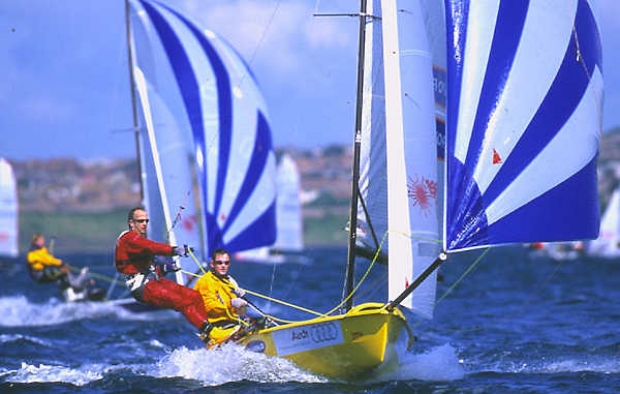
Why asymmetrics?
Asymmetric spinnakers have taken the sailing world by storm over the past decade. True, they've been around for a long time in some form or another. Sailing historians might point out that they were in common use over a hundred years ago, but in their modern form they first made their mark in the 18 foot skiffs on Sydney Harbour during the 1980s. Next we saw the 12-Metre Australia IV break out an asymmetric spinnaker in Fremantle, during Alan Bond's ill-fated attempt in 1987 to defend the America's Cup that he had prised from Dennis Conner's grasp four years earlier.But the first boat to really open the sailing public's eyes to the broader potential of the gennaker was the International 14. This catalysed an asymmetric revolution in the early 90s with the launch of one-design classes like the Iso and Laser 5000, followed by an explosion of new boats including the Olympic skiff, Julian Bethwaite's 49er.
My first experience of asymmetric sailing happened about 10 years ago, when International 14 legend Will Henderson asked me to crew for him in his latest Morrison-designed 14. Once I'd experienced the power and speed of the gennaker, as well as the added tactical dimension of sailing wide angles downwind, it was hard to think of going back to traditional dinghies. I've been racing 14s, Laser 5000s and 49ers ever since.
Over the next 10 weeks, I'll be interviewing some of the world's best asymmetric experts about how they get their boats around the track with the maximum of speed and minimum of fuss. We've pitched this series at the asymmetric dinghy racer, but we hope that you'll get some valuable lessons from the series even if you race a sportsboat like a Melges 24 or a high-performance cat like a Formula 18.
We will be talking to the likes of reigning 18 foot skiff and International 14 world champion Trevor Baylis from the USA, three-time 49er world champion Chris Nicholson from Australia, and a host of home-grown skiff stars such as Olympic 49er Silver medallist Ian Barker and RS400 and 800 champion Geoff Carveth. We'll be pressing them for answers to the important questions, such as:
- How to gybe in high winds without falling over
- When you should oversheet the gennaker and why
- Why you need to be planning your next hoist half way up the beat
- The best ways to pick a clear path through a leeward mark melee
- How to outgybe the boats around you.
Next week, Hyde Sails' technical director Mike Lennon kicks off the series with an explanation of straight line sailing with gennakers. Sounds simple, but according to Mike there is a time to 'send it' and a time to 'soak'. Having won national championships in asymmetric classes as diverse as the RS800 and Melges 24, aside from having designed a ton of fast sails in his time, Mike is well qualified to explain the different ways of getting downwind in the shortest time possible.
This is the full run-down of topics we'll be covering:

Straight-line sailing downwind
How to gybe - safe and fast
Pre-start control with a fully-battened sail
Tuning for maximum speed
Straight-line sailing upwind
How to tack, and when to tack
Downwind tactics
Mark roundings
Heavy air survival
Light wind pace.
If you want answers to specific questions on asymmetric sailing, then email us at The Daily Sail and we'll do our best to get the expert's answer. In the meantime, here are a few tips that I’ve learned along the way. We’ll be looking at some of these topics in greater detail over the coming weeks.
Five Top tips for asymmetric sailing
1) Take a quick look upwind before bearing away round the windward mark. If the wind is gusting more strongly on one side of the course than the other, then head that way. This could mean gybe setting, particularly if you are arriving at the mark on a starboard lifting gust.
2) Dive deep while the gennaker is going up. This helps the crew hoist more quickly as the gennaker is protected from the wind behind the mainsail, plus it gives you more depth towards the next mark. This makes it harder for other boats to get down inside of your line before the first gybe on to port.
3) On a normal port-rounding course, aim to approach the leeward mark on starboard gybe. This gives you rights on other boats on pretty much every count. Outside of the two boatlengths circle, and you hold precedence on the basic port/starboard rule, and inside the two boatlengths you have water on boats outside of you.
4) Keep the gennaker constantly ‘on the curl’. It’s easy to be lulled into thinking the gennaker is a forgiving sail to use, but to get the last ounce of speed out of it you have to keep the leading edge well curled with constant adjustment. The helmsman can feel a dramatic difference in the feel on the rudder. Oversheeting the kite can be like putting the brakes on.
5) If you’re used to sailing slower, symmetric-spinnaker dinghies, you need to start looking for the wind in a different place. Because you’re sailing wider angles downwind with a gennaker, and because of the big component of apparent wind, you need to be looking for wind over your front shoulder. On a fast skiff like a 49er, you can sometimes catch up the gust in front of you, and the gust that you saw behind you might never reach you because you are sailing faster than it is travelling. It’s a hard one to get used to, but a lesson worth learning.

Most Read
Most Commented
Comments
Businesses


Pro businesses
Editor's choice
Member blogs
-
 Ned Collier Wakefield: MOD70 round BarbadosWell that was intense. 12 hard fought for seconds for the win. In idyllic conditions, Tony Lawsons MOD ...
 -
 Mini Transat leg 2 reportThe second leg of the Mini Transat started on 31st October, just over a month after ...
 -
Leg 1 reportI’ve been working towards the Mini Transat now for three years. In 2013 I was part ...
Business blogs
-
 The Island Sailing Club in Cowes, Isle of Wight, is delighted that Prince Michael of Kent ...
 -
Peta Stuart-Hunt chats with the 25 year-old British solo sailor Lizzy Foreman before she sets sail ...
-
The 2015 Student Yachting World Cup (SYWoC), an ISAF-recognised event hosted and run by students for ...
Editor's Choice
All time favourites...
-
 Three legs down into Ian Walker’s
 -
 Winning all but two races at
 -
 For the first time in its
Latest Comments
Add a comment - Members log in