
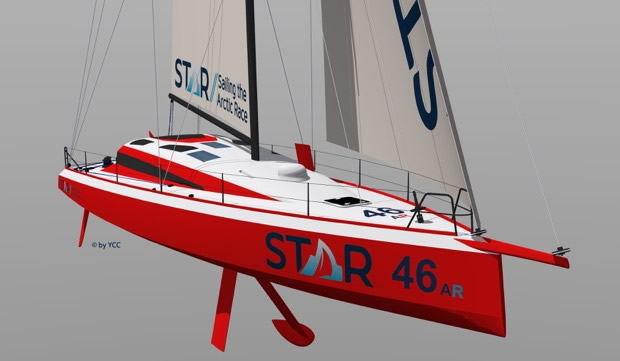
North West Passage race
Sailing The Arctic Race is an ambitious project, organised by a group in Victoria, British Columbia led by Robert Molnar, that intends to be the first ever yacht race through the North West Passage.
The event is scheduled to run in 2017, starting from New York in July with the intention of finishing in Victoria, British Columbia on the west coast of Canada in October. The 7,700 mile course is:
New York-Halifax, NS - 550 nm
Halifax-Nuuk, Greenland - 1500 nm
Nuuk-Cambridge Bay, NU - 1600 nm
Cambridge Bay-Tuktoyaktuk - 650 nm
Tuktoyaktuk-Dutch Harbor, Alaska - 1675 nm
Dutch Harbor-Victoria, BC - 1750 nm
The intention is for the race to be sailed in one designs, the STAR 46. The design, by YCC GmbH in Austria and Vincent Lebrailly Yacht Design, features a canting keel, a single daggerboard and twin rudders. It has many of the same structual safety features of IMOCA 60s and Minis such as a series of watertight bulkheads (dividing the boat into six compartments). In anticipation of sailing through the North West Passage it also has a heavily reinforced bow plus a unique 'hull within a hull' construction beneath the waterline.
Most notably the boat will be built in basalt fibre/volcanic fibre. Basalt fibre has better mechanical properties than fibreglass but is substantially cheaper than carbon fibre. It also has handy fire retardent qualities.
We haven't heard of basalt fibre before but some figures from Wikipedia indicate that basalt fibre has similar tensile strength properties to high end glass and low end carbon fibre, an elastic modulus somewhere midway between the two, and a similar weight to high end glass.
| Density (g/cm³) | Tensile strength (Gpa) | Elastic modulus (Gpa) | |
| Glass | 2.46-2.6 | 3.31-4.83 | 28-39 |
| Basalt fibre | 2.65 | 4.15-4.8 | 100-110 |
| Carbon fibre | 1.74-1.8 | 3.62-6.21 | 228-297 |
Another winning aspect of Basalt fibre is that it appears to be a substantially more 'eco' than both glass and carbon. Its manufacturing involves washing it and then melting it - admittedly to 1400°C - while the tricky bit is the technique for extruding filaments from the molten basalt.
The basalt fibres from Austrian company Fipofix have already been used to build a 16ft long offshore boat. This was constructed with basalt fibre laid over a balsa sandwich core, the laminate then infused with resin. Last summer this boat successfully sailed from Palm Beach, Florida across the North Atlantic to Les Sables d'Olonne and then back to the USA from Gijon, Spain. The boat was sailed singlehanded on the outbound leg by Austrian Harald Sedlacek, who's father Norbert competed in the 2008-9 Vendee Globe, before Sedlacek senior took over the helm for the return crossing. It doesn't take much joining of the dots to imagine that Sedlacek may have used the crossing as a test bed for building an IMOCA 60 out of Fipofix. Whether it will be in time for the 2016-7 race remains to be seen.
Back to Sailing The Arctic Race and it is great that an organiser is mounting such an event, although one imagines that the possibility of holding the event will rely heavy on Mother Nature/global warming allowing a passage through the ice in 2017. One wonders how long it will be before there is a full Round Arctic yacht race taking in the North East passage too.
More info on Sailing The Arctic here and on Fipofix 'volcanic fibre'
Businesses
Pro businesses
Editor's choice
Member blogs
-
 Ned Collier Wakefield: MOD70 round BarbadosWell that was intense. 12 hard fought for seconds for the win. In idyllic conditions, Tony Lawsons MOD ...
 -
 Mini Transat leg 2 reportThe second leg of the Mini Transat started on 31st October, just over a month after ...
 -
Leg 1 reportI’ve been working towards the Mini Transat now for three years. In 2013 I was part ...
Business blogs
-
 The Island Sailing Club in Cowes, Isle of Wight, is delighted that Prince Michael of Kent ...
 -
Peta Stuart-Hunt chats with the 25 year-old British solo sailor Lizzy Foreman before she sets sail ...
-
The 2015 Student Yachting World Cup (SYWoC), an ISAF-recognised event hosted and run by students for ...
Editor's Choice
-
 Three legs down into Ian Walker’s
 -
 Winning all but two races at
 -
 For the first time in its
Latest Comments
Add a comment - Members log in