

Getting around the world in one piece
Alex Thomson is trying to shake off his bad karma. Carnage and destruction are no stranger to the IMOCA 60 class, but the Hugo Boss skipper has attracted more than his fair share, pulling out of the 2004 Vendee Globe with damage to his yacht’s gooseneck and deck, suffering a collision with a fishing boat en route to the start of the 2008 race and then a collision with an unidentified object in the water soon after. There was the loss of his first IMOCA 60 in the 2006 Velux 5 Oceans, the appendicitis before the start of the last Barcelona World Race. The list is quite long...
Last year there was some embarrassment for the team when they admitted that buying the ultra-powerful Juan K-designed former Bahrain Team Pindar, which Brian Thompson had somehow got around the world singlehanded in the 2008-9 Vendee Globe, had been a mistake. So they acquired another IMOCA 60 – the third they currently own – in the 2008 generation Farr-designed former Estrella Damm/BT, campaigned in the last Vendee Globe by Seb Josse (until it was forced to retire after a rudder breakage). In this boat, finally, Thomson has succeeded in putting in a sorely needed good result, coming home second in last autumn’s Transat Jacques Vabre sailing with Guillermo Altadill.
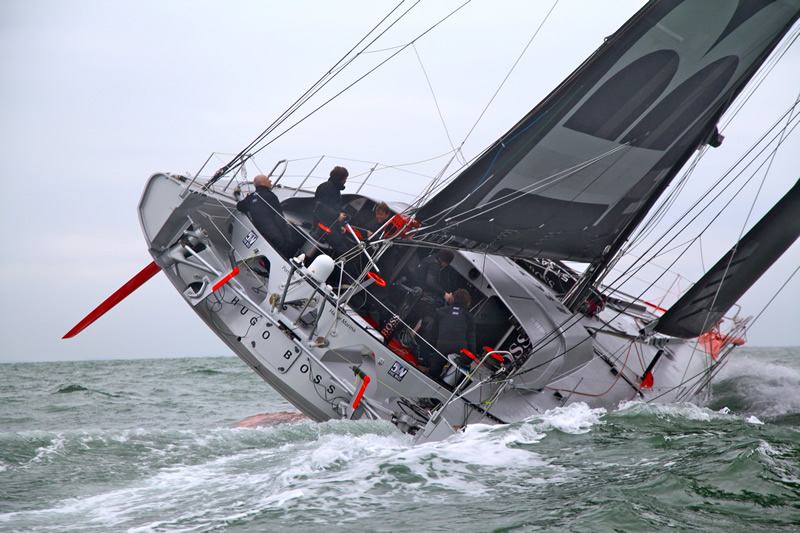
So what does this mean for Thomson and Hugo Boss’ Vendee Globe campaign?
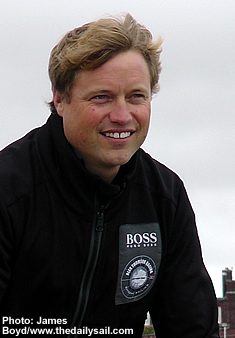 Over the winter, the latest Hugo Boss went through a refit with a difference. Thomson is all too aware of his track record and so the prime driver was reliability over performance. As he puts it: “We had a lot of choices from extreme as cutting the boat off in front of the mast and sticking a new piece on. The reality is - with the Vendee Globe everyone concentrates on performance and what everyone, including myself, tends to forget is that in the last race 65% of the boats that started didn’t finish the race. So reliability should be the no1 priority.”
More profoundly, he adds: “For me – personally I have to finish this. That is what this is about - finishing.”
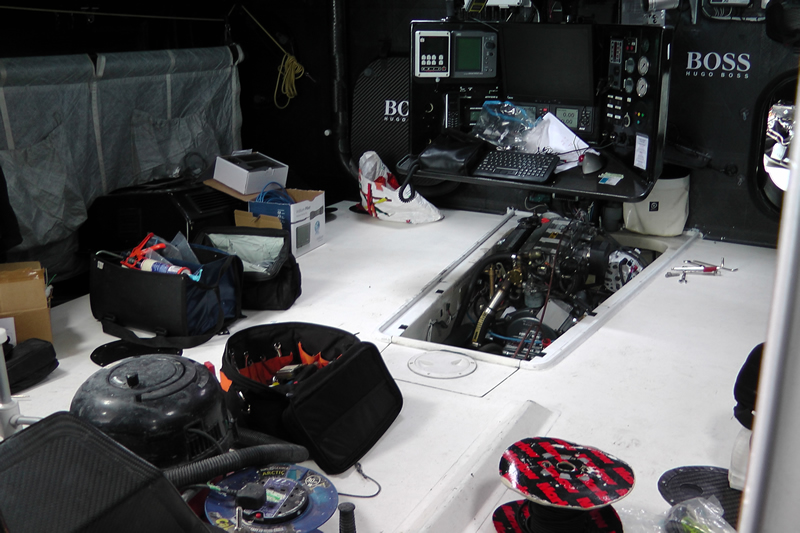
During the refit everything was taken off the boat that could be. This, in turn, received a full ‘non destructive testing’ survey, partly carried out by the team’s partner, Caterham Composites, and other specialists in this field.
“What we have concentrated on in this refit isn’t developing the boat - because the boat is pretty close to being fully optimised already - we have concentrated on the reliability," says Thomson. "Everything has come off, the boat has been fully structurally checked and Caterham Composites have helped us with that, making sure that everything is going to last for the Vendee Globe.”
Thomson says that after their disaster(s) at the start of the last Vendee Globe he did considerable soul searching to find out what they did wrong. “We ended up needing to be in a place where we can capture the detail and manage the risk better than we ever have done.”
Caterham Composites, which has a background of some 20 years in Formula 1 both as a team and as a engineering contractor, has helped show them the way with this. “In an F1 team you know exactly how long everything is going to last - it is called ‘lifeing’,” says Thomson. “We have started the process of doing that. We are still a long way from getting it perfect, but you need to know how long something is going to last and the only way to know that is to record everything properly and when stuff breaks it goes into the system and you build up a picture.”
So the plan is to do this as far as they can before the Vendee Globe. Ultimately if this were perfected then their IMOCA 60 would finish the Vendee Globe and then fall apart – if it doesn’t, then it’s too heavy.
“The big problem with sailing still is that they don’t know what the loads are,” Thomson continues. “That wave that came over Telefonica is the same as screwed us in the 2004 Vendee Globe and another nearly destroyed this boat [when it was racing in the 2009 Transat Jacques Vabre, when it was all but destroyed north of the Azores]. I don’t think these boats are engineered for that. If we see those conditions I will be saving the boat. I will be keeping the boat out of it. At the end of the day you don’t have to sail 90degrees to the waves.”
Caterham Composites has also assisted them with some specifics – Thomson points out the number of boats that have suffered mast track issues during past Vendee Globe and the company has been able to help them with ways of connecting carbon fibre pieces together with inserts, etc.
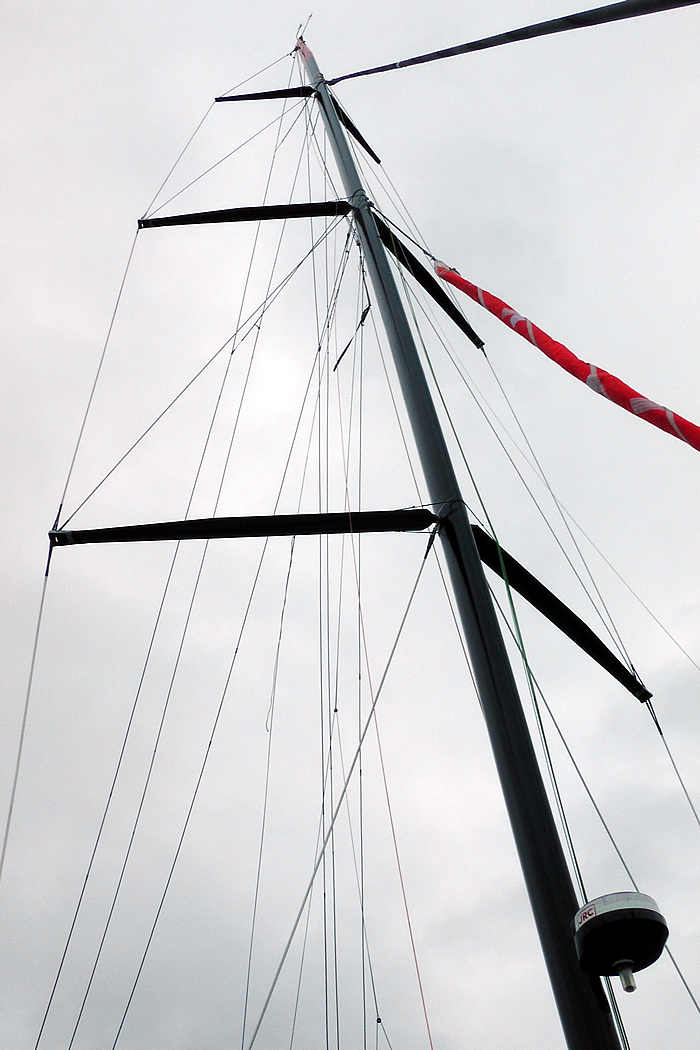
One of the best indicators of the conservative manner with which the team is preparing for the race is in the mast and standing rigging. Hugo Boss will be racing around the world this winter with the same mast that Seb Josse used in 2008 and that Thomson used on his double Transat crossing last autumn.
“This boat came with three rigs, one of them brand new,” says Thomson. “From a structural point of view, it is totally pucker. The new one we could put in is very similar in terms of CoG, but we would like to go with something we know works.” So an interesting point – when it comes to reliability over the duration of an event like the Vendee Globe - is it better to go with a mast (or indeed any composite part) that is tried and tested, but also has many miles on it and is thus more fatigued, or to go with one that is newer, less tried and testing, but less fatigued? Your thoughts below please.
The latest carbon rigging has proven itself to be a weak point on the Volvo Open 70s. However rather than go for round the world trialled EC6, on Hugo Boss they are sticking with Navtec PBO rigging.
Thomson explains: “We have carried on from where the boat left off. It is a bit lower tech, but there is trap you get stuck in with these things: What is the fastest thing you could do? That would be to go carbon. Then you end up pushing the boundaries in an area that is not going to win you the race, but could easily lose you the race. So reliability and risk management - not trying to change the world, not trying to eek out a tiny amount of performance for a load of risk. Would the boat go faster with carbon rigging? Maybe marginally, but maybe it wouldn’t get around. We’d have to change the spreader ends. It is like electing to have surgery if you actually don’t need it.”
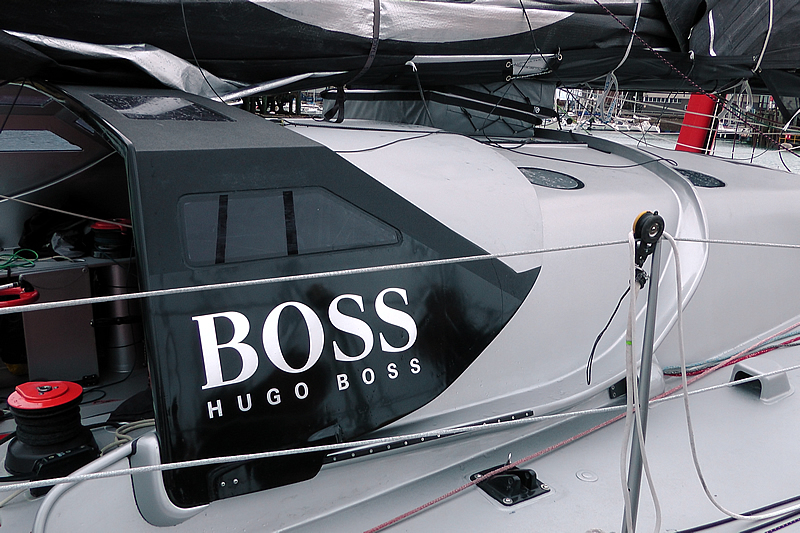
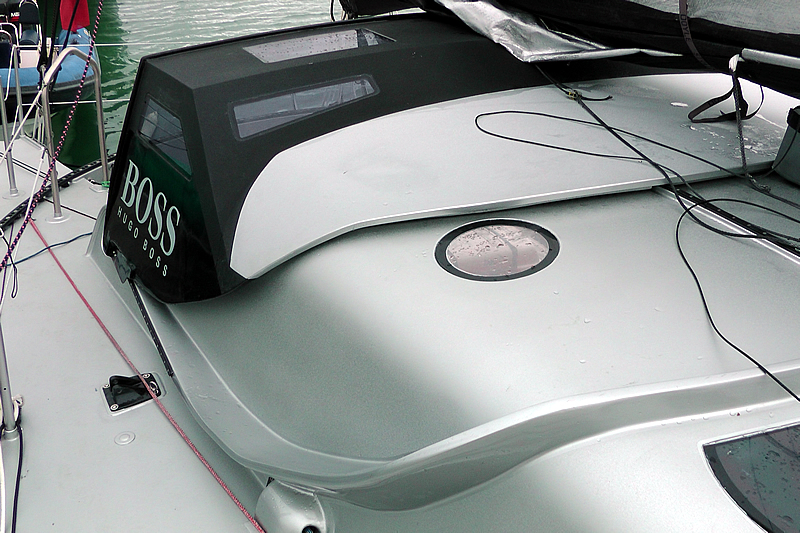
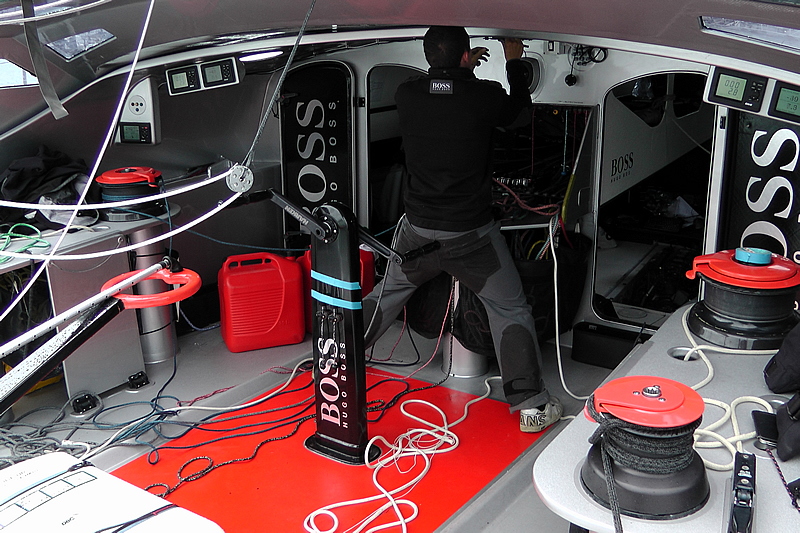
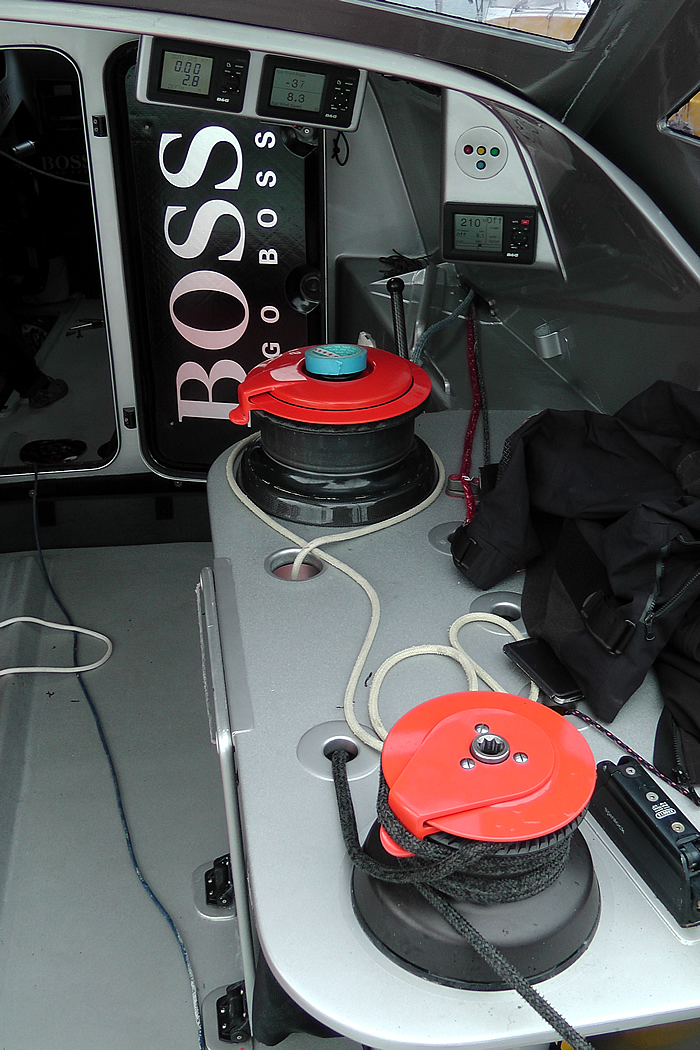
In the refit some additional changes have been made to the boat such as fitting a sliding coachroof. As Thomson puts it: “The more comfortable you are, the harder you are going to work.”
They have also worked on a new sail wardrobe this time with America’s Cup and Volvo Ocean Race legend Richard Bouzaid of Doyles NZ.
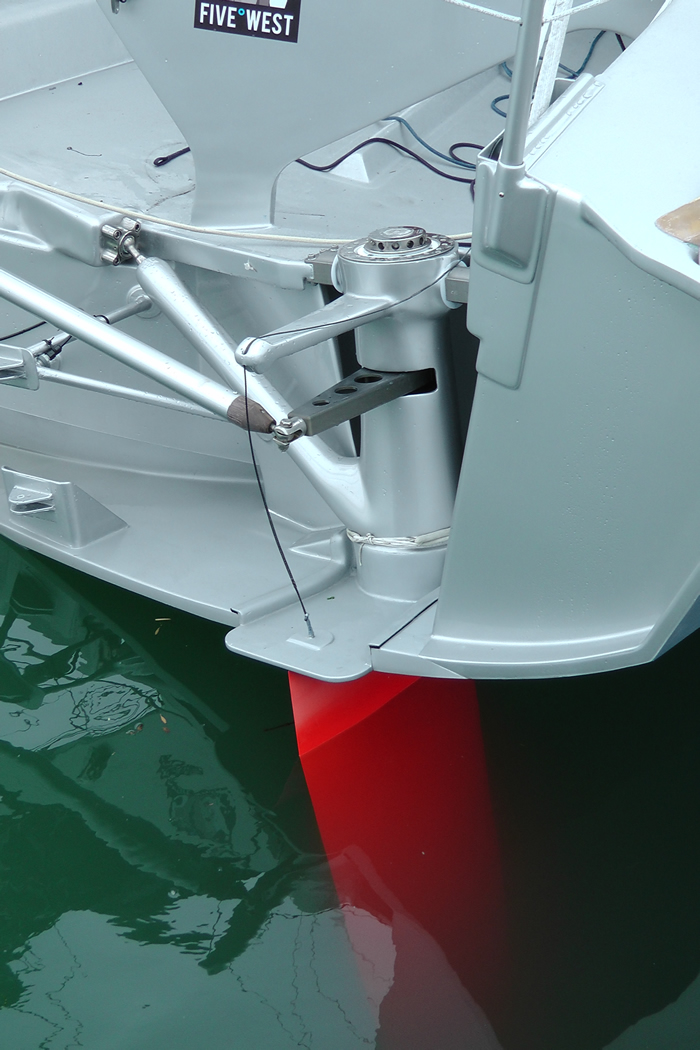
The previous engine has now been replaced with a Lombardini, which is lighter and is a make the team knows better. The net result of all these changes in terms of all-up weight is that the boat weighs in at around 8,300kg, or around 50kg lighter than before. “Mike [Golding] reckons Gamesa is down to 8,000kg. The main different is that we have a steel fin, which weighs about 1,000 kg whereas Mike’s carbon one will weigh about 300kg,” says Thomson.
A downside of refitting the boat for reliability rather than performance is that it probably won’t win the next Vendee Globe. Thomson admits that the newer boats do have a speed edge, especially reaching and downwind. “But that edge is much smaller solo – that was apparent on the B2B. But the boats aren’t reliable and the skippers don’t believe that they are reliable and you could see that in the TJV when all the boats turned left to head away from a storm and still suffered damage...”
For example at 28m the latest Hugo Boss’ mast height is nowhere near the maximum permitted by the IMOCA class rules of 30m. Thomson reckons it is around 28m. “But the boat doesn’t need it,” he adds.
However we have a feeling that this may be slightly hype and we understand that lurking somewhere on boad is a significant piece of go-faster technology the team is keeping under wraps until a later date.
En route they have uncovered a few horrors. The boats single hydraulic ram used to cant the keel began to recycle oil and wouldn’t keep the keel up prior to the start of the Transat B2B. This was fixed with a full service including replacing all the seals and is now fine. However when they examined the keel axis pin, it became apparent that it had partly locked up and on further inspection they discovered one end had broken. Some expensive bushes were made up in the States and were fitted by UK keel specialists, Irons Brothers.
As an aside Thomson says that the boat is the first he has sailed with what he calls ‘flappy spreaders’. “I remember this boat was launched at the same time as our Finot boat and we did the Channel Race together. We ended up to leeward, sailing upwind and we looked at this boat’s leeward spreaders moving around and you think ‘that is not right’. But having done 10,000 miles sailing on the boat now I like the idea and it seems very reliable.”
The idea is that with 20° of sweep on the spreaders, when you ease the main out, it hits the leeward spreaders and with the set up on the new Hugo Boss, these just twist forward. Having some ‘give’ in the system is better for the mainsail and the shrouds, spreaders and mast tube than if leeward shrouds and spreaders still bar tight.

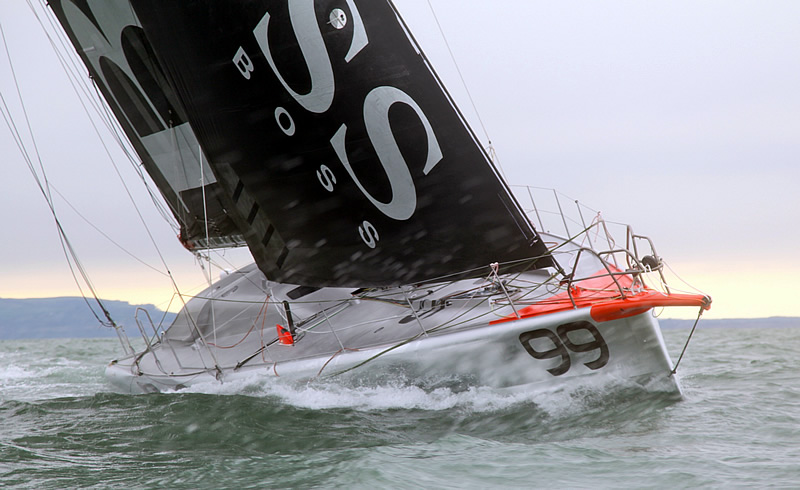
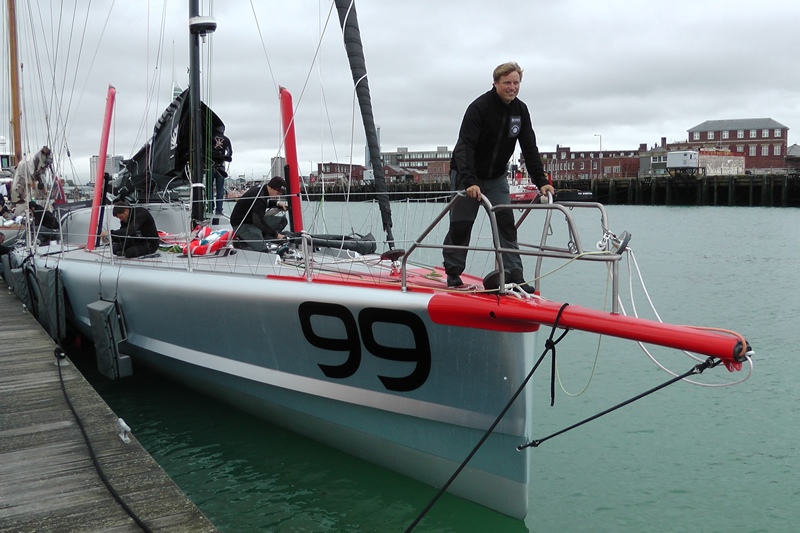
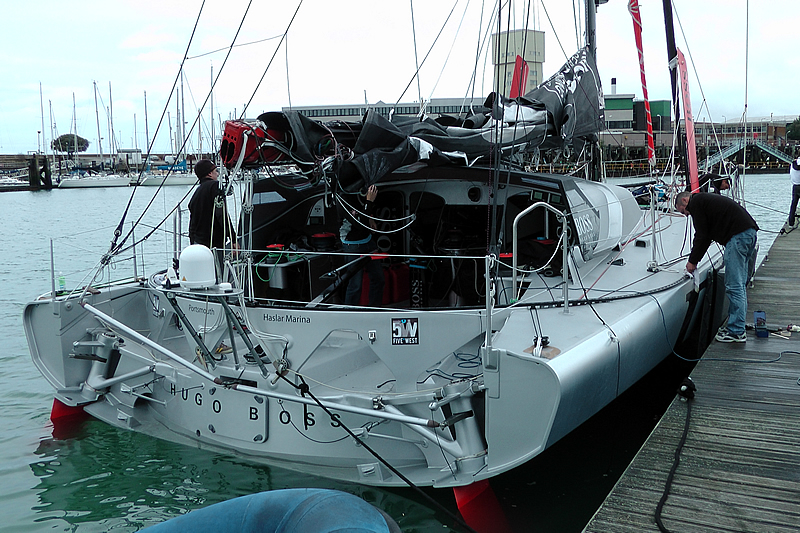
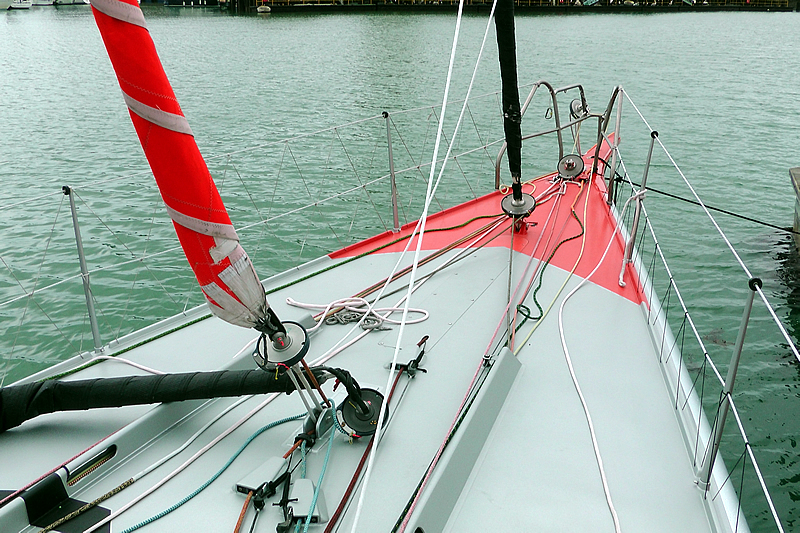
The boat has also undergone a repaint at Destys Marine at Hamble Point, where her refit was carried out. The team’s MD Stuart Hosford says of the paintjob: “For this boat going into the Vendee Globe, we wanted to try and do something. It has been a great process working with Hugo Boss on this. They are a fashion company so the look of the boat is almost more important than the speed or the performance. We have gone a little F1 – very chrome and silver, performance-based - a little bit ‘accessories’ with orange touches here and there and vertical branding on the sails, which means we get away with reefing issues. We are pretty proud of how the boat looks now...”
And indeed new-look Hugo Boss is very sexy with her silver hull. Silver we understand isn’t an easy colour to get to work as it easily turns grey. On Hugo Boss it definitely looks metallic, but not the ‘mirror’ finish as we once upon a time saw on part of the TP52 ONO.
From here until October
The cream of the French IMOCA 60 fleet has been out training daily from Port la Fôret and will then be competing in the Europa Race or ‘the Europa Warm’Up’ as it has been recently rebranded – starting this weekend from Barcelona, bound for Cascais fully crewed, before the boats continue singlehanded to La Rochelle via the Azores and Fastnet Rock. However no British teams are competing in this.
Last Friday, Hugo Boss set sail from Gosport bound for Monaco which the team has an annual engagement for the Monaco Grand Prix (Hugo Boss is a long term sponsor of the McLaren F1 team). However after this Thomson will get into training mode.
“The best training you can do for the Vendee would be to go out and sail competitively singlehanded. Unfortunately the only race that was going to happen singlehanded was cancelled [The Transat] and was replaced by a race [the Europa Race] that got cancelled!” Obviously the Europa Race has re-emerged in a new shortened state now starting from Barcelona rather than Istanbul, but one imagines there was also a conflict with the Monaco Grand Prix, which runs over 24-27 May.
So instead, after the Grand Prix Thomson plans to undertake a singlehanded lap of the north Atlantic, where nominally he will be attempting to break (or set) singlehanded monohull records. In the case of the Cadiz-San Salvador Route of Discovery record it will be establishing a new singlehanded monohull record. The boat will then be delivered up to New York where he will set out on the New York-Lizard attempt, where the record is currently held by Bernard Stamm - set in 2002 with a time of 10 days 10 hours 55 minutes and 19 seconds.
However these passages aren’t primarily for record breaking, as Thomson explains: “The problem for us is - how do you replicate a race situation? The idea of these two record attempts isn’t to break the record, it is about putting me into a pressure situation, so I can learn something from it more than I would be doing a delivery, so I am motivated to push the boat hard and make mistakes and to learn and to get 12,000 miles under my belt before the Vendee Globe. So don’t expect me to break records. I will be leaving New York on 15-16 August and the weather won’t necessarily be ideal. But I am trying to make a little more difficult for myself...”
Hugo Boss returns to UK in time for Aberdeen Asset Management Cowes Week before starting her preparations for October and the start of the solo non-stop round the world race out of Les Sables d’Olonne.
Meanwhile the Juan K boat is currently carrying out a hospitality tour of Asia with former Mini sailors Simon McGoldrick and Jesse Naimark-Rowse in charge of her. Thomson explains: “Hugo Boss is a global player and at the beginning of the contract we asked ‘where do you want us to go?’ And they said ‘five continents...’ The boat has most recently been in China.
Going one design
Thomson is keeping a close eye on the IMOCA AGM, due to take place in June, where the decision is likely to be made on whether to go one design (it is a believed a Farr design is being touted) or part one design.
Thomson has distinct reservations about all of this. “We have got an Executive Board that is concentrating all the resources and all the money on the one design and no one is working on how to make the calendar more effective, how to reduce costs for the teams, how to increase the value and that is the most important thing they should be concentrating on.”
Thomson has spoken to us before about how he doesn’t favour going one design. “Personally it would make it a lot less interesting as it would for Hugo Boss. The reality is that there will be 18 good boats on the Vendee Globe start line. And after the Vendee those 18 boats should be able to go and still be competitive in any other event that happens. The big danger of introducing a one design is that it could massively devalue the existing fleet, whereas what you should be doing is protecting them.”
The one design is being pushed hard in particular by IMOCA President Luc Talbourdet and skipper Jean le Cam but there are a significant number of skippers, teams and sponsors who are ardently against the move, including Safran (who sponsor Marc Guillemot’s campaign as a technology showcase) and most of the teams with new boats, who could find their 18 month old steeds suddenly obsolete. Thomson reckons at present the split for and against around 50-50.
The AGM has been cleverly scheduled so that the person who is tasked with arguing against the one design (in favour of going part one-design - a much better idea) will be tied up with an event in the USA...
 |
 |
 |
 |
 |
 |
 |
 |
 |
 |
 |
 |

Businesses

Pro businesses
Editor's choice
Member blogs
-
 Ned Collier Wakefield: MOD70 round BarbadosWell that was intense. 12 hard fought for seconds for the win. In idyllic conditions, Tony Lawsons MOD ...
 -
 Mini Transat leg 2 reportThe second leg of the Mini Transat started on 31st October, just over a month after ...
 -
Leg 1 reportI’ve been working towards the Mini Transat now for three years. In 2013 I was part ...
Business blogs
-
 The Island Sailing Club in Cowes, Isle of Wight, is delighted that Prince Michael of Kent ...
 -
Peta Stuart-Hunt chats with the 25 year-old British solo sailor Lizzy Foreman before she sets sail ...
-
The 2015 Student Yachting World Cup (SYWoC), an ISAF-recognised event hosted and run by students for ...
Editor's Choice
-
 Three legs down into Ian Walker’s
 -
 Winning all but two races at
 -
 For the first time in its
Latest Comments
Add a comment - Members log in