

Camper VO70 design
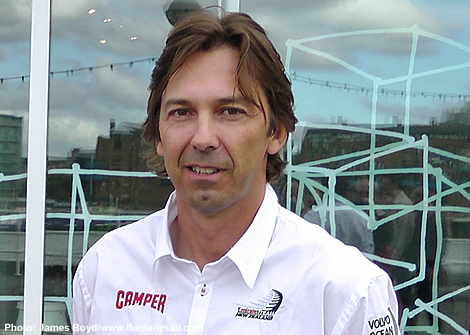
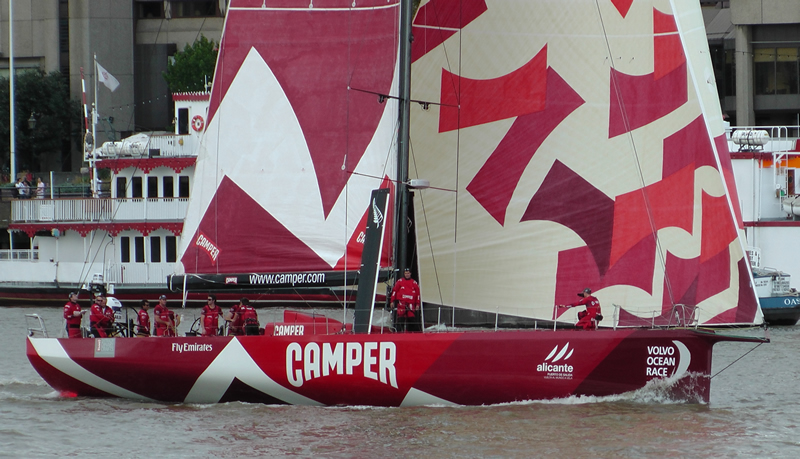
While back in the day Paul Cayard first applied America’s Cup techniques when he undertook the two boat EF campaign, Emirates Team New Zealand’s masterminding of the Camper campaign is the first time an active AC team has entered the Volvo Ocean Race, no doubt spurred by CEO Grant Dalton’s past association with the race.
Much of the design work for the Camper VO70 was carried out by Emirates Team New Zealand’s in house boffins as the America’s Cup was in hiatus. However, oddly, the campaign has been spearheaded by two Australians, skipper Chris Nicholson, who after his 49er Olympic campaigns first sailed the round the world with Grant Dalton aboard Amer Sport One in 2001 and Neil Cox, once ABN AMRO Two crewman and boat captain. Both worked for Puma during the last Volvo Ocean Race.
Whether having an America’s Cup team behind a Volvo campaign makes a difference we will see when the round the world race gets underway, but this time both Camper and Groupama (which has a similar set-up to the Kiwi team in terms of resource in in-house designers, engineers, rig and sails specialists, etc) may benefit from the unparalleled amount of available brainpower applied to the various components of their campaigns both in the build-up and during the race.
As usual with Team New Zealand, the most key elements of the project were undertaken locally – the boat built by Mick Cookson, having been engineered by Giovanni Belgrano with sails designed by Burns Fallow and built by North New Zealand and a mast from Southern Spars - just as their V5 AC boats were.
Plus there was input from sailing team members who had experience with all the major teams from the last round the world race: Nicholson and Cox came with Puma know-how (as did Rob Salthouse) where they previously worked with Marcelino Botin, who was also the Kiwi team’s in-house naval architect for the 32nd America’s Cup, plus Stu Bannatyne (ex-Ericsson) Daryl Wislang and Mike Pammenter (ex-Telefonica), Roberto Bermudez de Castro, previously skipper of Delta Lloyd, and Andrew Maclean (Green Dragon).
Chris Nicholson was integral to the last Puma campaign as the principle interface between the designer and the team. Nicholson says it is important that they carried this relationship on. He cites Juan K’s relationship with Brad Jackson and Tony Mutter who went from ABN AMRO One to Ericsson 4 and this time around are with Puma. “I think you see teams which can keep momentum going in these races, they normally do well.”
“We did the naval architecture of the boat and the Team NZ group of engineers did the structures, the design of the mast, the sails,” says Marcelino Botin. “We shared 50-50 the deck layouts and interiors, so basically it is not very different from how we worked on the America’s Cup.”
Compared to the last Puma campaign, Botin says that this time he and his team of six in Santander, northern Spain on this occasion were able to approach the design having previous experience in the VO70 class, but, significantly, had much more time to develop the design. “Even though Camper came in pretty late, we had been working a potential design for three or four months.”
Much more man hours were ploughed into CFD backed up with tank testing. While tanking testing for the previous Puma boat was carried out at the high speed tank on the Isle of Wight, this has since closed, so, with tank testing being run by Southampton’s Wolfson Unit, they had to tank test this time in Belgium. Three models were studied at 1:8 scale.
“We looked hard at appendages especially,” says Botin. “That was to see if what we were seeing in the CFD was real. We also wanted to visualise the performance of the boat. CFD results are pretty reliable, so you don’t expect many difference, but the nice thing about the tank is you actually see the boat in the water, how it operates, how it trims, etc and with the appendages it is really nice to see if they are ventilating or if anything strange is going on.”
In developing Camper, the team went back to basics, but also made some clear decisions on what aspects of the boat they felt were most important. As skipper Chris Nicholson explains: “One of the parameters was for the boat to be more manageable, for the sailors to be able to drive the boat at a higher level, without a great deal of difficulty. For that fact alone, the boat will be faster.”
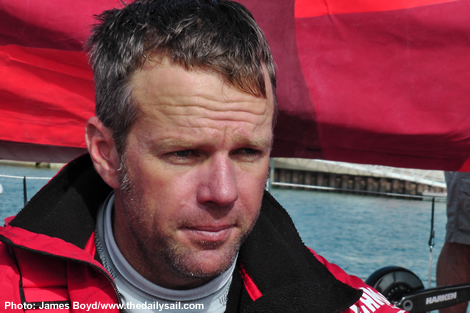
The latest iteration of the VO70 rule has caused bulb weights to be reduced by 200-250kg (according to Botin) compared to the last generation, so stability has been recovered by lowering VCG but also by increasing form stability within the hull shape. Obviously on a canting keel boat leeway reduction is carried out by the leeward daggerboard rather the keel foil so while the balance of the boat is determined by the relative positioning of the daggerboards to the mast and centre of effort the sail plan, on a VO70 the fore and aft positioning of the canting keel is determined by the volume distribution of the hull. As Chris Nicholson puts it: “At the end of the day the job of the fin is to hold the lead out to 40 degrees and fore and aft positioning of it just needs to match the centre of volume.”
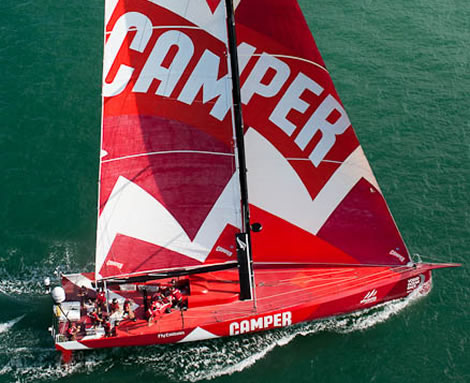
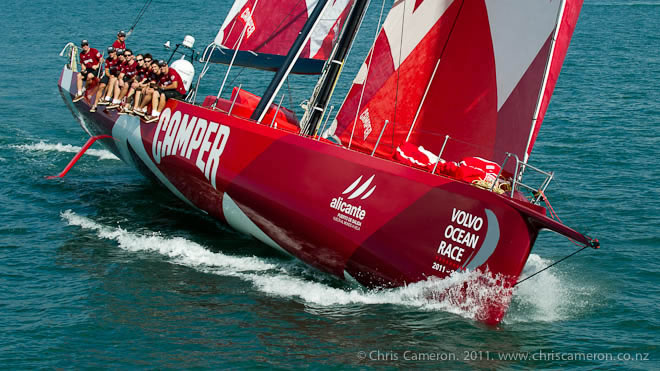
Hence with added form stability further forward, so her canting keel has moved forward with it. Thus, in the VO70 fleet, Camper is unique in having her keel forward of her mast while her daggerboards are her alongside/slightly aft of the mast.
“The boat is really nicely balanced, which is hard to achieve on these boats, because you have all sorts of sizes of jibs, big differences in sail areas,” says Botin (now of Botin & Partners since former partner Shaun Carkeek chose to return to South Africa last year). “So typically you can see negative helm to positive helm of 6-7 degrees. So you want to achieve is a boat that is balanced all the way through the range of sails and with Camper we have made a clear step forward in that respect.”
However Botin has mixed feelings about form stability. “In terms of stability, we have gone down a little bit from Puma, which was very extreme in that respect. One of the things we learned from her was that you can’t always use form stability even if you’ve got it, because when the sea gets very rough, which is when you need it, you have to slow down. So we have tried to make it a little more seaworthy so that even if you have got less form stability you can push harder.”
The keel/mast/daggerboards being in closer proximity to one another has also meant that that weight could be removed from the structure. As Botin puts it: “The whole structure of that area is linked nicely.”
However potentially a significant issue with the position of Camper’s boards and her canting keel is that it is possible for them to collide, however there are safety mechanisms in place to prevent this from occurring. “With the centre of effort of the sails on these boats it is still fairly well aft, so if you can get your daggerboards back to match that, you end up with a nicely balanced boat,” says Chris Nicholson. “She handles like a dream through every wind range. We thought we were going to have a few problem areas but we don’t have a single weakness with regards to the balance of the boat. Now we have got to go sailing, that one percent of doubt you had because it was new was removed straight away.”
A most obvious variation between the hull shapes of the VO70s is in their chines. On the three Juan K designs the chine is carried most of the way to the bow. On the Farr-designed Abu Dhabi and Camper it barely extends halfway along the hull.
“Obviously if you want to extend the volume as far outboard as possible you need chines, because you have a maximum beam and you have to cut the hull somewhere,” explains Botin. “With the chines it is debatable about whether you have a gain from having them [as opposed to a round bilge]. There could be a viscous benefit of having some sort of chine at the back because it cuts the water from the hull in a nice way. Volume distribution is a much bigger deal than whether the chine goes to the front or not.”
Skipper Chris Nicholson observes that the chine angling upwards as it goes aft encourages the bow to lift at high speed, combined with the more powerful bow.
As to the performance of the new boat, Botin reckons Camper will be quite a bit faster than the old Puma VO70 on every point of sail, and this stems from design evolution. However a significant constraint of the new VO70 rule is the limitation in sails. This has led to teams making more detailed weather studies to optimise their sail programs to the anticipated conditions. As Chris Nicholson put it: “I would have to say that our heavy airs running and reach is a marked improvement and areas that might have been weak points are even or still better than the previous race. Compared to the last race, there isn’t a weak spot.”
While the keel is further forward otherwise throughout the boat the trend is to move weight aft. Botin says this is an evolution that has also been seen in the TP52 class where the Emirates Team New Zealand boat was the first to move the main sheet pedestal aft of the main sheet track, something which they have repeated on the Camper VO70. This gets not only the pedestal but also the weight of grinder(s) manning it further aft, and further away from the waves.
Tomorrow we will publish Neil Cox's guided tour to the Camper VO70

Businesses
Pro businesses
-
Italy
-
-
-
United Kingdom
Editor's choice
Member blogs
-
 Ned Collier Wakefield: MOD70 round BarbadosWell that was intense. 12 hard fought for seconds for the win. In idyllic conditions, Tony Lawsons MOD ...
 -
 Mini Transat leg 2 reportThe second leg of the Mini Transat started on 31st October, just over a month after ...
 -
Leg 1 reportI’ve been working towards the Mini Transat now for three years. In 2013 I was part ...
Business blogs
-
 The Island Sailing Club in Cowes, Isle of Wight, is delighted that Prince Michael of Kent ...
 -
Peta Stuart-Hunt chats with the 25 year-old British solo sailor Lizzy Foreman before she sets sail ...
-
The 2015 Student Yachting World Cup (SYWoC), an ISAF-recognised event hosted and run by students for ...
Editor's Choice
-
 Three legs down into Ian Walker’s
 -
 Winning all but two races at
 -
 For the first time in its
Latest Comments
Add a comment - Members log in