
En route to Barra
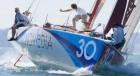
The opening leg of the Royal Western YC’s doublehanded Shetland Round Britain and Ireland Race, between Plymouth and Kinsale, had an unexpected elapsed time winner in a Class 40 monohull - Nick Leggatt and Phillippa Hutton-Squire’s Phesheya Racing. They arrived in an elapsed time of 1 days 6 hours 18 minutes, just six minutes ahead of Sungard Front Arena sailed by Marco Nannini and ex-Mini Transat competitor Paul Peggs, in turn 11 minutes ahead of the first multihull home – Mike Wigmore and Grant Kelly’s F31 Freebird, the smallest multihull in the fleet. As we mentioned in our preview it looks like there could be a good race on this occasion between the hot shot monos and the larger cruiser racer multis.
The Round Britain race is now scored under IRC but traditionally it has been in the Royal Western YC’s traditional style, racing in elapsed time in length-defined class bands. Currently leading under IRC is the Class 3 boat, The Shed, a Lightwave 395 sailed by Pip Hare and Phil Stubbs.
Full results from leg one are here
The boats each had 48 hours in port before they have a rolling re-start heading for the next stopover - Barra in the Outer Hebrides.
The information coming out of the race is frankly amongst the worst we have come across recently... We know that leg two has started and the tracking shows that the fleet is currently dodging the fishing nets off southwest Ireland. It appears that the multihull Paradox, sailed by Will Caxton and Matt Gill may have pulled into the lead overall by taking a more offshore course. Phesheya Racing still leads the Class 40s, in second overall now, with the Norwegian duo of Rune Aasberg and Arild Schei up to second in the Class 40s aboard Solo.
Race Director Peter Taylor at Kinsale sent this report yesterday:
All but the last five boats of the Shetland Round Britain & Ireland Race have arrived here now and are enjoying the summer sunshine of Ireland.
The Race started from Plymouth Sound at noon on Sunday, also in sunshine with a light breeze. Since then the competitors have experienced a mixed bag of wind and weather. The easy beam reach out to the Eddystone Lighthouse allowed them all to settle in well, with the eight multihulls and nine Class 40 monohulls quickly drawing ahead to establish the pecking order of the 56 boat fleet.
The remainder of Sunday was spent hard on the freshening westerly wind, forging south-westward along the coast of Cornwall. Indications from the trackers showed some of the fleet moving away from the direct track to the Lizard Point instead of pushing up hard to maintain the direct route. These were later to regret their plan of action which was laid to catch the first of the gathering southerly wind. In the event, the wind died down as the evening wore on and the whole fleet almost wallowed in the calm between the Lizard and Lands End. By the time the long-forecast southerlies filled, there was no great advantage for those who had hung south. Their adversaries nearer to the Scilly Isles turned easily to starboard and flew off to Ireland.
What followed turned out to be a glorious sleigh-ride to the north-west, complete with Demolition Derby as one by one the spinnakers rolled into the water. Fortunately, as the wind and rain swept over the Celtic Sea all our intrepid sailors stayed onboard, and only bits and pieces of equipment were lost to the sea. The Sailmakers and Chandelers of Kinsale have enjoyed something of a field day!
Wind held up well for the early leaders who made it to the Irish Coast before sundown, but not so for the majority of the fleet who struggled to arrive in dying coastal winds.
Berthing Masters were up all night finding places for all in the arrivals, all weary, sunburned and delighted to be in Euroland where the Murphy’s Stout flows from taps on every corner. Some continued to enjoy the sailing, staying out all night for a second time, and gradually creeping to the welcoming shores beside the Old Head of Kinsale. Now we have completed about 15% of the total circumnavigation of Britain and Ireland. There will be a lot of stories to tell in the days ahead.
Darren Newton reports from Suenos:
We started last over the line in the multihull fleet, due to my error on the prestart, but soon started making good progress, sailing past the Dragonfly, Cold Fusion Reloaded. Then the pace started dropping off. The steering was not feeling good and we realised the rudders were misaligned; with only 12 miles under our keels, the fluid link had moved and was preventing the rudders aligning properly. As well as this the autopilot couldn’t steer, so valuable time was lost trying to realign the rudders, losing us the lead we had gained. The initial pace of the boat was excellent round the Eddystone, the 1stlandmark after the start, and it felt good to be finally on our way in a brand new boat, built in 7 months alongside an 1195 kit. Sueños has new features we have not used before, including fluid link hydraulic system and skeg style rudders, which allow the boat to beach/dry out, but as with all new features there were a few teething problems to sort out.
The wind built and the ride got bumpy with channel chop while we were beating to windward, and that was when we noticed the next problem – the bow seemed very low in the water. Never having sailed it in any seaway, we initially thought it was because we were pressing the boat hard. However, my curiosity aroused, I made my way to the bow to inspect the fender lockers which, when opened, pushed the hatches open because they were filled with sea water. The seal around the hatch had leaked and the drain hole in the fender locker was not large enough to work properly. Various methods of solving the problem were discussed – drilling a large hole in the hull to drain the locker, or draining the water into the shower compartment – but both required drilling a hole and we had neglected to bring a drill with us. In the end we tacked and sailed the boat to lift the bow compartment, and with much heaving and bailing with buckets the old fashioned way, we emptied out the water. We must have been carrying 3 tons of water, so it took a while, and to prevent it happening again we used gaffer tape to seal the fender locker lids. We also opened a skin fitting – a black tank breather - to increase the level of drainage to that compartment, so if more water got in there would be another option to drain it.
Time was lost doing this, putting us at the back of the fleet, but once underway we slowly made our way through the mass of yachts heading for the Isles of Scilly and the next point before crossing the Irish Sea. Progress was painful due to the rudders not lining up and the autopilot not steering boat. We had to hand steer all the way, which drained our stamina and reduced the performance of the boat through the first night. At dawn the Bishop Rock was to starboard; as indeed all our landmarks will be during this race. We tried a new method to align the rudders by manually pulling the ram on the port side in line with the rudder reference unit, while the helmsman kept his feet on the deck to notify zero degrees on the other rudder. This worked much better and the feeling of the steering radically improved. But we still could not trust the autopilot as it would bear away for no reason. In rough conditions we had to keep realigning the rudders time after time while reefing. We also ripped off one of the bottom car sliders on the main sail. Luckily we managed to refit it, but it restricted our sail plan for a while, which as it turned out was not a problem as it was bloody windy, with 25-30 knots of wind, giving us a top boat speed of 20 knots. Nearing Kinsale, we started experimenting with the pilot, adjusting its sensitivity, but again it lost the plot after a while as the new hydraulic steering was creeping under use, so misaligning the rudders again and again, losing us more and more time. The fog was thick and the sea fierce, but we were still having fun and committed to the longest sea trial we’ve ever done for any boat. This one was launched only three weeks before the race and we have only sailed her in Plymouth Sound, and around the Channel in perfect conditions for the qualifier.
We were a bit down when we arrived at the first layover in Kinsale, wondering how to fix the problems. We talked to the other competitors and lots of people had had major problems due to the extreme weather; the local sail makers are doing overtime fixing the huge number of spinnakers blown. Various stories of breakages and problems actually cheered us up a bit – we weren’t the only ones to have had issues and we were still 4th in the Multihull fleet. In particular Strontium Dog has ripped a genoa track and reacher, and Drama Queen broke a spinnaker halyard. To help try to resolve the steering issues we have decided to fly out our engineer Ian Critchmoor, who will arrive at about 2pm today and will have until 21:55 when we are due out. Rupert has got the weather fax working today which should help us choose our route but we expect it to be a windward beat to Barra. Hospitality in Kinsale has been really good, though we haven’t had time to sample much Guinness.
The last monohull has come in so the place is buzzing, but boats will be starting to leave again soon and the race will be back on. Meantime we have at least solved the problem with the forward fender lockers, sealing them with draught excluders bought from the local DIY shop. We have had little tussles with everyone in the fleet – all good fun – and hopefully we will do a bit better on the next leg to Barra.

Businesses
Pro businesses
-
Italy
-
-
Netherlands
-
United Kingdom
Editor's choice
Member blogs
-
 Ned Collier Wakefield: MOD70 round BarbadosWell that was intense. 12 hard fought for seconds for the win. In idyllic conditions, Tony Lawsons MOD ...
 -
 Mini Transat leg 2 reportThe second leg of the Mini Transat started on 31st October, just over a month after ...
 -
Leg 1 reportI’ve been working towards the Mini Transat now for three years. In 2013 I was part ...
Business blogs
-
 The Island Sailing Club in Cowes, Isle of Wight, is delighted that Prince Michael of Kent ...
 -
Peta Stuart-Hunt chats with the 25 year-old British solo sailor Lizzy Foreman before she sets sail ...
-
The 2015 Student Yachting World Cup (SYWoC), an ISAF-recognised event hosted and run by students for ...
Editor's Choice
-
 Three legs down into Ian Walker’s
 -
 Winning all but two races at
 -
 For the first time in its
Latest Comments
Add a comment - Members log in