
Taking on the Channel
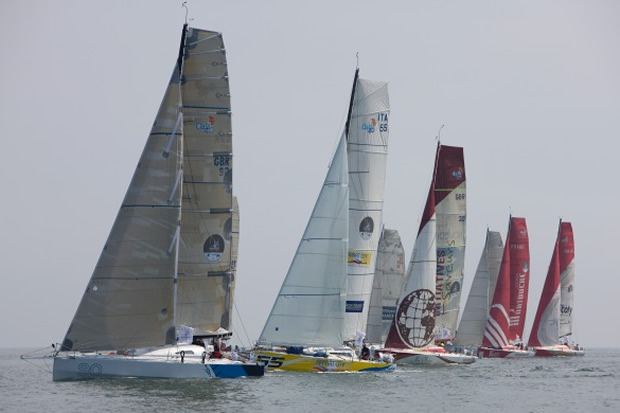
The Normandy Channel Race set sail today at 1400 off Hermanville-sur-Mer, France. 10 Class 40s and their doublehanded crews have over 1,000 miles ahead of them now, taking them through some tricky areas for navigation including the islands of Saint-Marcouf, Barfleur, the Solent, the south coast of England, the Celtic Sea, the Irish Sea, the Fastnet Rock and the Raz Blanchard. Competitors are expected to complete the 1000 mile course and return to Caen by Friday or Saturday.
The start took place in calm conditions with and a 10 knot WSWerly breeze. Yvan Noblet and David Taboré got off to the best start on port tack. Upwind several boats opted to hug the coast, where some got tangled up in lobster pots. Solidaire du Chocolat winner Tanguy De Lamotte even had to dive under his boat to unravel nets tangled around his rudders. Just off the port of Courseulles-sur-Mer after two hours of racing, the fleet were tightly bunched with Destination Dunkerque leading, followed by Moonpalace and Novedia Initiatives, the boats further offshore falling back a little…
Bound for Saint-Marcouf, the first passage mark, the first 37 miles spent tacking offshore or along the beaches, it was a adrenalin-charged introduction to the race.
For the double-handed crews it’s all about getting into the rhythm of the competition, to negotiate the wind shifts and, above all, the current, which is likely to have considerable influence on positions as the fleet passes Barfleur early this evening. This initial tricky passage may well have an impact on the results. However, once this section is behind them, the skippers will then focus on crossing the English Channel, setting a course towards the Solent and the Isle of Wight, which has to be left to port. The wind is expected to drop as the wind shiftes into the northwest.
Tanguy Leglatin on Destination Dunkerque said before the start: ”The idea is to be at the front of the pack at Barfleur this evening so as to get by with the current. Sailing close-hauled for the first 30 miles, we’re going to be flat out and won’t have time to rest. We’ll get into the rhythm as we traverse the Channel. Following on from that it’s important to choose our trajectories well according to what headsails we carry. Finding the right angle and the right compromise is one of the key features inherent to the Class 40s”.
Businesses

Pro businesses
-
United Kingdom
-
United Kingdom
-
Netherlands
-
France
Editor's choice
Member blogs
-
 Ned Collier Wakefield: MOD70 round BarbadosWell that was intense. 12 hard fought for seconds for the win. In idyllic conditions, Tony Lawsons MOD ...
 -
 Mini Transat leg 2 reportThe second leg of the Mini Transat started on 31st October, just over a month after ...
 -
Leg 1 reportI’ve been working towards the Mini Transat now for three years. In 2013 I was part ...
Business blogs
-
 The Island Sailing Club in Cowes, Isle of Wight, is delighted that Prince Michael of Kent ...
 -
Peta Stuart-Hunt chats with the 25 year-old British solo sailor Lizzy Foreman before she sets sail ...
-
The 2015 Student Yachting World Cup (SYWoC), an ISAF-recognised event hosted and run by students for ...
Editor's Choice
-
 Three legs down into Ian Walker’s
 -
 Winning all but two races at
 -
 For the first time in its
Latest Comments
Add a comment - Members log in