
Anti-collision device put through its paces
Tuesday January 5th 2010, Author: James Boyd, Location: United Kingdom
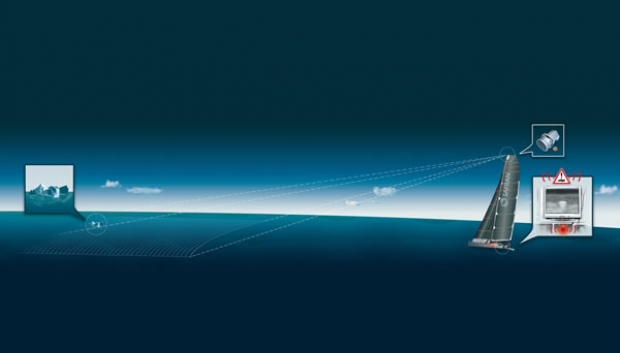
The anti-UFO system, designed to spot unidentified floating objects, developed by Safran and used on board Marc Guillemot's IMOCA 60, is entering an important phase: it has been installed for a few days now aboard
ADA 2, Isabelle Autissier’s boat for her expedition to Antarctica. On this voyage the system will be coming across all sizes of iceberg and Isabelle Autissier will bring back some vital pictures to enable further progress to be made with this innovative technology, which is aimed at protecting sailors from the risks of colliding with growlers and other semi-submerged objects.
Former singlehanded round the world sailor Isabelle Autissier set off from Ushuaia on 3 January on her fourth expedition. "During this expedition, if possible, we shall be sailing down to 69 degrees south and approaching Peter I Island," she said. "In this region of the Antarctic Peninsula, the charts are not very accurate. It means watching where we’re going, while sailing almost all of the time in amongst the icebergs." This is the 'No Man’s Land Project', an adventure and expedition to the ends of the earth, for which Isabelle Autissier is accompanied by a crew of sailors and mountaineers: the sailors, Tristan Guyon Le Bouffy and Jacques Marty, the glaciologist-climber Patrick Wagnon and Lionel Daudet, the professional mountaineer famous for climbing some out of the ordinary peaks and Mathieu Cortial, trainee guide and member of a mountain rescue team.
The crew is to sail along the west of the Antarctic Peninsula and the boat will be used as a base camp for climbing unconquered peaks until they reach Peter I Island, where the mountaineers hope to climb Lars Christensen Peak. This maritime and mountaineering expedition will involve more than ten weeks of sailing through ice.
ADA 2 will be fitted with a simplified version of the anti-UFO system developed by Safran and used by Marc Guillemot during the 2008 Vendée Globe. The system comprises an infra-red camera at the mast head, connected to a screen with alarms enabling small objects (2x2m) to be spotted, when their temperature is different from the water. ADA 2 is expected to be frequently in the vicinity of icebergs and growlers.
Isabelle Autissier’s expedition will be a useful proving ground for the equipment. "This is exactly what we were missing up until now to enable us to fine tune the product," said the project leader for the Group Safran monohull, Jean-Marie de la Porte. Autissier confirms: “We shan’t be using it for navigational purposes, but will be making regular 5-minute recordings, which will then be used by Safran. For me, this is a way to give a helping hand and enable this technology to advance, as it is aimed at improving the safety of sailors at sea."
For Safran, the goal is for the prototype to be perfected ready for the 2012-2013 Vendée Globe. "Once work on this innovative safety device is complete then it can be mass produced," says de la Porte. "We shall certainly be willing to sell it to other competitors. We shan’t be reserving for ourselves a system that is capable of enhancing safety."
Other applications are planned away from the world of ocean racing, such as search and rescue operations, the detection of floating objects (other than ice), etc. "We’ve already been contacted by teams attempting records, but also by the French lifeboat service, the SNSM," added de la Porte as examples.
"The system is one of the ways in which Safran has been contributing to the marine sector and more generally, shows its desire to continue to innovate.”
In 2010, the innovations from Safran on the monohull will deal with weight saving and clean energy solutions.
Most Read
Most Commented
Comments
Businesses
Pro businesses
-
-
France
-
United Kingdom
-
Editor's choice
Member blogs
-
 Ned Collier Wakefield: MOD70 round BarbadosWell that was intense. 12 hard fought for seconds for the win. In idyllic conditions, Tony Lawsons MOD ...
 -
 Mini Transat leg 2 reportThe second leg of the Mini Transat started on 31st October, just over a month after ...
 -
Leg 1 reportI’ve been working towards the Mini Transat now for three years. In 2013 I was part ...
Business blogs
-
 The Island Sailing Club in Cowes, Isle of Wight, is delighted that Prince Michael of Kent ...
 -
Peta Stuart-Hunt chats with the 25 year-old British solo sailor Lizzy Foreman before she sets sail ...
-
The 2015 Student Yachting World Cup (SYWoC), an ISAF-recognised event hosted and run by students for ...
Editor's Choice
All time favourites...
-
 Three legs down into Ian Walker’s
 -
 Winning all but two races at
 -
 For the first time in its
Latest Comments
Add a comment - Members log in