
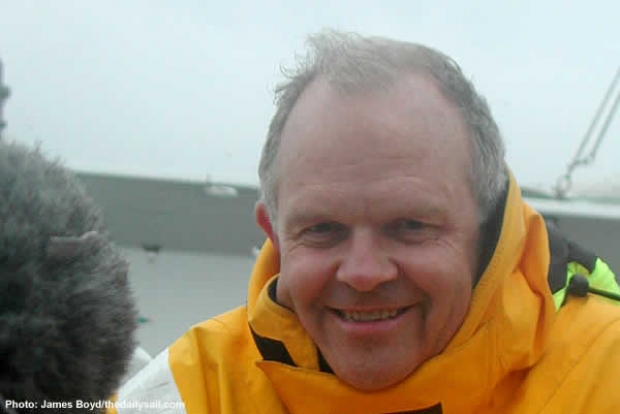
Steve Fossett
Steve Fossett looks ahead at his voyage round the world
Friday February 6th 2004, Author: James Boyd, Location: Transoceanic
1600 this afternoon will see skipper Steve Fossett and the crew of
Cheyenne, the world's largest racing catamaran, leave the dock in Plymouth in order to head towards the start line of their attempt on the outright, fully crewed round the world record attempt.
The trip across the Channel to Ouessant is likely to be a lively one as the shipping forecast has the wind 'veering from southwest to west force 5-7 occasionally gale eight'.
Fossett says that they anticipate starting sometime between 0300 and 0900 tomorrow morning. "We haven’t refined what our most preferred start time yet," he told thedailysail earlier.
A potential problem with starting tomorrow morning is that the forecast looking forward is not ideal. "We had been hoping for a very traditional pattern, where you have a great big high pressure centre and you can just run down that until you get into the trade winds," says Fossett. "This is much more complicated, where we are going out after a front, but then having to sail through a high pressure ridge and then sail over the top of another low pressure, before we get to the Trades. So it is not an obvious pattern. The problem with these type of patterns is that they are vulnerable to change rather than being a great big solid pattern."
The forecast shows that by the time Cheyenne sets sail tomorrow morning the wind will have backed to the northwest. However the Bracknell charts show an area high pressure taking up most of the Bay of Biscay over Saturday-Sunday. This is being pushed northeast by a depression approaching from the west.
"Our strategy is to forecast to the equator," says Fossett. "Good times to the equator range from 6.5 to 9 days, so anywhere in that range we would be happy with. We’ve waited this long waiting for a pattern that will get us there in nine days or less."
As published yesterday, Fossett's regular navigator Stan Honey has had to bail from the trip due to commitments to Pyewacket and has his shoes filled by Adrienne Cahalan while 60ft trimaran skipper and Jules Verne Trophy veteran Thomas Coville is being replaced by former News Corp crew Justin Slattery. Cahalan was navigator on Cheyenne when as PlayStation she set the Fastnet course record.
Fossett says it is difficult to say what time is achievable non-stop around the world. "I would be happy to break his record by any amount. But I think this year or next year you’ll see a boat break 60 days."
As ever with this record so much comes down to ensuring that the boat doesn't break or require down time and then that Mother Nature deals a fair hand with the weather. "All you can do is be completely prepared - the boat is better prepared than it has ever been - and have a first rate crew," agrees Fossett. "We have as good a crew as has ever set out on a record attempt. And then hope that you prepared well enough and sail it well enough and don’t get tripped up by the weather. Basically you have to do it all..."
He says that rather than trying to maintain a high daily average during the trip they will be constantly measuring themselves against Orange's record.
A significant political complication with Fossett's bid for the outright round the world record is that technically he is not going for the Jules Verne Trophy. Although ostensibly the same, in fact they are not.
"The Jules Verne Trophy is the Trophy. The record is the round the world record," says Fossett. "We’re going for the official round the world record which is certified by the World Sailing Speed Record Council. We would be very pleased if they present us with the Jules Verne Trophy, as they have presented previous round the world record breakers.
"The complication is that their rules call for a payment in order to be eligible for the trophy and for your first year of eligibility it is 30,000 Euros, for any subsequent years to be eligible it is 11,000 Euros. I’ve told them I’m willing to pay what my competitors are paying. Olivier and Bruno would be paying 11,000 this year and I said I’d pay that too. They have not accepted that offer.
"I don’t think that is the end of the discussion. Of course, we’d have to break the record first. If we were to break the record I’m sure there would be another discussion over our eligibility to receive the trophy."
Other parties (other than Fossett, we should point out) have questioned exactly what Jules Verne Trophy competitors get for this money. True, you potentially get your name put on what is genuinely a fabulous piece of modern scupture, but the Jules Verne Trophy has no official website (the domain name www.julesvernetrophy.com owned by an enterprising gentleman from Winchester has no site attached to it) nor are there any media deals associated with it.
The upshot of this, aside from the added complication of the imminent attempts of both Bruno Peyron and Olivier de Kersauson on the 'Jules Verne Trophy' while Fossett is attempting the 'non-stop round the world record' is that Cheyenne will start her attempt tomorrow from a line between Le Stiff lighthouse on the island Ouessant and the Lizard Point and not between Lizard and le Créac'h lighthouse, the traditional Jules Verne Trophy start line. Le Stiff is to the east of le Créac'h and effectively their line is three miles behind that of the Jules Verne Trophy. "That way we are encompassing the Jules Verne Trophy course in the process of our trying for the official world record," says Fossett.
In theory in attempting the official WSSRC record rather than the Jules Verne Trophy Fossett could start somewhere other than Ouessant and sail a shorter course.
The WSSRC rules over what exactly constitutes a round the world record are complicated. For a vessel officially to sail around the world it must:
- start and return to the same point (hence why The Race wasn't considered a round the world passage)
- must cross all meridians of longitude
- must cross the Equator
- may cross some but not all meridians more than once
- the orthodromic track of the vessel be more than 21,600 miles (ie the circumference of the earth). 'In calculating this distance it is to be assumed that the vessel will sail around Antarctica in latitude 63deg south,' say the rules.
Quite how this stacks up considering that no one on a round the world record attempt or race goes anywhere near 60deg south (let alone 63deg) these days is unclear. Orange and most recently Francis Joyon both crossed the Indian Ocean at around 40degS and the furthest south they ever ventured was 57degS when they had to round Cape Horn. Generally the Jules Verne Trophy course is considered 26,000 miles long in terms of how far you have to sail and to give an example Orange sailed 28,035 miles on her last record capturing voyage.
The WSSRC definition was established following Titouan Lamazou's 109 day record in the first Vendee Globe. This race started and finished in les Sables d'Olonne and the WSSRC are believed to have taken this as the minimum distance for a round the world voyage in their eyes. Thus it would be possible for Fossett to sail a shorter course if he set out from Les Sables d'Olonne or even the line Joyon used in the mouth of the Rade de Brest to the south of Ouessant.
"It would be possible to start at Les Sables d’Olonne, but I want to break the record held by Bruno Peyron in Orange and therefore I want to sail the same course that Bruno sailed, even though it would be possible to pick a course that is slightly shorter," says Fossett.
Regis Rassouli, who handles the media relations for Olivier de Kersauson this afternoon confirmed to thedailysail that there are no plans for Geronimo to leave this weekend.
Most Read
Most Commented
Comments
Businesses

Pro businesses
-
United Kingdom
-
-
Italy
-
Editor's choice
Member blogs
-
 Ned Collier Wakefield: MOD70 round BarbadosWell that was intense. 12 hard fought for seconds for the win. In idyllic conditions, Tony Lawsons MOD ...
 -
 Mini Transat leg 2 reportThe second leg of the Mini Transat started on 31st October, just over a month after ...
 -
Leg 1 reportI’ve been working towards the Mini Transat now for three years. In 2013 I was part ...
Business blogs
-
 The Island Sailing Club in Cowes, Isle of Wight, is delighted that Prince Michael of Kent ...
 -
Peta Stuart-Hunt chats with the 25 year-old British solo sailor Lizzy Foreman before she sets sail ...
-
The 2015 Student Yachting World Cup (SYWoC), an ISAF-recognised event hosted and run by students for ...
Editor's Choice
All time favourites...
-
 Three legs down into Ian Walker’s
 -
 Winning all but two races at
 -
 For the first time in its
Latest Comments
Add a comment - Members log in