
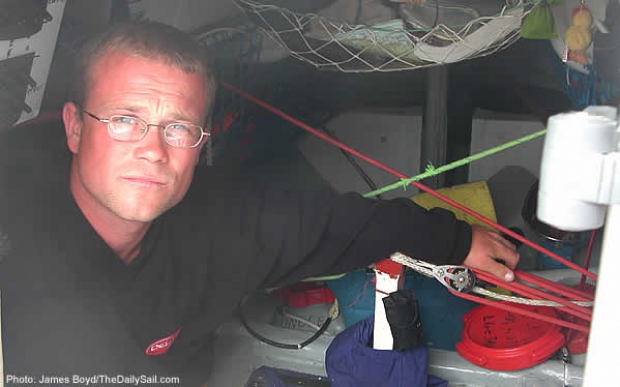
Ian Munslow
More tales from the Mini Transat
Thursday October 23rd 2003, Author: James Boyd, Location: Transoceanic
Ian Munslow was the first British sailor to finish the Mini Transat, arriving in Salvador de Bahia 14th in the proto class to finish 14th overall.
"I could have been five places higher, but just the weather conditions were heinous," recounts Munslow in his characteristically frank way. "We were upwind from 10degN to 13degS. Every skipper has been saying it was the most tedious experience of their life... in foul current and upwind all the way."
Like Irishman Cian McCarthy Munslow was up to 8th at one point only to lose out by going too far west once into the South Atlantic. "I ended up pinned on the coast [of Brazil] and I just couldn’t get lifted off while everyone further offshore had more pressure and they were sailing freer - they just pulled out the miles," he complains. "You could see them. Like David Raison [one time leader of the Series class] was five miles further east and he just came through me - I could do nothing. You think you can get close to the coast, the wind will dial and you’ll be going downwind - but no way, it just didn’t play ball at all."
After a relatively light wind first leg, the start of leg two was in brisk downwind conditions. This separated the smart from the stupid. "The first night out of the Lanzarote it was crazy. Everyone was just going mad," says Munslow. "It was 25-30 knots downwind in big seas and some guys were getting a little bit stupid with the kite. At midnight I was doing constantly 14-15 knots with a small kite and two reefs and you just can’t sustain that, especially with two or more weeks coming up. So you say to yourself ‘na, I’ll just get the jib up and get some kip and not lose the mast now’." A number of competitors came unstuck at this time, most notably Fred Duthill, one of the race favourites and Ghislain Dendron, who both dismasted. Another competitor later claimed he saw 22 knots on his log that night.
According to Munslow the misbehaviour of the weather started after the Cape Verdes, when the Trade Winds failed to materialise. "The wind was northwest and it never went to the easterly section," says Munslow. South of this the Doldrums were unusual in that he suddenly broke into light south southwesterlies. "Your tacking angle from 10degN was like you could make 150deg or you could make 260-270deg - it was just crap."
Beyond 2degN Munslow says he was back under a blue sky again and the wind was southeast or southsoutheast, consistently shifting but with no great pressure. "You could get 5-6 knots out of the boat, but with a knot of current against you.."
The real treat for competitors was left until the finish as a slow moving front moved north up the coast forecast to bring with it gusts of up to 40 knots. It was in these conditions that race leader of the time, Sam Manuard, was dismasted just 80 miles from the finish line. At the time it was blowing 30 knots with the sea whipped up badly.
"I was eight miles offshore and the sea was big," says Munslow of this period. Off the coast of Brazil the water remains shallow a considerable way off the coast and in big winds the seas here can be hideous. Munslow says that he had to get into deeper water or he was sure to lose his rig too. In fact the worst of the weather only lasted around 10 hours.
Munslow arrived in Brazil less of a man than when he started. He had run out of gas just after the Cape Verdes, forcing him to eat raw freeze-dried food, which he subsequently began to run low on food. "I didn’t take enough food which wasn’t very smart, so I lost 9 kilos - I’m a bit thin. With 1200 miles to go I had 12 meals left. So I had a meal every 100 miles." However his predicament was not as bad as that of Bertrand Lecharpentier in the series class, who forgot to load on his food for the second leg and who had to survive on a small amount of dried fruit and tuna salad for the three week passage to Brazil.
Overall Munslow says that this last leg was not something he wants to repeat. "It was boring. Every skipper arrived saying it was grim. There was no great enjoyment in it. If you are going to sail in a 21ft boat you don’t want to sailing upwind for two weeks. Last time the weather was more favourable and it was a lot more fun."
He adds "I had no breakages other than one batten in the mainsail and my specs, so I now look like an uncool Harry Potter with my old spare held together with tape and I got really bad sunburn on my backside when I was trying to dry my very spotty arse."
From here his Mini Ishtar goes back by ship to Tilbury and then is up for sale. Personally now with two Mini Transats under his belt Munslow says he would like to move up the food chain a bit and see if he can secure a sponsor for a bigger boat. "I’d love to do it in a faster boat but I’ve got to think about moving away from Minis and growing up a bit. They are good fun because at times they are awesome, but at other times it is pretty tedious. Doing 4 knots for days on end is not something you want to dream about and spend all your money on. At 12 knots it starts being nice and all worth while. But when you do 4.5 knots for a week the wrong way you think this is a very expensive way of boring myself senseless..."

A man who Munslow took a tenner off on this leg - subsequently lost as they crawled through Salvadors bars on their arrival - was Irishman Cian McCarthy (above). McCarthy finished an impressive fifth on the first leg and at one point was up to sixth on this leg. Ultimately he finished 18th in the protos on this leg and to come tenth overall on combined elapsed times - not a bad result considering that McCarthy's Mini The Tom Crean was severely disabled for the duration of leg two.
Within 24 hours of leaving Lanzarote his forestay broke. "It was a **** long race - two weeks upwind - without one, I wouldn’t recommend it." McCarthy says there was a rod failure at the top of the stay. "There wasn’t an incident where it went bang. Just the first morning it was hanging off my jib halyard. It was just one of those things. I’ve been happy with the mast all year. The rods were new this year. There is only so much you can do..."
Once spotted McCarthy headed downwind, took the caps off, wound the rig forward, tensioned up the halyard, put the caps back on and tensioned the halyard back up with the runners. This worked but was far from perfect. "With halyard stretch it’s not up to it. Even the jammer has got slippage in it. Then you have to take it off the winch every so often to do another job and you lose a bit more. So you’ve just got to settle for 9-12 inches of forestay sag. I don’t think it is particularly slow but you just can’t point. And after the Doldrums it was upwind and you just have to resign yourself to it..."
McCarthy, like Munslow, headed west across the Doldrums a move that paid great dividends but only in the short term. "All the climatology I had said it was likely to go easterly after the Doldrums so I thought at the Cape Verdes I had a westerly gybe I could take that was probably making and I thought after that once I got through the Doldrums I could come back east on the light easterlies. But it never materialised and I ended up too far west..."
The Doldrums, says McCarthy, wasn’t a big deal. "I had two nights of Doldrumy rain squalls but there was no great punch in them and it was not a big deal. I was not really becalmed. I was a long way west, over 27 west, so you’re not really in the Doldrums to be honest."
Once he was out of the Doldrums and on the wind McCarthy says he lost out big time. "It was very hard for me to make an impression and I just had to be careful with the mast. There are five boats here without rigs and I’m lucky to have mine here. Whenever the weather got dirty I just looked after the boat. I didn’t make any attempt to be stupid with it."
Aside from the forestay he broke very little. "I broke my rudder chainplate pins and the runner went flying past my head with the masthead kite up which wasn’t particularly fun and just keel block lashings but nothing I couldn’t fix within 10 or 15 minutes. I had no hours of downtime because of serious breakage.
Like Munslow, McCarthy's overall impression of leg two was the tedium. "The solitude didn’t bother me. I’m quite comfortable at sea, I quite like being out there. I am quite content to be out there. But two weeks is a long time to be going upwind in a Mini - it is not a huge amount of fun and it’s not what you design a Mini for. It is a pity because my boat is actually very good upwind."
Unlike Munslow, McCarthy intends to be on the start line again in 2005 in the same boat (both Munslow and he have Owen Clarke design, but McCarthy's is newer and professionally built).
"I’ve got some improvements in my head. There are carbon rigs next time, so I’m going to look at that when I get home if I can afford it. So I’ll try and do that for the boat for next year. I still have a lot of improving to do as a sailor on the boat just to get better at sailing it. And most of my sails I need to sized up a bit because it is a very powerful boat and it needs area to drive it. There are lots of improvements I can do. Fitting a carbon mast might sort out the keel so it might pass the stability test. I need to look into all this when I get back, to find out what the cheapest way to do it."
In many ways Munslow and McCarthy were lucky to make it to Salvador in one piece. Jean-Baptiste Dejeanty on Artech-Caen la Mer collided with a whale, virtually writing off his Mini - dismasted and nearly losing its keel. His boat was towed into Recife by one of the Mini's mother ships.
Aside from the devasting dismastings of Jonathan McKee and Sam Manuard while both were leading the Mini, similar disaster befell Mini veteran Michel Mirabel who put in a dramatic upturn in speed in the closing stages of leg two to take the lead in the series class. Shortly before crossing the finish line Mirabel fell asleep and ran his boat on to the rocks off Salvador's lighthouse - just two miles from the finish line...
Kiwi Mini sailor Chris Sayer would have finished fourth on this leg had he been an official entry and despite returned to Lanzarote to fix his bowsprit shortly after the start. Sayer finished just ahead of Jonathan McKee on the first leg and had he been in the race would have probably finished second overall.
Most Read
Most Commented
Comments
Businesses

Pro businesses
Editor's choice
Member blogs
-
 Ned Collier Wakefield: MOD70 round BarbadosWell that was intense. 12 hard fought for seconds for the win. In idyllic conditions, Tony Lawsons MOD ...
 -
 Mini Transat leg 2 reportThe second leg of the Mini Transat started on 31st October, just over a month after ...
 -
Leg 1 reportI’ve been working towards the Mini Transat now for three years. In 2013 I was part ...
Business blogs
-
 The Island Sailing Club in Cowes, Isle of Wight, is delighted that Prince Michael of Kent ...
 -
Peta Stuart-Hunt chats with the 25 year-old British solo sailor Lizzy Foreman before she sets sail ...
-
The 2015 Student Yachting World Cup (SYWoC), an ISAF-recognised event hosted and run by students for ...
Editor's Choice
All time favourites...
-
 Three legs down into Ian Walker’s
 -
 Winning all but two races at
 -
 For the first time in its
Latest Comments
Add a comment - Members log in