
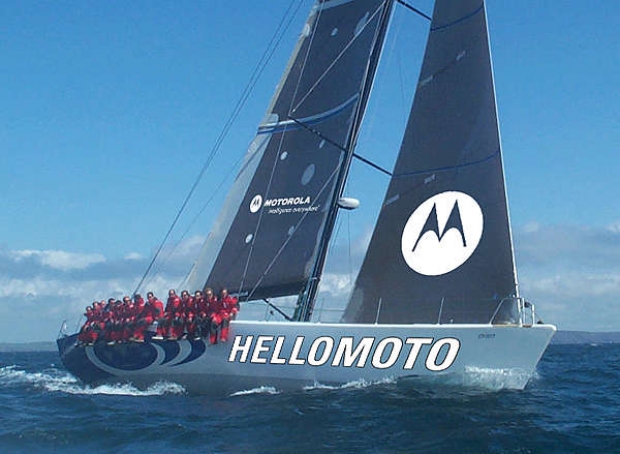
Conrad Humphreys hooks Motorola
Wednesday June 18th 2003, Author: James Boyd, Location: United Kingdom
Getting to the start line of the Vendee Globe is no mean feat even if you already have some profile and are the winner of the 2000-01 BT Global Challenge. However today Conrad Humphreys has taken a definite step in the right direction by securing the backing of mobile telecoms company Motorola, the global leader in wireless, automotive and broadband communications.
The deal will at this stage enable Humphreys to compete in the Rolex Fastnet Race in August aboard a Volvo Ocean 60 and subsequently to charter a boat for the two handed Transat Jacques Vabre from Le Havre to Salvador de Bahia this November. Humphreys will also be sailing his old Challenge boat, rebranded Hellomoto, in this Saturday's Round the Island Race.
For the Fastnet they will be racing Kevin Shoebridge's old Tyco, recently sold to Hamish Oliphant and now based down in Plymouth. Oliphant will be using the boat to race in major events such as the Fastnet at a more competitive level than he has been to date as well as for corporate work. The partnership between him and Humphreys' company O6T is an obvious one as they are both west country-based . For the Fastnet Humphreys says that they will be taking 2-4 Motorola guests on board and more on the Round the Island.
The clever part about this news is the way Humphreys has managed to bring Motorola on board.
"I think a lot of companies when they are looking at their whole sponsorship programs will say ‘what does this sport really deliver? There’s the whole Bols thing, what we think of as the ultimate sponsorship - a proper thought-out campaign with a product placement, etc etc But what we’ve done is completely different. It isn’t about consumer branding of a product of Motorola’s. It is saying that if Motorola can build a better relationship with TMobile, Orange, O2, Volvo, BMW - all major customers of Motorola’s - and if we can improve their communication and teamwork and abilities on the water and build trust between these organisations, they’ll do better business together."
 Central to Humphreys' attack has been the corporate executive development and training offered by his company. This involves days out on the water either on the Challenge boat or the former Tyco, but Humphreys says a majority of the training he carries out at various corporate HQs.
"Probably 90% of what I do goes into the company’s premise," he says. "This year I have built this new ocean racing leadership simulation with Henley Management College and that allows us to effectively race business leaders against each other around the globe, taking strategic decision based on a round the world yacht race that parallel their business lives. That simulation has been one of our key projects in the portfolio for our leadership work. And that has really got business leaders thinking about ocean racing.
"One of the biggest growing areas of leadership training in both the UK and America at the moment is this metaphor-based training and ocean racing perfectly mirrors a lot of difficult business situations.
"To give you two or three examples: One of the programs we run is on communications and speed - two really important factors in ocean racing and in the world of business. Another one is how do you win in highly turbulent times such as 9/11 and a difficult economy this year has been a real hardship for a lot of companies including the Telcoms who have been in real difficulty since the dotcom crash. So we take the exact lessons of what you do approaching a big storm in the ocean and use that to teach business leaders what to do in their businesses which is really cool.
"I think from a sponsor’s perspective, it puts ultimately puts less pressure on the PR element. Sailing still isn’t the most high profile sport in the world. Motorola will will chose bigger higher profile sports to get their name out there. But sailing is a brilliant sport for teaching teamwork and leadership and because it is a clean, healthy image sport as well.
"The great thing is that big ocean races parallel business years and if you try and compare Steve Redgrave doing a 2 minute sprint, the lessons are motivational and he is a motivational guy, but you can’t easily take that as a business metaphor. Whereas ocean racing has that ingredient. You go through quiet times in the Doldrums, you suffer severe turbulent times in the Southern Ocean, how do you sustain performance through the Doldrums, how do you win in highly competitive situations such as race finishes, etc. It has all those ingredients that provide a great environment for learning good team work."
This approach has clearly worked for him. "I’ve been lucky to have built up a solid motivational and team development organisation and that’s kept everything running and been getting us into the right level of people to speak to about the campaigns and projects," says Humphries. "We’ve been working with a lot of companies this year from Pfiser to Microsoft and obviously Motorola and just keeping those relations running with good team leadership programs which have ultimately got us out on the water doing things with them which have led to further interest and now funding."
The burning issue at present is over the boat he will sail in the Transat Jacques Vabre. Humphreys says they have the budget to get a potential race-winning 60, although not the budget to re-equip it with new sails. A deal has yet to be finalised. Kingfisher and Mike Golding's Ecover 1 are in theory possible choices, but if neither of these come off then Humphreys says he would prefer to race the TJV in a race winning Open 50 such as the former Cray Valley which Nick Moloney sailed in the Route du Rhum, rather than a second rate 60.
"The key thing for us is to get a good result and have a good clean campaign with a good sponsor," he says. "If we get to the other end in good shape and on the podium then I’ll be absolutely delighted, but we have a long way to go in terms of preparation and effort to get there."
Humphreys hopes that whatever boat they end up with he will start training on board from the moment the Fastnet is over. From that point Humphreys says he will be concentrating on his own personal development as a short-handed sailor on an unfamiliar boat. " I am the first to admit that we could spend a lot of money on equipment, but I’m realistic - to date I’ve done to date 1,500 miles offshore on my own and about 15 days of shorthanded sailing. So our best preparation will be time on the water as always."
With any luck Humphreys will have more success in the Transat Jacques Vabre than he did when his Open 40 dismasted in the Bay of Biscay in last year's Route du Rhum, his first ever solo race.
"It was one of those moments - something we had to put behind us and move forward," says Humphreys. "Luckily we did that pretty quickly. You also learn an enormous amount from those situations. The key thing from that moment was being out there on your first solo race when you lose you rig - we were in good company, but more importantly it taught me that if I didn’t want to be out there at that moment in time, then I’d comeback and give up the solo stuff. But I found that even with the rig over the side it was still quite enjoyable out there." This sounds like retrospect talking...
"In hindsight you look back on these things," he continues. "It was bloody tough when it happens but you cope with it and you come out a lot stronger because of it. It’s not an experience I would have wanted to have but having chalking it on the side of your arm, it is a good one for the future."
At the time of the dismasting he was in the middle of the Bay of Biscay with the storm brewing to the west.
"I sailed back to Brest under jury rig with the boom. I did 9 knots with the boom up! I was motoring as well and about half way through I had to do a fuel transfer. There were these amazing majestic waves just picking us up and surfing us down and we were only making 4.5-5 knots under engine with a bit of sail, so I thought it was a good time to go and transfer some fuel. This involved feeding a pipe on deck and into the fuel filler. Just as I got the tap off and I was down below pumping fuel across, I heard this massive gush of water and we were just surfing down this wave, broached on to our side and were carried sideways and filled the cockpit and the inside of the boat. So I thought that was it - the fuel was going to be full of sea water, but luckily it wasn’t."
Regarding his Vendee plans the obvious hope is that Motorola will extend their contract and fund a new boat.
"We’re getting very close to a deadline for a build," says Humphreys. "Really September is the draw the line in the sand time when we say ‘no, we’re not going to be building new’. And then it is a case of chartering. The decision on that will bottom out after the Jacques Vabre. After that we’ll start to understand the programme we’ve got for next year. Ultimately we have to be on the start line of the OSTAR with the boat we are going to be sailing in the Vendee if we’re going to be there at all.
"So at the end of TJV, I’ll be saying we’ll be on for the Vendee or we’ll be looking at 2008 and we’ll go for Around Alone. At the end of the day we’re not pushing the boat out here to be the youngest, fastest or whatever. Those records have already been smashed. I would like to complete a good solo transat as my third round the world. The best place is still the Vendee, but we’d like to be there with a good credible entry."
At present Humphreys says that he hasn't chosen a designer. He has been fortunate to have sailed in fully crewed races or deliveries on a number of different Open 60 designs.
"I did the EDS and stuff with Mike [Golding] originally. I did the transatlantic from Bahia back to the UK on Kingfisher and I sailed quite a bit on Hexagon last year when the boat arrived in Zeebrugge - taking it over to London with Graham [Dalton] and down the south coast. I’ve got about 15,000 miles on the 60s, but more importantly having sailed a range of boats, I’ve built up a picture of what I’d like to see on a Vendee boat."
But it is his approach to getting sponsorship that sounds like a real winner. "You’ve got to find some way of getting a sponsor to think ‘absolutely, we’re committed to this’ and I think it is a dimension that more and more sponsors will take on and if they haven’t thought about it they’ll start to."
Most Read
Most Commented
Comments
Businesses

Pro businesses
-
-
United Kingdom
-
United Kingdom
-
Italy
Editor's choice
Member blogs
-
 Ned Collier Wakefield: MOD70 round BarbadosWell that was intense. 12 hard fought for seconds for the win. In idyllic conditions, Tony Lawsons MOD ...
 -
 Mini Transat leg 2 reportThe second leg of the Mini Transat started on 31st October, just over a month after ...
 -
Leg 1 reportI’ve been working towards the Mini Transat now for three years. In 2013 I was part ...
Business blogs
-
 The Island Sailing Club in Cowes, Isle of Wight, is delighted that Prince Michael of Kent ...
 -
Peta Stuart-Hunt chats with the 25 year-old British solo sailor Lizzy Foreman before she sets sail ...
-
The 2015 Student Yachting World Cup (SYWoC), an ISAF-recognised event hosted and run by students for ...
Editor's Choice
All time favourites...
-
 Three legs down into Ian Walker’s
 -
 Winning all but two races at
 -
 For the first time in its
Latest Comments
Add a comment - Members log in