
Upwind Round Britain
Thursday July 24th 2003, Author: James Boyd, Location: United Kingdom
The Calais Round Britain Race proved to be one of the closest races the IMOCA Open 60 fleet has ever seen with boats finishing just minutes apart and race winner, Vincent Riou's
PRB only making a small break away from the chasing pack on the final day.
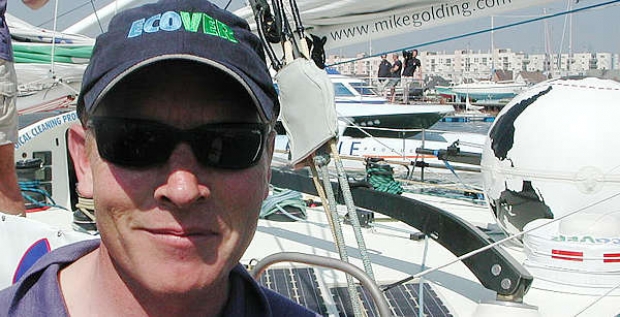
Partly the high competition was down to a good fleet: of nine boats taking part seven had the potential to win. Ecover skipper Mike Golding gave TheDailySail his views: "It was a great race. It seems like a very good course. You don’t traditionally do round Britain without stops, so you don’t get an impression of the true nature of the course. But the course was so tactical it kept the boats together and the positions changing. From an on-board point of view and for the people ashore it was a good event to participate in and to follow."
Weather-wise the course could not have been less ideal for the Open 60s. While modern Open 60s are considerably better upwind than older generation boats, they still suffer on this point of sail - and after a fast run down the Channel following the start, the crews found themselves beating or at best fetching for the rest of the race.
"When we beat our way up to Muckle Flugga and turned the corner and had to beat back down it seemed a bit wrong!" says Golding. "The wind followed us around every corner after the Scillies. So not ideal for the old bus..."
Since Ecover was launched Golding has been maintaining a constant campaign of improving her upwind performance by for example, enlarging her daggerboards. Now his flat bottomed, beamy Groupe Finot design can hold her own on this point of sail - just...
"We were with Sill yesterday, half amile apart and the breeze got up to over 20 knots and we climbed away from them – we had good height - but they had more speed and consequently were gaining towards the mark quite significantly," said Golding. "In the course of six hours they pulled out five miles straight. What it shows us is that we made some pretty smart tactical choices during the race to hang in where we were."
Golding admits that Sill's torn Solent worked to their advantage, but there was one key moment coming down the North Sea, where they won out.
"We were on the left hand side of the fleet coming down the North Sea with Bobst on the shore and PRB and Sill in the middle and we saw a situation arising where Bobst appeared to be doing slightly better than PRB and Sill and we were on the outside of a shift that was coming in from the right. So we tacked to the right, crossed in behind Sill and PRB on an unfavoured tack for three hours, but gained significantly on both boats and caused us to overtake Bobst...
"We felt that although the right hand shift would happen, because it was so sunny and clear and we were seeing clouds over the land during the day that any right hand shift would be killed by the sea breeze. You’d end up with an along-the-shore breeze which would be a header, whereas we were sailing in slightly more lifted conditions, further offshore, but we still had more right hand shift than Sill and PRB."
On board Ecover the problems were more electrical in nature. "The tactical computer crashed completely," said Golding "I think it was because Brian asked me to do a routing calculation for the entire course at five minute intervals!" From St Kilda on they were unable to download any weather information from the net and had to resort to getting forecasts from Radio 4 and from the coastguard via VHF. "We benefited from the French contingent perhaps not understanding that as well as we could. But then I’ve spent a lot of time listening to French forecasts and not having a clue what they’re on about!"
With no routing software the crew resorted to paper charts once they'd located a pencil and dividers. "The dividers had to be dug out and sharpened and then we were doing traditional plots which is time consuming compared to flashing things up on screen, but it doesn’t materially affect you on the course."
Ironically had the course been around Britain anti-clockwise, the boats would have been able to set a much faster time. "We were looking at it about four days into the race," says Golding. "A boat could have started four days after us and got round before us going the opposite way!" When the race was originally conceived by the Challenge Business the course was anti-clockwise, but when the new race organisation took over it was changed.
Should this race happen again, a much better solution would be to decide the route 24 hours before the start. "It would have been interesting if you could have sat there the day before the start and said ‘let’s go the fast way.’"
Golding thinks that their result might have been entirely different if it had involved more downhill sailing. "Going down the Channel we were smoking - reeling them in."
The race has proved that Vincent Riou's PRB is now an Open 60 to be reckoned with following her extensive refit and the fitting of her new traditional mast arrangement over the winter.
Ecover returns to her base in Ocean Village, Southampton later this week before being readied for the Rolex Fastnet Race. This is likely to be Golding's last race aboard her before his new Open 60 arrives from New Zealand early in September.
Most Read
Most Commented
Comments
Businesses

Pro businesses
Editor's choice
Member blogs
-
 Ned Collier Wakefield: MOD70 round BarbadosWell that was intense. 12 hard fought for seconds for the win. In idyllic conditions, Tony Lawsons MOD ...
 -
 Mini Transat leg 2 reportThe second leg of the Mini Transat started on 31st October, just over a month after ...
 -
Leg 1 reportI’ve been working towards the Mini Transat now for three years. In 2013 I was part ...
Business blogs
-
 The Island Sailing Club in Cowes, Isle of Wight, is delighted that Prince Michael of Kent ...
 -
Peta Stuart-Hunt chats with the 25 year-old British solo sailor Lizzy Foreman before she sets sail ...
-
The 2015 Student Yachting World Cup (SYWoC), an ISAF-recognised event hosted and run by students for ...
Editor's Choice
All time favourites...
-
 Three legs down into Ian Walker’s
 -
 Winning all but two races at
 -
 For the first time in its
Latest Comments
Add a comment - Members log in