

From on board Kingfisher2
Monday February 3rd 2003, Author: Preece/Altadill, Location: Transoceanic
 Andrew Preece reports from on board
Kingfisher2
Andrew Preece reports from on board
Kingfisher2
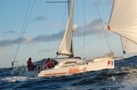
Today has been a day of action. At around 0800 the ‘all hands’ call came from the deck watch to help get the big gennaker down; there was a small tear in the tack and our sailmaker Bruno Dubois wanted to fix it before it had a chance to spread. While Neal McDonald dialled the boat down in around 20 knots of wind, every other crew member except Hendo on the halyard dived for the foot at the edge of the boat to bring the beast under control. We wrestled it down, took ten minutes attaching sticky Kevlar to the small wound and then it was all hands to the halyard to pull it back up. Within 15 minutes we were back up to over 20 knots.
For me that was followed by an interesting breakfast: yesterday I missed the porridge and settled for muesli scrapings with powdered chocolate Nesquik and water. Today Ellen was kind enough to put some porridge aside for me in my bowl. Unfortunately, last night I had given the remnants of my cod stew to Nigel (who has started loitering in the galley at the end of mealtimes to finish off anything that anyone leaves). He ate the cod stew but I think he only gave the bowl a cursory rinse. Cod stew flavoured porridge is not the greatest thing to wake up to but I ate it all!
 The next thing that happens is a burning smell starts pervading the starboard hull. A sprint to the galley revealed nothing but soon we worked out it was coming out of the back beam. A trip across the net and I find Ronny and Jason upended in the generator compartment. For a while we couldn’t identify the cause until we saw sparks coming off the alternator; a couple of the wires had worked loose and were heating up. 20 minutes later and Ronny is giving the Gallic thumbs up. We are making electricity again. To celebrate, Hendo brings out the soap and washes his hair in the next squall; the rinse off takes place at the stream at the bottom of the mainsail.
Tactics-wise we are at a tricky stage. We carried the wind jetting south at high speed until early morning but we have run into an area of squalls which suck the air off the water and spit it out unpredictably: either you get nothing or 35 knots. The course is starting to weave as we head off in the gusts and come up in the lulls but generally Ellen and Meeno [the shore-based router] are worried about getting too far west; we are already at the longitude that we need to be at the Equator and we are still at 28 degrees north. The problem is that there appears to be less wind to the east right now so if we cut south we risk sailing out of the best pressure. The next couple of days will be crucial.
 Kingfisher2
's Spanish watch leader, cat specialist and former
Club Med
(and
ASSA ABLOY
) crewman Guillermo Altadill gives his version of events:
Kingfisher2
's Spanish watch leader, cat specialist and former
Club Med
(and
ASSA ABLOY
) crewman Guillermo Altadill gives his version of events:
For me sailing on Kingfisher2 for the Jules Verne is a new challenge. I was on board Club Med for The Race and this is now my fifth circumnavigation (and also my last). In theory this kind of record should be less stressful racing against the clock rather than against other boats. But if you see how we raced in The Race and you see how this record is getting more competitive, you can see that this kind of sailing is getting harder: in The Race, when we got a guy 1000 miles behind us we started sailing conservatively. Here, in the Jules Verne, you can’t do that because you never know what will happen in the future. So it is like sailing with an opponent just one mile behind all the time.
We have Orange’s and Geronimo’s positions but the only positions that are important are those of someone who holds the record and not someone who is actually on the record. It’s good to have a boat ahead to help push as along but to me it doesn’t mean much.
I think we are pushing the boat as hard as we raced Club Med, perhaps a fraction more because we know more about the boat than we did in The Race. The worst thing with these boats is going upwind. It is then when you start to get problems that affect the structure of the boat so we have to try to avoid these kind of winds carefully.
But so far I am enjoying myself but I know that in these round the world races you enjoy the beginning and the end and occasionally in the middle.
I think we are in good shape to take this record but like all these things we must avoid mechanical breakdown and we will also have an eye on Geronimo ahead of us; if they pass Cape Horn ahead of the record then the final stage north will be better for them than for us as a trimaran should be faster in headwinds we will see from The Falklands to the Equator. This is the toughest part: in The Race we had structural problems hammering upwind at this time and with Orange, Bruno Peyron was well ahead of the previous record and had to slow down to get north.
Guillermo

Most Read
Most Commented
Comments
Businesses
Pro businesses
-
United Kingdom
-
-
United Kingdom
-
Editor's choice
Member blogs
-
 Ned Collier Wakefield: MOD70 round BarbadosWell that was intense. 12 hard fought for seconds for the win. In idyllic conditions, Tony Lawsons MOD ...
 -
 Mini Transat leg 2 reportThe second leg of the Mini Transat started on 31st October, just over a month after ...
 -
Leg 1 reportI’ve been working towards the Mini Transat now for three years. In 2013 I was part ...
Business blogs
-
 The Island Sailing Club in Cowes, Isle of Wight, is delighted that Prince Michael of Kent ...
 -
Peta Stuart-Hunt chats with the 25 year-old British solo sailor Lizzy Foreman before she sets sail ...
-
The 2015 Student Yachting World Cup (SYWoC), an ISAF-recognised event hosted and run by students for ...
Editor's Choice
All time favourites...
-
 Three legs down into Ian Walker’s
 -
 Winning all but two races at
 -
 For the first time in its
Latest Comments
Add a comment - Members log in