
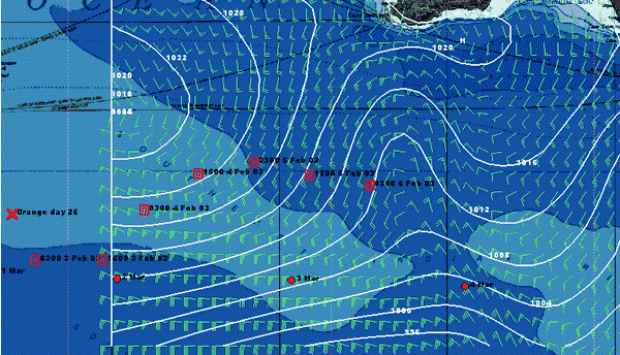
Red dots = Cheyenne's progress, Red square = Geronimo's 2003 run, red cross = Orange's 2002 record
Another record in the bag for Fossett
Thursday March 4th 2004, Author: James Boyd, Location: Transoceanic
Yesterday Steve Fossett and the crew of his maxi-catamaran
Cheyenne set a new record from Ushant to the longitude of Cape Leeuwin, southwest Australia. They achieved this in a time of 25 days 14 hrs 8 mins beating the previous record of 26 days 4 hours 53 minutes and 13 seconds as set last year by Olivier de Kersauson on
Geronimo.
There has been another enormous daily run deep down south for Cheyenne who in the 24 hours up until 0505GMT this morning sailed 577 miles. Under two reefs and storm jib the boat was reaching speeds of 36 knots. This has left Fossett's maxi-cat some 1,474 miles ahead of Orange's 2002 record and some 360 miles ahead of where Geronimo was at an equivalent stage of her attempt last year - and remember everyone thought Geronimo was outstandingly fast. Cheyenne is also benefitting from sailing a shorter course some 350 miles south of Geronimo.
Cheyenne looks like she will be able to maintain a similar performance for at least the next two days. The next tactical challenge will seeing how a high pressure system over New Zealand will affect the depression they are currently riding.
 From on board Cheyenne Brian Thompson writes...
We are only 30 miles from the longitude of Cape Leeuwin at the SW tip of
Australia. That’s not to say we are anywhere close to the long beaches and
brilliant summer sunshine of Western Australia, as we are 1000 miles to the
south and enjoying overcast skies, drizzle and a temperature of 3 degrees
C - more like the Western Approaches in winter.
On the plus side sailing conditions are great for churning out the miles; we
are in 25 to 30 knots of wind at 115 TWA, with 2 reefs and the staysail.
Earlier today the wind speed was up in the mid thirties and we had the storm
jib, and for a time a reefed storm jib, coupled with the double reefed main.
As always the sea state is the limiting factor on boat speed. In flat water we
could be doing 35 knots with more sail, but in these slightly confused seas
we are keeping our speed between 22 and 32, depending on whether or not we
are surfing on the long westerly swell. Gino Morrelli and Pete Melvin, the designers
and Cookson Boats, the builders, have done a great job on creating a
Southern Ocean speed machine. We have not once yet put the front beam into
the waves (touch wood) and the seas are hitting the back beam first, which
being flat faced, does create a cascade of spray. It appears to be holding
up well. We have had only one solid hit to this beam where the boat speed
went from 25 to 17. Occasionally we hit the main beam, but this is not as
noticeable.
Matching the boat speed to the sea state, and if possible not putting ourselves
into a position where we are limited by the seas, is very crucial to this
record. We are confident we have a strong boat, but everything has its
limits and we are being careful to minimize the danger to our structure. We
are not overstepping the boundaries of how we have sailed the boat before in
shorter records. Of course the sheer distance of the course, the three and a
half weeks in the Southern Ocean may cause some fatigue so we have to take
that into account as well. Most of the maxi cats, and the 60 foot tris, have
had problems with their beams and their bows in rough conditions so we must
be ever vigilant.
We are doing excellently on the record, being more than 3 days and 1377
miles ahead of Orange at the same time. We are also going to improve on the
best time from Ushant to Cape Leeuwin, set by Geronimo last year. We clocked
a voyage best 585 mile day yesterday and are also looking at several more
days of reaching or one gybe conditions, where every mile sailed takes us
straight down the course.
At the latitude of 50S every degree of longitude is 38 miles apart, and at
45S they are 42 miles apart, so there is about a 10% difference due to the
shape of the globe. In one 500 mile day at 50S we can gain 50 miles in
easting on a boat at 45S (which is the typical maxi-cat track in the Indian
Ocean) The potential downside is stronger winds, a bigger sea state, iceberg
risk and a chance of getting on the wrong side of a low. So it is a
calculated risk and one that Steve, Adrienne and Commanders Weather is
watching carefully just as we are closely monitoring the state of the boat.
The same risk/reward analysis has to be assessed in every decision we make.
Is it the correct choice for our goal of this round the world record, are
we being too conservative or too bold? There is always a range of opinion
but we are all focused on the target and so far making the right calls. We
still have all our sails and all our equipment is working well. The structure seems solid and our route has taken us on a smooth and short course sailing out of storms and calms. Our multinational team is in great spirits, no friction anywhere and the all important sense of humour is intact..Everyone is healthy and taking care of themselves. What more could
you ask for?
Brian
Most Read
Most Commented
Comments
Businesses

Pro businesses
-
Italy
-
United Kingdom
-
-
Editor's choice
Member blogs
-
 Ned Collier Wakefield: MOD70 round BarbadosWell that was intense. 12 hard fought for seconds for the win. In idyllic conditions, Tony Lawsons MOD ...
 -
 Mini Transat leg 2 reportThe second leg of the Mini Transat started on 31st October, just over a month after ...
 -
Leg 1 reportI’ve been working towards the Mini Transat now for three years. In 2013 I was part ...
Business blogs
-
 The Island Sailing Club in Cowes, Isle of Wight, is delighted that Prince Michael of Kent ...
 -
Peta Stuart-Hunt chats with the 25 year-old British solo sailor Lizzy Foreman before she sets sail ...
-
The 2015 Student Yachting World Cup (SYWoC), an ISAF-recognised event hosted and run by students for ...
Editor's Choice
All time favourites...
-
 Three legs down into Ian Walker’s
 -
 Winning all but two races at
 -
 For the first time in its
Latest Comments
Add a comment - Members log in