
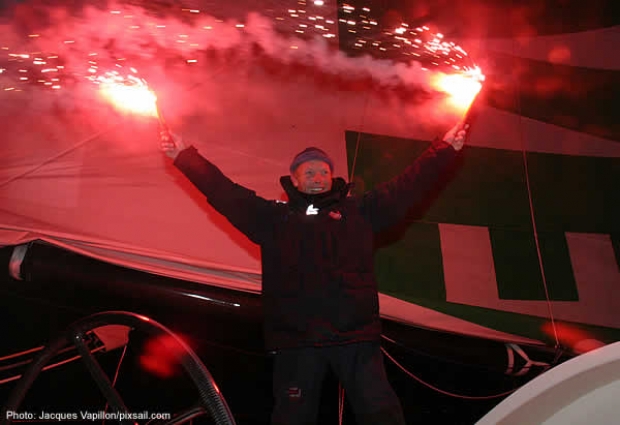
Golding victorious
Wednesday December 17th 2003, Author: James Boyd, Location: Transoceanic
The last few years have been frustrating in many ways for Mike Golding. The launch of his last Open 60 saw him demolish the opposition in the first leg of the 1998 Around Alone only to come acropper running into the north island of New Zealand. Since then his Open 60 has consistently proved to be fast, a podium finisher, but never a winner.
Now Golding is kitted out with his new Open 60, an Owen-Clarke design with the added benefit of many thousands of miles of racing and five years hindsight, and he back into winning mode.
The new Ecover was all set up for a win in the recent two handed Transat Jacques Vabre until spinnaker halyard chafe issues left them with a shortage of kites on a predominantly light downwind course.
On the Defi Atlantique singlehanded return race from Brazil to La Rochelle victory also seemed to be slipping through Golding's fingers as the fleet divided with Virbac and AT Racing heading west and the rest heading east. "That did cut the race up a little," says Golding. "For a while it looked like it wasn’t going to work and then all of a sudden it worked rather glamorously. If you ran that race 100 times, it wouldn’t work 99 of them, but it did and Alex stuck to his guns and stayed out there even when it looked like it wasn’t going to pay. Meanwhile Virbac was on his way back to the rest of us. He’d obviously had enough of it and decided to cut his loses whereas Alex stuck to his guns and kept going which was frankly a pretty cool move. I don’t know how you adopt such an unconventional strategy from so far out. It was some call. I suspect they were comfortable because the two of them went off together. You say “let’s give it a shot and at least there is another numpty there if it all goes wrong”."
The rest was the Virbac lost their rig while Thomson's flier to the west put him into a band of strong southerlies that ultimately saw him break the solo monohull 24 hour record and pull back into first place.
Golding meanwhile had taken the easterly option, but had just managed to lose his grip on leader Vincent Riou's PRB. "The whole of the course back from Brazil there was really strong gradients across the course," said Golding. "Being 10 miles one way or 10 miles the other, you could reap massive gains or losses. I fell behind PRB by being 30 miles too far east. Even though I was sailing the boat well, I was always in less breeze and slightly more headed and I just couldn’t get out to where she was. And the whole course was like that."
Golding's big break came just before rounding the corner at Cape Finistere to head into the Bay of Biscay. Golding says that although his boat is quick upwind at the time he wasn't on that point of sail.
"My getaway took place beating, but my pass was reaching, code sailing which was interesting because I didn’t have any code sails. It was more to do with where you were on the course. PRB and AT Racing had taken the shortest route and a hole was developing right where they were and there was just a little more gradient to the west. VMI and I saw that happening and shuffled our way across there very gently. So I was only 30 miles across the course from AT Racing but that was enough to allow me to not only catch but to catch up. Alex and I met up as we went away from Finisterre and we were side by side for a while."
From there is was a one tack beat in building breeze to around 50 miles from the finish when it turned into a full-on beat, conditions in which Ecover excells. Last night Golding had 35 knots over the deck. "Again by being ahead I was always in a little more breeze, I was always just a little bit better off, and again it was this business of being on the right side of the gradient. Yes, we are fast upwind, but also by being where I was I was just that little bit better off than the guys behind. I have never known a race to be so controlled by gradient across the course."

Golding's race also nearly came acropper when off the Cape Verdes Ecover suffered a collision possibly with a whale, although Golding admits he has no idea what he hit. The impact destroyed the sacrificial fore-foot to the bow but left the integrity of the hull intact - as it was designed to. This cannot have helped the boat speed and Golding says there was certainly a lot more water coming up over the bow as a result.
While the Transat Jacques Vabre saw Golding unable to use his gennikers and spinnakers through halyard chafe, for the Defi Atlantique it was the turn of the Code sails. The Code five was destroyed near fatally in the TJV and the North team had attempted to salvage it in Salvador. Eight days out when conditions for the first time demanded the code sails, sure enough it didn't survive. Golding immediately replaced it with the Code Zero, but then the halyard snapped.
On this occasion it was not the fault of the masthead fitting causing chafe. Dave Barnaby from Southern Spars had been out to Brazil to fix that.
"There was no sign of chafe on the halyard. When the 2:1 [halyard] snapped of course the whole lot fell to the deck so I was able to inspect it for chafe and I am happy to report there was none! So I am gob smacked about why it happened. It was high modulus Spectra. It is the first time we have tried that as I am a Vectran man so I have to say I’m not impressed. And it is like a rubber band compared to Vectran. I am surprised because everyone told me it was the new Vectran. So if you want gold rope - get gold rope." At the time, Golding says, the halyard wasn't even highly loaded - there was 15 knots and he was reaching.
"So I didn’t really have any code sails for the whole race and there turned out to be quite a lot of Code sailing. The fortunate thing about our set-up is that our code Eco is a big and powerful sail because we are masthead. You lose a bit of area because you don’t have much overlap and you aren’t going out to the end of the bowsprit, but it is still a big sail and it is surprising how quick the boat is even with just that. I wasn’t far off my polars even with just that. It is an interesting one."
Aside from the prang to the bow and the minor issues with the code sails Golding says Ecover is ready to go to sea again. "Reliability-wise in terms of gear and equipment it seems to be really good. For a boat which is so new and that has had so little time in the shed, I am pretty pleased. Over the TJV and this race we’ve had some testing conditions for the rig and the rig has done real well. So we are pleased. And as ours is such is an unusual rig, it is something I am continually looking up at - is it still there?!"
The boat will soon be heading back to the UK and will go into the shed. Golding says there is not a huge job list, but more a case of tweaks to deal with some sail handling issues. "We are going to shuffle some deck gear around and move a few bits and pieces and do what we can do to try and exploit a bit more out of the boat. The deck gear for instance - we’ll probably go with lateral tracks for the headsails. We are also having a lot of problems with outboard sheeting and a lot of string, so we are trying to get rid of some of that. We might put another grinder in the cockpit for the mainsheet and traveller because the boat is pretty grunty."
The plan is to be in fighting form ready to do the Vendee Globe as of the end of March. Aside from the Vendee Globe, this boat's raison d'etre, Ecover will be taking part in the Transat and all the other events in the IMOCA calendar including a 1,000 miler in April-May. Golding says he is unlikel to take part in the Quebec-St Malo race because it is a fully race which will come at a time (between the Transat and the Vendee) when he doesn't want to start sailing the boat fully crewed. Only after the Vendee Globe will he look at more fully crewed sailing on the boat.
The Vendee Globe itself is lining up to be one hell of a regatta. "Our first impression of the Jacques Vabre was that the new boats are a quantum leap," says Golding. "That was for the first few days, but then we thought ‘well actually maybe we haven’t’. So we do have some speed in certain areas, but the old boats are still very quick, particularly the well developed boats like PRB and Sill/AT Racing."
At present the Open 60 world is awaiting the launch of the two new Lombard designs, next generation examples of Alex Thomson's AT Racing. "It will be interesting to see what Lombard comes up with because he has got some talent! And working with Bilou and Jean le Cam, clearly that is a threat, but a Vendee project is about the whole package, it is not just about the fastest, newest boat. If it was simply a case of building a new boat then you’d just build a new boat as late as possible. The reality is that I reckon that they are on the back foot in terms of timing, but that is not to say they aren’t the two people most likely to achieve it, particularly Bilou because of the depth of his experience. I feel our project and Virbac have had the optimum timing."
Generally Golding is over the moon about his win. "We’re delighted. I’m pleased for myself, but also for our team, because we have done a lot in a year. We built a boat, got it from New Zealand, continued to race the Finot and we’ve done these two races back to back. We didn’t come into these races expecting necessarily to romp home into victory straight away. If you look at Sill, she’s dominated the fleet for the last two to three years but when she was new I beat her in on the Transat Jacques Vabre and she didn’t shine until after the Vendee. So this boat has massive potential and if we are discovering it now so quickly, I am chuffed to bits. It was a real rollercoaster ride of a race and it’s nice to be here with a bullet."
Most Read
Most Commented
Comments
Businesses

Pro businesses
-
France
-
Netherlands
-
-
France
Editor's choice
Member blogs
-
 Ned Collier Wakefield: MOD70 round BarbadosWell that was intense. 12 hard fought for seconds for the win. In idyllic conditions, Tony Lawsons MOD ...
 -
 Mini Transat leg 2 reportThe second leg of the Mini Transat started on 31st October, just over a month after ...
 -
Leg 1 reportI’ve been working towards the Mini Transat now for three years. In 2013 I was part ...
Business blogs
-
 The Island Sailing Club in Cowes, Isle of Wight, is delighted that Prince Michael of Kent ...
 -
Peta Stuart-Hunt chats with the 25 year-old British solo sailor Lizzy Foreman before she sets sail ...
-
The 2015 Student Yachting World Cup (SYWoC), an ISAF-recognised event hosted and run by students for ...
Editor's Choice
All time favourites...
-
 Three legs down into Ian Walker’s
 -
 Winning all but two races at
 -
 For the first time in its
Latest Comments
Add a comment - Members log in