
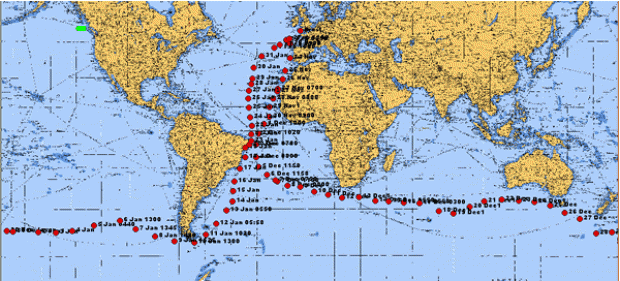
My voyage
Thursday February 5th 2004, Author: James Boyd, Location: Transoceanic
After stepping off his 90ft trimaran on Tuesday morning, cracking some champagne and spending an hour in a press conference, Francis Joyon announced to the gathered throng with genuine sincerity "I'm sorry, I am very tired," before hightailed it from Brest back to his home in Locmariquer, near la Trinite-sur-Mer to catch up on his sleep and be with his wife and two children.
The hardest part of any singlehanded voyage, after perhaps getting the money in the first to do it, is going from the relative harmony and routine of your own encapsulated world on board straight into the arms of a stressful media grilling, with lots of bastard journalists asking awkward and often stupid or inappropriate questions.
Although Joyon has a reputation for being short with the press, when we finally caught up with him at his home he was the height of politeness and couldn't have been more helpful.
Joyon says that the solo non-stop round the world voyage was something he had been considering for almost a decade, but the pieces had only fallen into place last summer when he had been able to charter Sport Elec. At the time the 90ft trimaran was lying unused in Brest as her owner Olivier de Kersauson was busy out sailing with his newer toy - the maxi-trimaran Geronimo.
Joyon moved the boat down to La Trinite where he spent three months working on her prior to setting out on his ground breaking voyage. As is his way, he refitted the boat either alone or with help from his family. Among the main jobs was changing the rudder to one with a new profile to provide better balance, thus reducing the effort required for the autopilot to steer.
He also fitted of a new Solent jib on a roller furler. As Sport Elec she was set up to be sailed fully crewed and had no furlers. The remainder of the sails were de Kersauson's. The mainsail was 10 years old as was the staysail and both had been round the world before... "I was very surprised," Joyon said. "These made the whole round without a problem. Maybe they can make a third or fourth one around the world!" His campaign was perhaps summed up by the fact that when they repainted the boat in her new corporate colours - they did so while the boat was in the water!

Joyon - en famille
At 07:59:54 GMT on the morning of Saturday, 22 November Joyon set sail from a line off the mouth of the Rade de Brest. A high pressure system in the Atlantic provided the ideal conditions, but on the third day, as he was passing Gibraltar and heading down the African coast, the conditions were becoming a little too brisk.
"It is stronger than was forecast," Joyon reported at the time. "But I don't have too much concern. There was one hairy moment when the crest of a wave struck the boat on the windward side causing her to slew sideways." To get out of the worse of the weather he hugged the African coast, sailed very close to Fuerteventura in the Canary Islands and continued this route sailing to the east of the Cape Verdes.
His passage through the Doldrums was at 22deg 40W and although he slowed down a little he was never at a standstill. By day nine of the voyage IDEC crossed the Equator. At this point Joyon was already four days ahead of Michel Desjoyeaux's record in the Vendee Globe, but significantly was a day and a half ahead of his boat's record, when in 1997 as Sport Elec she had been sailed fully crewed on the Jules Verne Trophy.
If there had been any doubts about Joyon's ability to manhandle a 90ft long trimaran alone, by this stage they had been dispelled. The main reason for his abilty to make this Herculean task look so easy was that Joyon had spent more than a decade campaigning 60ft trimarans singlehanded, including a win in the last OSTAR. Although IDEC was some 50% longer her sail plan was by no means proportionally larger. Her mast for example is 33m compared to 30m for an ORMA 60, her upwind sail area 340sqm compared to 280sqm on his 60ft trimaran Eure et Loir.
In retrospect Joyon felt that his passage south down the Atlantic had been good but not perfect. "I was obliged to go very close to Brazil and maybe somebody more lucky could have a shorter way, but I was already enough lucky," he said. In fact he is overstating his case - his furthest position west was at 30.5degW (between Rio and Salvador) in comparison Geronimo last year and Orange in 2002 were both forced right across to 33.5degW.
The latter part of his outbound crossing of the South Atlantic could not have gone better. He was not only able to cut the corner to the southwest of the high pressure system without losing the wind but he continued to put in high daily runs of 350-400 miles. Part of the reason for this was the South Atlanic high had divided in two and he was able to make good progress in the favourable wind to the north of the southerly one.
Timing his passage round the South Atlantic high to coincide with hooking into one of the depressions sweeping eastwards across the Southern Ocean can often present problems for those tackling this passage - but not for Joyon who was able to hook straight into the southwesterly winds of a depression to his southeast.
Approaching the Cape of Good Hope Joyon experienced another heart-in-mouth moment when IDEC collided with something in the water damaging her daggerboard. Joyon was able to repair the damage without missing a beat. "I had some problems, but I had many many materials on board and I repaired them at the same time as the problems occurred, so it was no so bad," he said.
He passed the longitude of the Cape of Good Hope at 04:30GMT on 12 December. At this stage he was an incredible 1,000 miles ahead of Sport Elec.
One way Joyon says that a non-stop round the world voyage could be made faster is by sailing further south in the Southern Ocean. He maintains that later in the season the track of the lows is further south, allowing you to sail at higher latitudes cutting considerable mileage off the course. However he adds "I am not sure the conditions for going down the Atlantic are better later."
Joyon certainly wasn't able to dive far south as he crossed the Indian Ocean. Had his rounding of the Cape of Good Hope been much further north he would have hit land. Across the Indian Ocean he made it no further south than 45deg before he was forced north again by some violent depression action below him. In comparison by this stage in the Indian Ocean de Kersauson on Sport Elec's voyage was already down to the 50s.
The object of the exercise says Joyon was to stay away from storm force winds. "I think I had the correct weather in the south, because I look for this weather," he says. "If I go on the normal way at 50deg of latitude I had 50 knots of wind, but if I stay at 40, the way was longer but I had 25 knots. So I tried not to be not too crazy."
He says that one of the interesting aspects of racing a big multihull is that to some extent you can dictate the weather conditions you are likely to be faced with. "I think with a multihull, which is a very fast boat, you can choose your strength of wind a lot of the time because you have plenty of latitude [to move about the race course relative to the weather] in front of you. If you want to sail in the 60s you can sail in the 60s, if you want to go in the 40s, you can . So it is interesting to choose the strength of the wind. This boat likes 25 knots of wind, going downwind." In 30 knots, he says, he has to slow down to 15 knots because the crossbeams start to impact with the waves. "If I have 25 knots I can stay at 20 knots which is better."
As IDEC passed Cape Leeuwin at the southwesternmost corner of Australia on 22 December she was at just 39deg south. Intense Southern Ocean depressions were still preventing him from diving south. In fact come Christmas Eve the situation was becoming so desperate that he did seriously consider sailing through Bass Straight and then on through Cook Straight.
"In case I had more than 35 knots south of Tasmania, it would have been faster for me to go through Bass Strait, so I did imagine going there but then the wind was about 30 knots to the south of Tasmania, so I went there instead. To be honest I would have been happy to see something green! It was a very great temptation for me!"
Christmas Day saw IDEC hanging a hard right passing close to the west coast of Tasmania and then across the bottom of the Tasman Sea on a southwesterly course that would eventually get the trimaran down to 52degS in time to pass New Zealand. Throughout this period Joyon was still notching up 400+ mile days however he said that crossing the Tasman the cross seas and the awkward waves were almost as bad as they had been crossing the Indian Ocean.
Completely in line with Joyon's low-tech approach to this record attempt was that he had no shore-based expert such as Pierre Lasnier or Jean-Yves Bernot feeding him routing advice. He was doing the whole job on board. For Joyon this was more of a philosophical issue. He had prepared the boat on his own prior to setting out, was sailing the boat singlehanded, why not do the routing himself too as you have to in the Vendee Globe?
During the voyage Joyon in his daily radio reports indicated that he was spending a considerable amount of time on the helm - possibly 8-10 hours a day. However when we spoke to him he said that it was normally less.
"I spend most of the time under the automatic pilot - it does a better job than me quite often - except some very good days when there was a lot of wind going downwind, I liked to steer. Usually in the afternoon I have an afternoon sail and put up a bit more sail and make 25-30 knots and after that I reduce sail and go under automatic pilot again. Maybe I go 90% of the time under pilot."
Joyon reckons that handsteering he was perhaps on average 5 knots faster in the Southern Ocean. "Generally I couldn’t steer more than 3-5 hours a day. Under the autopilot, the boat is doing 18 knots and when we steer we can do 22-4 knots which is really better." Certainly is.
On board IDEC was fitted with Brookes & Gatehouse and Raymarine autopilots, both of which he says he was impressed with. "Because of the new very efficient rudder, the automatic pilot had very little effort and I had no problem with my two automatic pilots." Unlike his 60ft trimaran IDEC only has one rudder and Joyon says this seemed to be quite effective (Olivier de Kersauson also advocates single rudders for round the world trimarans).
Just past the international date line Joyon experienced the most substantial physical challenge of the voyage when the large ring, made of 25mm diameter steel, on the headboard broke leaving the mainsail dumped between the lazyjacks with the halyard stubbornly at the masthead still. Joyon was forced to make an ascent of the 33m mast - wingmasts are not fun to climb because there is precious little to hang on to and it was in the middle of the Southern Ocean. Fortunately it was only blowing 25 knots at the time...
Joyon says that the headboard fitting broke because it was old but he was able to fix it and his repair lasted for the rest of the voyage. This was one of the rare occasions during the voyage that Joyon suffered downtime due to gear failure.
Once again in the Pacific part of the Southern Ocean Joyon was forced north adding considerably to the mileage necessary for him to sail. Less than four days away from rounding Cape Horn for example he was at 48degS - the Horn is at 56degS. Aside from a light patch he had to negotiate on New Year's Day, throughout the Pacific section he continued to rack up 400+ mile days.
During his voyage Joyon says his best daily run was 480 miles (this is hard to guage from the published figures which were rarely noon to noon). He feels that his boat is capable of much more.
"I think the boat can do maybe 500 miles a day without big difficulty, but we have to steer for doing this speed and there are so many jobs like the weather forecast being on the deck for the reefing, etc that." He says that the best speed he saw was 31 or 31.5 knots as he was steering on a big surf. Usually after he reached 27 knots he would reduce sail.

At 10:21GMT on 12 January, 49 days into his attempt, Joyon rounded Cape Horn and began his return journey up the Atlantic. 49 days into the last Vendee Globe solo round the world record holder Michel Desjoyeaux was some 3,450 miles further back up the course at a position Joyon had crossed on day 38 of his voyage. While recent Jules Verne Trophy record attempts had seen Orange and Geronimo pass the Horn on days 42 and 41 respectively Joyon by this stage was only two days slower than de Kersauson's time fully crewed on the same boat.
After passing the Horn Joyon found the wind on the nose (one of the rare moments he was upwind during this voyage). The boat took a pounding during this period and the Solent jib broke. It would take him the best part of a week to repair it.
However if he had been lucky with the weather sailing down the Atlantic, then he was even more so sailing up it. Although he left the Falklands to port he subsequently chose to converge with the South American coast and was able to sail in pressure in favourable westerly winds all the way up to Salvador de Bahia.
It was on this section of the course that both Geronimo and Orange experienced problems on their respective voyages - Geronimo though a lack of wind, Orange being forced to sail through the St Helena high and into the favourable winds to its northeast. While all the recent Jules Verne Trophy attempts have seen boats take around 10 days or more to sail from the Horn to the latitude of Salvador, Joyon covered it in just 8.
Joyon doesn't see it this way. "For going up it was not so easy, because there was no southeast trade at all, so I go until the latitude of Salvador de Bahia with the west wind and after the problem was there was no connection so I had to spent maybe five days with very little north east wind. And then I catch the northeast trade and I was against the wind with stronger wind. Very good conditions should be with the normal southeast trades which would make the coming up easier."
As Joyon says his luck ran out at Salvador de Bahia and it took him the best part of three days to around Recife. North from here he once again was held up very little through the Doldrums even but wasn't able to maintain his normal storming pace. His mileages during this period were still respectible - 280 being the worst, 350 the best.
Another technical problem developed when on 27 January Joyon noticed that a small hole had developed in his port float. Although he is not aware of exactly when or how the hole appeared he believes that it must have come through a collision. The position of the hole was such that he was unable to make a running repair and had to spend the remainder of the voyage with as much as a ton of water in the port float.
Finally on 29 January Joyon's fortune changed in his favour as he broke out of the light winds where the trade winds should have been and into a strong southwesterly airflow to the southwest of the north Atlantic high (at this period hovering over the Canary Islands). Once again, as he had found on the way out, Joyon would experience the strongest winds of his voyage in the North Atlantic, not the Southern Ocean even though he says the waves were worse down south. An issue concerning those ashore more than it seemed to be concerning Joyon was that on the run towards the finish in the strong southerly breeze, sailing on starboard gybe meant that the holed float was in the water.
The conditions were ideal for a brisk run to the finish and once again Joyon was able to start putting in runs approaching the 400 miles mark. At the equator it looks likely that he would finish in around 76 days but Joyon benefitted greatly from being able to sail a direct course to the finish rather than having to circumnavigate the Azores high.
In the end he managed just under 73 days, a record which we believe will be very very hard to beat.
One person who has been watching Joyon's record with much interest has been Ellen MacArthur. Her new Castorama B&Q trimaran has been developed especially for singlehanded offshore passages and the round the world record is to be one of the most significant attempts Ellen will make on her new steed.
"I am incredibly happy for Francis, and I feel that he has completed something not only extraordinary, but in an incredibly successful way," commented Ellen on hearing the news about Joyon. "To complete a solo non-stop voyage around the world is an incredible feat. To complete it in the time Francis has just goes to show what is achievable with determination, strength and courage. He has managed to sail with averages similar to that of a fully crewed boat. In fact, you can almost forget the averages, because he has jsut sailed a huge trimaran designed for a crew of eight people around the world. It takes someone fairly special to do that, let alone maintain fully crewed averages!"
A commonly held view is that Joyon's record is so quick that it will be virtually impossible for Ellen to break. This is partly a comment on Joyon's superhuman ability, but more because Joyon was undeniably fortunate with the weather (to almost the same degree as by contrast Olivier de Kersauson was unlikely with the weather as he sailed up back up the Atlantic last year).
Ellen's Castorama B&Q is some 15ft shorter than IDEC but in its favour it is brand new, has been specifically designed to be able to sail fast singlehanded in large down hill conditions, just like the month Ellen will spend in the Southern Ocean. Singlehanded we would guess she should be the faster weapon, but it being still so early in the development of Castorama B&Q it is too earlier to say definitely. Whether she could ever go round in such great conditions seems unlikely.
What will be crucial is the mileage Ellen fells comfortable pushing out each day and that these are larger than IDEC's. Also she must develop a deeper relationship with her autopilots so that the boat can be pushed harder while they are in command.
Joyon's record and his effectively 'achieving the impossible' has many other implications. The first is that Joyon has proved that if you have the right experience (ie a decade in 60ft trimarans) it is possible to sail a large multihull singlehanded to a high enough degree of efficency to be incredibly fast. Does this mean it would be possible to hold a Vendee Globe-type race in multihulls?
"For the moment I have no opinion," says Joyon wisely when we put this to him. "I like multihulls, but I think that monohulls, like the Vendee Globe ones are safer than a multihull in the south and that will stay a reality. So I have no real opinion. Sure, we can go faster with a multihull, but the idea when someone organises a race is to make something very safe - maybe it will stay safer with monohulls."
It is not hard to imagine that the next logical step is for some bright spark to sail one of the giant G-Class catamarans round the world alone. Alternatively how about taking a multihull around the world westabout against the prevailing winds? NO ONE has done that before - and how often can that be said these days?
In the meantime Joyon is trying to work out his future. Following his incredible success, his construction company sponsor, IDEC, seem keen to continue with him and Joyon says he is going to see if he can extend the charter of the boat from Olivier de Kersauson for another year.
If this comes to pass then Joyon says he is keen to return to the UK and have a pop at beating his Round the Island race record. He may also have a go at the outright round the island record and also Cowes-St Malo. There are many other records that he could do - Laurent Bourgnon's time for the west to east transatlantic passage singlehanded is certainly an attraction. If so, maybe he will line up against Ellen MacArthur?
What is certain is that whatever programme Joyon comes up with, it will continue to be done in a low key, low budget and entirely endearing fashion.

Most Read
Most Commented
Comments
Businesses

Pro businesses
-
Italy
-
United Kingdom
-
-
France
Editor's choice
Member blogs
-
 Ned Collier Wakefield: MOD70 round BarbadosWell that was intense. 12 hard fought for seconds for the win. In idyllic conditions, Tony Lawsons MOD ...
 -
 Mini Transat leg 2 reportThe second leg of the Mini Transat started on 31st October, just over a month after ...
 -
Leg 1 reportI’ve been working towards the Mini Transat now for three years. In 2013 I was part ...
Business blogs
-
 The Island Sailing Club in Cowes, Isle of Wight, is delighted that Prince Michael of Kent ...
 -
Peta Stuart-Hunt chats with the 25 year-old British solo sailor Lizzy Foreman before she sets sail ...
-
The 2015 Student Yachting World Cup (SYWoC), an ISAF-recognised event hosted and run by students for ...
Editor's Choice
All time favourites...
-
 Three legs down into Ian Walker’s
 -
 Winning all but two races at
 -
 For the first time in its
Latest Comments
Add a comment - Members log in