
Tales from the Transat Jacques Vabre
Thursday November 20th 2003, Author: James Boyd, Location: Transoceanic
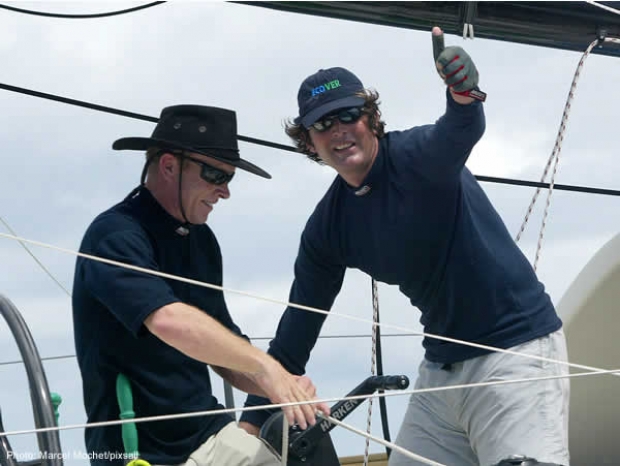
"We had them scared for a while," opens Mike Golding when we talked to him upon his arrival in Brazil at the end of what for him was an ultimately disappointing Transat Jacques Vabre. Golding and Brian Thompson on board the new Owen Clarke designed
Ecover were leading the Open 60 division of the Transat Jacques Vabre until day eight of the race when disaster struck.
"From the point we got to spinnaker conditions, the first halyard chafed through after roughly 24 hours and so we lost that sail," recounts Golding. The cause he believes was due to a new masthead halyard exit system they are using called a 'tulip exit'.
"It is used widely on the multihulls and isn’t used very widely on the monohulls. It appears we have got some teething problems…" he continues. "What you normally have on most Open 60s is an externally hung block, so your halyard will be internal but it will come out of an exit and go up to an externally hung block and will therefore find its own position. With a tulip exit, you have a normal type sheave arrangement but with a very wide, deep sheave - maybe 70mm across. Then it has a faired-in section on each side so that the halyard can lie against that when the mast is rotated. It is a very neat system aerodynamically and weight-wise. So we have transposed a working technology from the Finot [the old Ecover], which is the Vectran halyard, to the new technology of the Owen Clarke with the built-in tulip sheave and the compatibility between the two doesn’t seem good or there is some set-up up problem with that sheave. Southern Spars are sending out for someone to have a look..."
There was rumour of it being a problem with the halyard locks - Ecover is one of the first in the Open 60 fleet to use them - but Golding says they don't have them on the spinnaker halyards.
He believes the halyard chafed through because the boat was moving around a lot due to the chop left over from the previous bad weather. "There wasn’t a heavy weight on the halyard, it was just moving a lot and got accelerated chafe. So instead of it taking 2-3 days to chafe through it took 24 hours. So we ran another kite up on a different halyard, with a different arrangement that was also supposed to be compatible with the rotating spar - and that chafed through in an hour! That was a bit of a shock. We only did it because it was the middle of the night and we were bouncing around and neither of us wanted to go up the mast with a head torch on. So the halyard we put it up on was the man halyard, which is supposed to be beefy enough to take a kite in an emergency - but it only lasted an hour."
With two kites destroyed they were only left with their light weight spinnaker and soon after they got into heavier conditions this blew out. Aside from the first day and a half of downwind conditions, they did the rest of the race - the last week effectively - using gennikers.
Although this wasn't perfect, it wasn't disastrous. "Our Code 5s are quite well evolved and we were pretty quick, but you lose on depth," says Golding. "The reason we came close at the end was because we were in kite conditions going downwind, but because it was more reachy we were able to catch up on speed. As soon as we got near the finish and it was dead downwind, then it was about how quickly you could VMG downwind and we lost out consequently. You have to remember we have been racing Sill since before the Cape Verdes without a kite and I gather they flew a kite most of the way through the Doldrums when we Code 5ed all the way through. So it validates the fact that the boat is quick downwind."
Aside from the breakage that cost him the victor's spot, Golding says he is pleased with his new boat. "We were only able to assess a limited number of angles of sail because the race comprised of a big upwind, heavy then medium airs section both in which the boat performed extremely well and later there was a downwind section where we weren’t running kites. When we were running kites then we were we were making gains. When we weren’t we were holding station or losing slightly. Overall we are pretty happy. There was some reaching when we should have been kite reaching but were code reaching and it didn’t feel good, but in fairness to the boat I think we were flying the wrong sail. Even so it was still clocking in some good scheds, so it was fast. My overview is that we got what we asked for - a fast boat."
One theory about why Golding got ahead in the early part of the race was due to his experience upwind. Aside from skippering boats in both the British Steel Challenge and BT Global Challenge he has also in the past broken the record for sailing around the world the westabout upwind way singlehanded. "I’m not frightened of driving the boat reasonably hard. A lot of people were saying 'shouldn’t you be taking it easy it being a new boat at this stage?' Frankly from our perspective on board, the boat felt good so you just kept going. It wasn’t a question. We knew we were in a race and we pushed the boat but we weren’t doing anything crazy. The boat just wanted to go so we let it go."
Compared to the old Groupe Finot-designed Ecover Golding says his new steed is much much better upwind. "It is a different beast. You have more gear changes and more speed in each gear and a lot more height. So it is what we ordered. If we have got it wrong it is not because it is not what we ordered."

Aside from the kites, disaster nearly befell them two days out when they broke a runner. "We had a titanium padeye (although it was nothing to do with it being titanium), in the rig which pulled out and it has yet to be ascertained why. I have no idea why the rig didn’t come down. It must be a good rig! I looked up it and it was actually pretty straight. We were running solent and full main in 22-23 knots, power reaching and I don’t know how it didn’t break. Presumably the D1 takes all the load at that point, so we’ll have to have a close look at that."
At the time of the incident both Golding and Thompson were up and Golding was just inside the hatch. "I heard it go and came out and had a look at the runner, because that tells you if the rig is on its way down or not! And the runner and the topmast and check were still there but the main runner was all slack. It was the middle of the night so you couldn’t see anything. So we blasted the solent and the main to slow the boat right down. Then we ran a heavy duty vectran halyard and pulled that into the Solent halyard sheave - another tulip sheave - and it was fine."
The Farr-designed Virbac won the monohull division, but Golding is convinced his boat is the quicker. "Overall I think we would have stayed ahead had we been in the race. They sailed a good race [on Virbac] and frankly if you look at his program he probably deserves it. He has sailed the most miles this year. He had a lot of problems on his delivery and if we’d had those problems on this race we wouldn’t be here in Brazil. We pushed the boat and we broke some stuff, but the nice thing is that what we broke wasn't big - they are all fixable and we are left with a boat we know is quick."
From here Golding will be racing Ecover back to Europe singlehanded in the Open 60 class' Défi Atlantique race. This sets off from Salvador de Bahia on 30 November and is bound for La Rochelle.
"It has always been my intention to do the race back as a get-to-know-the-boat thing, rather than busting a gut to win the race. To my mind the Transat next year is a much better target to aim for. By then we will have a well-worked up boat and we will not be compromised by our newness. Here we have 10 days to turn the boat around. It is a further test for our shore team. They have got their work cut out. I am not going to put any great pressure to get back other to get back in time for Christmas to spend it with my family.
"They put this race on as a feeder race to get us back to Europe, but it is a tough call. You do the TJV, but just because you are doublehanded doesn’t mean it is an easy ride. It is still hard work and you are still tired at the end of it. We are going to do a prize giving this weekend and 10 days later we are going back. That is hard even by Vendee standards. I think the race is an excellent idea, because it allows people to race the Transat in the proper manner and I think that is more healthy rather than having a lot of people intent on just arriving at the other side rather [in order to qualify for the Vendee Globe]. It will make the Transat more competitive. That is not to say if we don’t get out in front we’re not going to shout about it but I will do it in a relaxed manner and I’m going to enjoy it...."
On page two Sill's Alex Thomson recounts his TJV experience

Most Read
Most Commented
Comments
Businesses

Pro businesses
-
Netherlands
-
Italy
-
-
United Kingdom
Editor's choice
Member blogs
-
 Ned Collier Wakefield: MOD70 round BarbadosWell that was intense. 12 hard fought for seconds for the win. In idyllic conditions, Tony Lawsons MOD ...
 -
 Mini Transat leg 2 reportThe second leg of the Mini Transat started on 31st October, just over a month after ...
 -
Leg 1 reportI’ve been working towards the Mini Transat now for three years. In 2013 I was part ...
Business blogs
-
 The Island Sailing Club in Cowes, Isle of Wight, is delighted that Prince Michael of Kent ...
 -
Peta Stuart-Hunt chats with the 25 year-old British solo sailor Lizzy Foreman before she sets sail ...
-
The 2015 Student Yachting World Cup (SYWoC), an ISAF-recognised event hosted and run by students for ...
Editor's Choice
All time favourites...
-
 Three legs down into Ian Walker’s
 -
 Winning all but two races at
 -
 For the first time in its
Latest Comments
Add a comment - Members log in