
Spot the difference
Tuesday February 5th 2008, Author: James Boyd, Location: United Kingdom


When it comes to Open 60s, times are good within the haven of activity that is the Farr Yacht Design office in Annapolis. As Russell Bowler points out to us with glee - Michel Desjoyeaux's Foncia won the Transat Jacques Vabre. Loick Peyron's Gitana 80 won the singlehanded return race, the Transat B2B, while barring disaster Gitana 80's sistership Paprec-Virbac 2 is set to take line honours next week sometime in the Barcelona World Race. All their designs.
Of course there have been a few upsets along the way. Barcelona World Race favourite PRB lost the top of her mast (her second dismasting since the Route du Rhum) while shortly after Delta Dore lost her mast in its entirety. Still, the catalogue of rig-related disaster that has beset the IMOCA Open 60 class recently is not limited to the Farr office.
While we still await the announcement of Marc Thiercelin's new Finot-Conq designed Open 60 so far 18 new Open 60s are set to be on November's start line of the Vendee Globe. Farr may have followed the trend, having gone exclusive with the Spanish team in the Volvo Ocean Race, they are making up for it in the IMOCA class, where they have designed six of the new boats, all of them being sailed by highly accomplished sailors including the two past Vendee Globe winners, Michel Desjoyeaux and Vincent Riou.
 In past Volvo races it has been hard at times to tell the Farr boats apart, but in the almost-anything-goes Open 60 class, differences between boats are much more evident. Farr Yacht Design VP Patrick Shaughnessy filled us in on the lineage of the new boats, all of which obviously stem from their first Open 60 design,
Virbac-Paprec, which Jean-Pierre Dick sailed in the last Vendee.
In past Volvo races it has been hard at times to tell the Farr boats apart, but in the almost-anything-goes Open 60 class, differences between boats are much more evident. Farr Yacht Design VP Patrick Shaughnessy filled us in on the lineage of the new boats, all of which obviously stem from their first Open 60 design,
Virbac-Paprec, which Jean-Pierre Dick sailed in the last Vendee.
"In terms of design methodology, we did a body of research and made some decisions particularly with the hull and appendages which we thought were the right answers," he says. "We started with the first Virbac and then we found what we thought was right for the Vendee Globe race course. Then, based on that, we worked with the teams to understand where they would like to go."
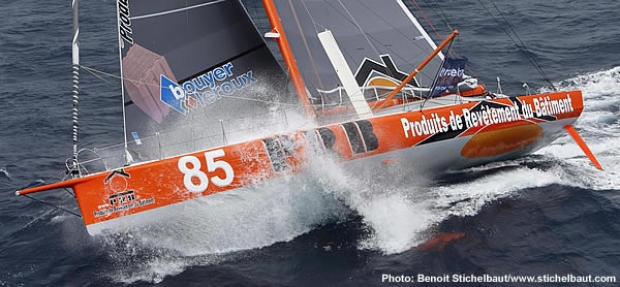
Essentially Jeremie Beyou's Delta Dore and Estrella Damm (soon to be reliveried as BT for Seb Josse to race this year) are the vanilla-flavoured standard Farr base boat in terms of their hull shape and vital statistics - although they have different rigs.
While Delta Dore was built by JMV Industries in Cherbourg and BT by OC Sailing Team's own construction team in Cowes, both PRB and Foncia were built from the same mould at CDK Composites in Port la Foret. They have a more powerful hull shape than the standard boat. Initially Foncia started with a slightly taller rig than PRB, but Riou's team rectified this when they built their second spar post Route du Rhum. With Foncia's minimalist accommodation and deck layout (she has one winch less than the other Open 60s) she is certainly lighter than PRB.
Meanwhile down at Southern Ocean Marine in New Zealand two other Farr designs were conjured into life in Jean-Pierre Dick's Paprec-Virbac 2 and then from the same moulds, Loick Peyron's Gitana 80. Unique to these boats is their planing board/trim tab positioned beneath the transom.
Shaughnessy explains: "They had much more work done on their hull shaping, because we were able to incorporate the trim tabs. So there’s a lot of volume that would have been in the bow sections (to try to keep the bow up to try and promote high speed reaching) that was taken away because you are able to alter the trim with the tabs." While there is less volume in the bow of these boats, aft there is more curvature and volume, because the run aft to the transom can be straightened out with the tab.
But the most obvious difference between the six Farr boats are their rigs. Shaughnessy says that prior to even getting an order for a new 60 they had carried out extensive research into the numerous different rig configurations. This primarily comes down to fixed masts and rotating wingmasts, but the latter come in all different shades, some with the shroud base widened through the use of trawler-style deck spreaders, others through hinged conventional speaders, others with diamonds.
"In a theoretical sense a rotating foil-shaped mast is superior in a routed simulation," says Shaughnessy. "But it means that it has been done in an incredibly light weight, which makes it potentially a risky decision to take. So when you step back from there, a smaller section rotating wingmast is probably less good and a fixed mast is less good again. And layered across that you have the deck spreader decision. Deck spreaders allow you to lighten your wingmast and it allows you to sheet your short-footed headsails further outboard. So you have better reaching performance from the short-footed headsails but then you limit the overlap of your larger reaching sails."
Gitana 80 is believed to be using an 'outrigger' system, like a removable deck spreader, as Marc Guillemot's Safranis certainly using, for sheeting reachers. "We believe there is merit in having a small shroud base so that you can have any size of reaching sails you like and having an outrigger-type system that allows you to have wide sheeting for any of your sails," advocates Shaughnessy.
While PRB and Foncia have returned to the deck spreader idea, originally pioneered with Yves Parlier's Aquitaine Innovations more than a decade ago, Delta Dore has a rotating wingmast with three sets of spreaders and a smaller section. "The Delta Dore rig is a development of the thought process where we said ‘there’s a rotating wingmast of the Southern Spars style [ie smaller section] that they’ve produced for the Ecovers and Virbac’ and we said ‘if you can engineer a hinged spreader connection and be successful at that, then it is a more structurally stable rig with multiple spreaders - and that’s what Delta Dore has. However it is quite a finicky process to try to define one axis of rotation and put all of your fore and aft stays and your boom thrust and all of those things together and to get your rig to rotate." Given this perhaps it is not so surprising that Delta Dore dismasted in the Southern Ocean.
So why is there such variation in the rigs still? Shaughnessy says it is entirely down to the skipper's preference. Most have very strong ideas about the type of rig they want and quite often the opinion from one to another is poles apart. They also have different levels of experience and typically the more experienced skippers prefer the wingmast option. Obviously a wingmast that is incorrectly trimmed, in terms of its rotation, will immediately destroy any aerodynamic benefits it has, so staying on top of the trim is essential.
"You have to chose what is right for the skipper, not necessarily just what is right to win the race. We worked quite hard on that on the first Virbac recognising that J-P [Dick] was new to the class. A lot of the decisions we made on that were very conservative, with a spreader at each reef point opposing each forward stay," says Shaughnessy.
Aside from the variation in sections between the wingmasts they also rotate about different points at the foot. While they are manually rotated, on some set-ups where the mast ball and cup rotational point is further forward the mainsail has more influence in auto-rotating the spar during manoeuvres. Shaughnessy explains: "The main is able to influence the rotation of the mast a lot and if there is a boom that is thrusting on it, the boom can influence it, so I think the ones that have the boom arriving on the mast are most easily mis-aligned than the ones which just have a sail luff force which is pulling the mast in the right direction."
Traditionally Open 60 booms were always deck stepped just aft of the mast step, however recent boats, a trend started by Mike Sanderson's adaptation of the previous Pindar Open 60, has seen a return to conventional booms being attached to the mast.
Aside from the rigs, the Farr office also researched the materials used to construct the keel foil (if Open 60s have issues with their rigs at present, in the last Vendee Globe foils were proving the weak point). Essentially the choice comes down to carbon fibre (lightest, but has the fattest and most draggy section), fabricated steel and forged steel (solid, narrowest section, but heaviest).
"In a theoretical sense, the lighter you can make the keel foil, the better," says Shaughnessy, illustrating the options. "So carbon is theoretically the faster, then fabricated steel and then solid steel. You can do a routed study around the world and you can find delta hours for each of those configurations, but the amount of delta hours you are looking at between two different keel configurations might be 15 hours in a Vendee Globe and that isn’t enough to dissuade someone with a strong opinion. The amount of hours you are discussing in that process you can still say I’d like the most conservative material."
Inevitably the Farr boats have a mix. Delta Dore originally had a carbon foil but experienced a problem with a fitting at the top of it and changed to a fabricated one prior to the start of the Barcelona World Race. It is believed they will go carbon again this year. The rest have taken the most conservative option and gone forged, although there may be another team within the six who will go fabricated for the Vendee Globe.
When it comes to sails, Open 60s being sailed singlehanded around the planet non-stop presents some unique challenges. "With a conventional boat you take your range of expected conditions and you create a sail chart across it which divides it up into zones. But on these boats you have to look at optimum sailing of course, but you have to look very carefully at off-optimum sailing and when you have off-optimum zones on either side of a sail you want to make them to be less bad and more forgiving. The boats get sailed off-optimum a lot just because the guys are tired or they have to go in a certain direction to get to somewhere - so that is very prevalent." Studies into 'off-optimum' trim is something Farr has studied for various key aspects of these boats.

Next week there should be some good feedback on how well the under transom trim tab (planing board) has worked on Paprec-Virbac 2. Generally they have been regarded as a successful development says Shaughnessy. "Certainly on paper it makes perfect sense that you should be able to alter the hull shape of your boat to produce bow up or bow down performance characteristics. Provided you are able to do that in a safe way, or an easily controllable way, should only be good. And the study work we did with the tabs, looking at them like the rotating rig - in an off-optimum sense - we can’t find enough potential bad to outweigh the potential good."
Shaughnessy reckons the greatest benefit of the tab will be hard-pressed reaching where they will be able to keep their bows up more and press harder than the non-tab boats. "In that situation they have the tab up, so the bow is able to rotate up. That is a real problem these boats have. You can see it is difficult in a very wide boat to be able to balance any kind of heel and volume at the front."
A downside of the tabs is their size - they are large bits of kit spanning the width of the hull beneath the transom and in order not to present too sharp an angle for the water to pass over they are inevitably long fore and aft. According to Shaughnessy they add about 30lbs (14kg), although the system on Gitana 80 has been refined and is lighter than the one Dick and Foxall have been pulling around the world.
When it comes to displacement, Shaughnessy says there is a reasonably large variation partly due to the boats coming from different builders. Partly this is down to the complexity of the boat, but also down to the different builders. In general they are all around 8-9 tonnes.
After Finot-Conq designs have won the last four Vendee Globes, perhaps there might be a new king of the mountain when it comes to Open 60 design.
Most Read
Most Commented
Comments
Businesses

Pro businesses
-
United Kingdom
-
France
-
-
Italy
Editor's choice
Member blogs
-
 Ned Collier Wakefield: MOD70 round BarbadosWell that was intense. 12 hard fought for seconds for the win. In idyllic conditions, Tony Lawsons MOD ...
 -
 Mini Transat leg 2 reportThe second leg of the Mini Transat started on 31st October, just over a month after ...
 -
Leg 1 reportI’ve been working towards the Mini Transat now for three years. In 2013 I was part ...
Business blogs
-
 The Island Sailing Club in Cowes, Isle of Wight, is delighted that Prince Michael of Kent ...
 -
Peta Stuart-Hunt chats with the 25 year-old British solo sailor Lizzy Foreman before she sets sail ...
-
The 2015 Student Yachting World Cup (SYWoC), an ISAF-recognised event hosted and run by students for ...
Editor's Choice
All time favourites...
-
 Three legs down into Ian Walker’s
 -
 Winning all but two races at
 -
 For the first time in its
Latest Comments
Add a comment - Members log in