
Open 60 virgin
Monday July 1st 2002, Author: Peter Bentley, Location: United Kingdom

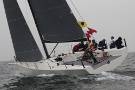
Earlier in the week I was lucky enough to sail aboard Graham Dalton's new Open 60 HSBC as she prepared to leave Belgium for her sail to London for her official launch today.
Never having sailed an Open 60 before I really didn't know what to expect. Anyone who has sailed a reasonable selection of big powerful race boats might be forgiven for thinking that they would have some idea what it would be like to sail an Open 60. They would be quite wrong. Open 60s are simply quite unlike any course-racing boat.
Despite being among the fastest monohulls for their size, Open 60s are also among the easiest to sail. While absolute speed is important in terms of race-winning potential, the ability to sustain high averages speeds is even more critical. Similarly, the majority of time will be spent with the autopilot in charge and having an easy helm is vital to reduce both wear and tear and keep the power consumption down.
The first thing that struck me on stepping aboard Graham Dalton's Open 60, HSBC was just how big it was. How could one man (never mind one small girl) manage all this on their own? The sheer physical effort of it all was driven home just as soon as the time came to hoist the mainsail. Even with two guys, this proved one hell of a job. The 'training' mainsail on Dalton's boat weights in at 180Kg and it all has to be hoisted over 20 metres into the sky. Imagine having to do that every time a reef had to come in or be shaken out. It would certainly focus one's mind on whether or not a sail change was really needed. Taking the mainsail down and rehoisting it would be something to do only in case of dire emergency.
Sheeting in takes time too. And as one does so the boat simply accelerates in time with the mainsheet winch. Speed builds up like an express train - slowly, gradually and relentlessly. And even at speed, everything seems easier than you might expect. Only a look at the electronics really gives the game away.
It is however when things start to go wrong that the Open 60 becomes an awesome beast. Early in our sail the huge brand new code zero which had been loosely rolled on the dock started to break free. With three of us aboard the prospect of unwrapping the sheets and getting the whole thing sorted out seemed testing enough. How hard would it be alone?
Running off downwind the superb controlability of the boat soon became clear. How would you fancy standing on the bow of your average 40 footer taming a flogging jib while running deep with the main pulled in to keep the speed down? On Dalton's boat there was barely a hint of drama.
With the jib tamed it was time to turn upwind. No big deal. Sure enough winding on the mainsheet is a fair old grunt and swatting down the leach to get some semblance of decent windward performance is a struggle. And even with the sail in she's not exactly weatherly. With her canting keel trimmed fully to windward, the wide hull and huge rig create enough drag to keep the tacking angle out at about 110 degrees. A good job then, that she's fast.
Finally allowed back to the helm, the difference between this and course racing boats becomes even clearer. At no angle of heel is there the slightest hint of weather helm and the steering though positive and strong is hardly quick. This is a boat set up for automatic steering not the deft flick of the bow over each and every wave as she jumps and leaps her way to windward. Then again, how would you want that if you had to sail 30,000 miles alone?
More of Peter's photos of HSBC can be seen on page 2...

Most Read
Most Commented
Comments
Businesses
Pro businesses
Editor's choice
Member blogs
-
 Ned Collier Wakefield: MOD70 round BarbadosWell that was intense. 12 hard fought for seconds for the win. In idyllic conditions, Tony Lawsons MOD ...
 -
 Mini Transat leg 2 reportThe second leg of the Mini Transat started on 31st October, just over a month after ...
 -
Leg 1 reportI’ve been working towards the Mini Transat now for three years. In 2013 I was part ...
Business blogs
-
 The Island Sailing Club in Cowes, Isle of Wight, is delighted that Prince Michael of Kent ...
 -
Peta Stuart-Hunt chats with the 25 year-old British solo sailor Lizzy Foreman before she sets sail ...
-
The 2015 Student Yachting World Cup (SYWoC), an ISAF-recognised event hosted and run by students for ...
Editor's Choice
All time favourites...
-
 Three legs down into Ian Walker’s
 -
 Winning all but two races at
 -
 For the first time in its
Latest Comments
Add a comment - Members log in