
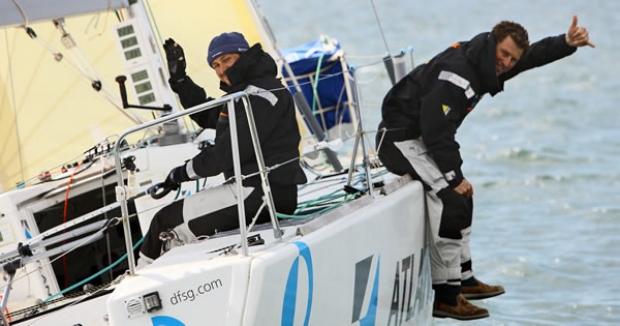
Phil Sharp takes on the Figaro
Wednesday April 16th 2008, Author: James Boyd, Location: United Kingdom
Following his momentus 2006 Route du Rhum victory in the Class 40 fleet ahead of several top French names, so British sailor Phil Sharp this weekend sets off on his first major shorthanded transoceanic race since the Rhum. On Sunday he will take the start line of the Figaro class’ doublehanded Transat AG2R from Concarneau in Brittany to St Barts in the French Caribbean sailing with Czech fellow one time Mini sailor David Krizek aboard
Atlantik FT. He is the only Brit in the race.
Since the Route du Rhum Sharp has remained relatively low key. Last year he trialled for a while with the Russian Volvo Ocean Race team and raced with them on the Volvo 60 in the Fastnet Race and delivered the former Pirates of the Caribbean VO70 to St Petersburg and back. “It was good Volvo experience. Then I had an offer from David Krizek earlier this year to have a chance to step into the Figaro,” says Sharp.
Sharp and Krizek didn’t sail in the Mini class at the same time – Krizek was third in the series class last year, Sharp was fourth in the Proto class in 2005. However the two came across each other prior to the start of the Mini Fastnet last year. “David was putting together a campaign to move on from the Mini, the next step up, to give him some more experience before moving on to 40s or 60s potentially,” recalls Sharp. “I leapt at the opportunity, because it is the best training you can get to give you the proper ground work and fundaments to move up to the 60 class.”
The green light was pressed on the campaign only in February this year, the project funded by Krizek sponsor Atlantik FT, a Czech bank who supported him in the Mini, with other corporate partners including Sharp’s own partner Dominion Fiducary Services Group.
It was then a case of trying to locate a Figaro to charter – no mean feat at that late stage. In the end they acquired Marc Lepesqueux’ boat which as Rapid'Flore Caen-La-Mer finished 10th in last year’s Solitaire.

After a chilly delivery from Dieppe the duo set up shop in Lorient where they have since been receiving training with leading coach Tanguy Leglatin (who has recently been coaching Dee Caffari).
“He gave us a good intro to getting up to speed as quickly as possible - the bare essentials and then tweaking the boat,” says Sharp. “I stepped on the boat, by myself to begin with, and day one was learning how to gybe a Figaro most effectively singlehanded. I came back bucketing with sweat! Gradually the days get easier and easier.”
Leglatin’s training regime has also included speed testing. “That was three days last week,” says Sharp. “We have been going out, testing, literally just lining up. We had four boats involved in the speed testing, just testing our downwind performance, somewhere up to about an hour downwind and then we did some reaching. There was a bit of practice on sail changing as well and some upwind speed testing.” In addition to this they spent a day looking solely at rig tension and attempting to draw some conclusions on the best rig set-ups.
“It is the first real speed testing I have done in yachting, so it has been pretty interesting,” admits Sharp. “It is a real way to learn - you learn so much more going out with another boat than going out by yourself when you don’t any reference. The instruments only tell you so much, but having another boat there really motivates you on. It always pulls out the best in you.”
The duo didn’t have to sail a qualifer for the Transat AG2R because all competitors have to do is to prove they have completed a major race previously and in their case they had the Mini and Route du Rhum under their belts. As part of his preparation Sharp says he attempted to compete in a Figaro singlehanded race out of Les Sables d’Olonne, however the decision to do this was very last minute and the race ended up being shortened dramatically due to the weather.
“It was going alright up until Ile de Re, when I got bogged down going very close with a spinnaker and I think I had quite a deep spinnaker which didn’t help and I lost a lot of positions there. The second day was a bit more encouraging,” recounts Sharp, who ended up an uncharacteristic 16th in the 25 boat fleet.
“We’ve made a lot of differences to the boat and I have improved since then,” he continues. “There are a lot of aspects to a Figaro boat. There are quite a lot of systems to understand. The autopilot is a really big thing - a lot of the time it will be quicker to use pilot and it takes quite a lot experiene to say ‘right the pilot is going to be quicker now – let’s switch over’. So I was playing with that quite a lot during the race and it wasn’t really set up properly at the time. Hopefully we have got things working a lot better now for the race.” Otherwise Sharp says their Figaro is in quite good shape, fitted with new sails, etc.
So how does he find sailing a Figaro? “Compared to Minis and 40s they are pretty slow boats. It is only really when you get racing against other guys that the whole appeal of the Figaro class starts making itself known. The boats themselves are quite difficult to sail well - they have very small keels, so you have to keep the boat very flat. There is a lot you can do with the boat with trimming as well which all obviously makes a difference. To be consistently at the front I think you need to know these boats extremely well. Because they are one design and fairly slow relative to Minis and 40s, it is not just a case of getting up and going - they go at very similar speeds. I think it is quite difficult to win on boat speed alone especially in a big race. You have to really spend a lot on navigation. That will be the big difference.”

In the Transat AG2R the boats have to cross the Atlantic via a turning mark off Madeira. During this time they can receive no ‘outside assistance’, specifically no shore-based weather routing (as Sharp and other Class 40 received during the Route du Rhum) but they are able to download GRIB files from MaxSea Chopper or Meteo France’s Navimail and weatherfaxes (which is more than competitors are allowed in the Mini). Thanks to his collaboration with the Slovenian Mini sailors Andraz Mihelin and Kristian Hajnsek of Team Adria Mobil, during the Route du Rhum Sharp was routed by Jure Jerman, head of the Slovenian Met Office.
“There is no phoning up Jure, my weather master, any more,” says Sharp of the forthcoming race. “He is coming down to the start and he is going to give us a briefing. Hopefully we’ll know what’s going on down to Madeira, and then really it is up to us to make the big call of whether to go north or south. It is interesting looking at the optimal routes - the fastest routes never cross over the rhumb line, so you have really got to make your commitment down there and that’s based on a forecast accurate to four or five days. A lot of it will be looking at the good navigators in the fleet and keeping an eye on a lot of other boats and playing tactical decisions with that in mind with regard to where everyone else is going.”
Aside from wanting to sail transatlantic in a Figaro, the main driver for Sharp doing this race is to get in some more training for his navigation, for apart from the Transat AG2R he says he has no pretentions to continue on after this in Figaro for the Solitaire, although many in the class would like a foreign solo sailor of his calibre to stay on.
“Everyone keeps asking me if I’m going to come back to qualify for the Solitaire,” says Sharp. “I don’t really have any interest at this stage to continue to the Solitaire, mainly because it is the big endurance adventures that I find a lot more interesting. The Solitaire would be a good way to consolidate - if you walk into the Figaro class it is difficult to walk away from it with a good result unless you have spent a great deal of effort and a great deal of time in the class. To really get up to speed will take you two years. So in all honesty if I was going to do the Solitaire I would be making a two year commitment to it. But I really have my eye set on finding a way to move up into the Open 60 class - my priority is really still on the 60s. That is a much more fascinating class from my point of view. I think it has a great future and the earlier I can get into it the better to fulfil my 2012 Vendee Globe ambitions.”
Clearly the route ahead for Sharp is to be invited on board an Open 60 for one of the doublehanded races such as the Transat Jacques Vabre. Given his track record this could be an attractive proposition for a 60 team. “The Figaro could be a good way into that,” says Sharp. “There are a lot of guys who are chopping and changing between Figaros and 60s. You could say that the Figaro is the Formula 3 of sailing, but then you are getting a lot of guys coming from F1 back to the Figaro, because they want to keep their foot in the most competitive game and to keep learning and keep improving and to keep their sailing technique perfected. It will be interesting speaking to Jean le Cam about it.”

While Michel Desjoyeaux and Loick Peyron regularly dip in and out of the Figaro class from whatever big boat project they have on, in fact for the Transat AG2R VM Materiaux skipper Jean le Cam is the only entry from the IMOCA class in this immportant Vendee Globe year. The triple Solitaire winner is sailing on Cercle Vert with Gildas Morvan, who sailed with him on the 60 in last year’s Transat Jacques Vabre. They are considered favourite for the race, along with the likes of Armel Tripon/Dominic Vittet, Nicolas Troussel/Christopher Pratt and Eric Drouglazet/Christophe Bouvet. As a result le Cam’s electric red 60 won’t be competing in The Artemis Transat.
Having stepped into an Class 40 and won the Route du Rhum and finished fourth in the Mini, despite an abyssmal start to the second leg which would have left most floundering mid-fleet, can Sharp pull off a similar stunt in the Transat AG2R? Sharp is realistic about his chances and is aware that the Figaro is a step up the competitive ladder. “It is very difficult to walk in and get anything like a top five in a Figaro, even a top 10 is difficult. There are quite a few guys there who have been sailing in the class for 6-10 years - Gildas [Morvan – who finished second behind Sharp in the Route du Rhum] has been sailing 10 years in the Figaro. So there is definitely a lot to play catch up on with them knowing the boats extremely well. I feel I have got it all to learn, but hopefully my learning curve is a lot steeper than theirs, so it is a matter of time and seeing if we can pick up some good performance in the race.”
Having already competed against some old Figaro hands in the Route du Rhum, Sharp says he has an idea of what he and Krizek are in this race. “It is an interesting circle when you get into it. I think to change to the Figaro mentality is not something you can do overnight. It will be interesting to see these guys’ level of endurance. I’ve sailed against two Figaro sailors in the Route du Rhum – Gildas and Dominic Vittet. Us three were pushing each other harder and harder. We were in the same seas to begin with in that we were quite new to Class 40s and no one was letting up - you got a mile out of them and they took three miles out you the next day just to say ‘ha – there you go. Don’t bother trying to pull some miles back out of me’. So they respond to a lot of pressure obviously. So I am definitely in shorthanded offshore sailing’s most competitive class.”
At present the Transat AG2R fleet is going through its build-up week in the picture postcard Breton fishing port of Concarneau. Prior to the start of the Transat AG2R there is a prologue race on Friday. At present the forecast shows a large area of low pressure centred over the Bay of Biscay for the next few days. Come start day the forecast is for the low to have contracted directly over the centre of the Bay of Biscay which will make for a fast downwind start to the race – one gybe and away.
“With the Figaro I think a lot of it comes down to miles,” concludes Sharp. “In terms of around the cans techniques we are not as quick as the guys who’ve been training down at Port la Foret where they seem to do speed testing week in week out. But we’ve got nothing to lose. We are not expected to do anything special. So we are just going to get stuck into the race and give it our all and see what happens. In these big races a lot of people who are fast in the short races tail off. I think we’ll be good on the long distance endurance and sustaining the pace and hopefully we can go the right way.” This formula has worked extremely well for Sharp in the past – one wonders if he can pull it out of the hat yet again.
Most Read
Most Commented
Comments
Businesses

Pro businesses
-
France
-
Italy
-
-
France
Editor's choice
Member blogs
-
 Ned Collier Wakefield: MOD70 round BarbadosWell that was intense. 12 hard fought for seconds for the win. In idyllic conditions, Tony Lawsons MOD ...
 -
 Mini Transat leg 2 reportThe second leg of the Mini Transat started on 31st October, just over a month after ...
 -
Leg 1 reportI’ve been working towards the Mini Transat now for three years. In 2013 I was part ...
Business blogs
-
 The Island Sailing Club in Cowes, Isle of Wight, is delighted that Prince Michael of Kent ...
 -
Peta Stuart-Hunt chats with the 25 year-old British solo sailor Lizzy Foreman before she sets sail ...
-
The 2015 Student Yachting World Cup (SYWoC), an ISAF-recognised event hosted and run by students for ...
Editor's Choice
All time favourites...
-
 Three legs down into Ian Walker’s
 -
 Winning all but two races at
 -
 For the first time in its
Latest Comments
Add a comment - Members log in