
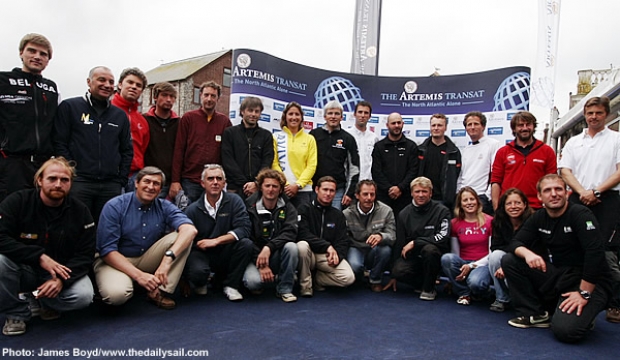
Top row: (l-r) Boris Herrmann, Thierry Bouchard, Christophe Coatnoan, Louis Duc, Benoit Parnaudeau, Yannick Bestaven, Dee Caffari, Vincent Riou, Armel le Cleac'h, Unai Basurko, Steve White, Michel Desjoyeaux, Giovanni Soldini, Simon Clarke. Bottom row: (l-r): Yvan Noblet, Halvard Mabire, Loick Peyron, Arnaud Boissieres, Seb Josse, Marc Guillemot, Yann Elies, Sam Davies, Miranda Merron and Alex Bennett.
The Artemis Transat - the form guide
Friday May 9th 2008, Author: James Boyd, Location: United Kingdom
The Artemis Transat, the grand-daddy of singlehanded ocean races, gets underway this Sunday at 1400 from a line to seaward of Plymouth breakwater. The fleet may be very depleted from what we were expecting - 30 IMOCA 60s are due to compete in the Vendee Globe this autumn, 20 of them new, yet only 13 are racing here in Plymouth, while 23 Class40s are entered in the Quebec-St Malo but only 11 are sailing to Boston - but both fleets contain considerable quality.
The race is of course ‘the classic’ among singlehanded transoceanic races from its original guise as the OSTAR, first held in 1960. The complexion of the race has change greatly over the years but no more so than back in 2003 when the race’s original organisers, the Royal Western Yacht Club, sold off the ‘professional’ element of the race to OC Events, the event organising arm of Mark Turner and Ellen MacArthur’s OC Group. Many of the competitors, as well as ourselves, still bemoan this division saying that today the race lacks the ‘spirit’ it once had in its heyday, of the amateur sailors in little boats being part of the same event as the rock stars on their giant sponsored machines.
Nonetheless this split was not made on a whim - there were profound commercial implications for the Royal Western Yacht Club, particularly the exorbitant insurance required to run the race since they lost the court case brought by the families of Beppe Panada and Roberto Kramar who’s Open 60 Berlucchi was tragically lost along with her crew during the 1986 TwoSTAR. The Faraday Mill OSTAR is still run by the Royal Western Yacht Club - the next event starts on 25 May 2009, but is now a supposedly ‘Corinthian’ event, although it is open to both monos and multihulls up to 50ft and is certain to include several Class 40s.
Another significant change from the race four years ago are the classes. Over the intervening period the ORMA 60ft trimaran class, examples of which have taken line honours in the OSTAR on every occasion since 1980, has died. As a result the grand prix class this year is that of the IMOCA Open 60, a class very much in the ascendancy (as the ORMA tris were six years ago). Four years ago the race was open to 50 and 60 classes of monohulls and multis, this year there are just two classes – the IMOCA 60s and the Class40s.
For the 2004 event the finish port of the race also moved from Newport, Rhode Island (its home for the previous 40 years...) to Boston where it will once again finish this year. However aside from this the race and the profound challenges it serves up to its competitors remain unchanged from how they were when Sir Francis Chichester won the first event 48 years ago.

Les chiquitas - (left to right) Miranda Merron, Dee Caffari and Sam Davies
As the race course, westward across the north Atlantic, is against the track of the prevailing weather systems, and in particular the depressions that track east or northeast across this section of ocean, competitors typically have to deal with a very rapidly changing met situation. Typically depressions track close to the great circle between Boston and Plymouth (that cuts close to the Fastnet Rock and across the southeastern part of Newfoundland) and this opens up a number of tactical options for crew who can sail a long long way north to find favourable conditions or find themselves battling upwind on the more direct course.
In addition to this there is substantial shipping traffic and tides to deal with while leaving the English Channel and crossing the Celtic Sea, but worse is to come on the approach to the US. While the event is considered a ‘transatlantic race’ in fact the crossing of the Atlantic represents only the first two thirds of the event – the rest is coastal. On the approach to Newfoundland the boats run the risk of encountering icebergs that have drifted south on the Labrador Current (hence why an ice waypoint gate was yesterday introduced at 40degN). To the south of Newfoundland the boats cross the Grand Banks where they are likely to play Russian Roulette in the fog with the fishing fleet that work the banks (remember The Perfect Storm?) And finally on the way in towards Boston there is the perpetual risk of running aground on the numerous bank and shoals that feature along this part of the US’ eastern seaboard. So the race may be over in just 12 days for the frontrunners, but these will be action-packed days of a kind not seen in open ocean events such as the Vendee or Route du Rhum/Transat Jacques Vabre.
On page two see our form guide to the IMOCA Open 60s
On page three see our form guide to the Class40s

Most Read
Most Commented
Comments
Businesses
Pro businesses
-
France
-
United Kingdom
-
Netherlands
-
United Kingdom
Editor's choice
Member blogs
-
 Ned Collier Wakefield: MOD70 round BarbadosWell that was intense. 12 hard fought for seconds for the win. In idyllic conditions, Tony Lawsons MOD ...
 -
 Mini Transat leg 2 reportThe second leg of the Mini Transat started on 31st October, just over a month after ...
 -
Leg 1 reportI’ve been working towards the Mini Transat now for three years. In 2013 I was part ...
Business blogs
-
 The Island Sailing Club in Cowes, Isle of Wight, is delighted that Prince Michael of Kent ...
 -
Peta Stuart-Hunt chats with the 25 year-old British solo sailor Lizzy Foreman before she sets sail ...
-
The 2015 Student Yachting World Cup (SYWoC), an ISAF-recognised event hosted and run by students for ...
Editor's Choice
All time favourites...
-
 Three legs down into Ian Walker’s
 -
 Winning all but two races at
 -
 For the first time in its
Latest Comments
Add a comment - Members log in