
Training wheels
Saturday May 10th 2008, Author: James Boyd, Location: United Kingdom
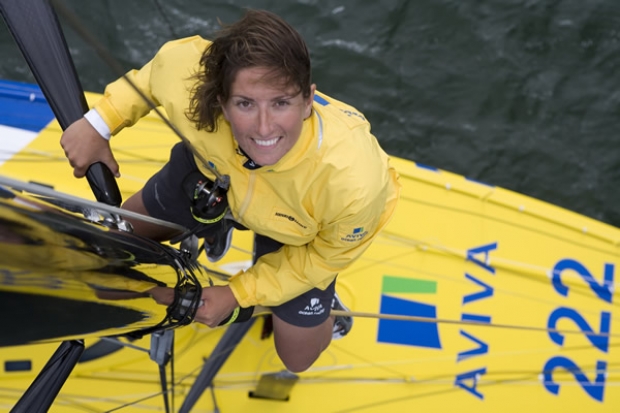
She seems ostensibly calm, round the world yachtswoman, but tomorrow Dee Caffari will set sail on her first singlehanded offshore race aboard her gleaming new vibrant yellow IMOCA Open 60
Aviva.
So how is Dee feeling? “It is kind of scary and exciting. I have spent a lot of time getting miles sailing solo on this boat already and that is a big difference to where I was last year when I had no solo experience on an Open 60. So I feel a lot more confident and a bit more confident with the systems, because they are complex boats now and I’m learning all the time. And that’s exactly what this race is - a big learning curve. We’re going to spend a couple of intense weeks together in hostile conditions – the North Atlantic is never very nice and I think we are going to through a lot closer and if there are issues now is the time to get them because ultimately the focus is for the Vendee this year.
“We’ve done a lot of work on the boat. The boys have worked really hard to get to the point where they are really relaxed this week which is having a really good knock-on effect on me and I am looking forward to putting my boat in a competitive environment and seeing what she can do and if I can keep up with her.”
Aviva was launched from Hakes Marine in Wellington in December last year and was already being sea trialled by project manager Joffe Brown and her five man shore time by the time Dee was racing in the Ecover Transat B2B. The team carried out sea trials in Wellington, testing their new steed in Cook Straight in a variety of conditions with the view that if there were any major teething problems then they would be close to the builder to have them repaired.

Aviva was then shipped to Portugal arriving at the beginning of March. The team spent eight weeks training out of Cascais, the benefit there being firstly the climate and secondly being able to head straight out into the open sea. During this time Dee carried out her qualifier for the Artemis Transat - 1000 miles down to Madeira and back. The routine was harsh - training and testing gear at sea during the day with the shore team working on the boat early in the morning and late at night so as not to eat into the all-important sailing time.
The delivery from Portugal to Plymouth for the start of the transat was also used for more solo training for Dee who spent nine days deliberately taking a circuitous route out into the Atlantic and up into the Irish Sea. “It was a good time to spend and I got used to spending time and being alone on the boat,” Dee says. To date the boat has 3000 miles on the clock, 2600 of them singlehanded.
While Aviva has been popped from the same moulds at Hakes as Mike Golding’s new Ecover, just how identical is she? According to Dee all the performance areas are the same, in particular the ballast arrangement and the foils. However she has made modifications to the deck layout and the nav station to suit her needs. Essentially Ecover has two pedestals and twin winches for the mainsheet whereas Aviva has one pedestal and a dedicated main sheet winch on a centrally mounted island in the middle of the cockpit. Down below Golding has a comfy canting bunk at the chart table while she has a more minimalist affair prefering to sleep on a bean bag.

Perhaps the most significant aspect of her and Golding’s campaign is that they have a technology alliance and will be two-boat testing. For example North Sails France are doing the sails for both boats and on Aviva’s return from the US the two boats will line up. In particular Dee says they will be looking at sails and set-ups. “We have systems and the only way of really knowing if some of them work or don’t work is by having two boats one with it being used and one without...”
The boats have slightly more complex water ballast arrangements in that they have five tanks in total down each side (most Open 60s have just three) the added two being aft in the boat. However presumably also into the mix they will attempt to find out the effect of the interceptor, the drop-down plate fitted beneath the transom of each boat.
One of the most alarming aspects of the campaign is over the keel foil issues Aviva’s sistership experienced in the Ecover Transat B2B, that has since forced Mike Golding to change his yacht’s keel. Ecover is presently over at JMV Industries in Cherbourg having a new carbon fibre foil fitted.
So how has this affect Dee’s campaign? “Obviously it was something we had to address and check our keel. We have been vigilant and we’ve ordered a new keel for the Vendee. In the summer we will be changing our keel. Mike has gone carbon and we are going forged stainless. There are three options and they all have pluses and minuses. We are not going fabricated again and this was the closest to a like-for-like fitting in the boat. Mike had to do some work to get the carbon one fitting because it is slightly bigger.”
But Aviva’s present keel for the Artemis Transat is the same as the one that suffered problems on Ecover - so there must still be the niggling worry that something could go wrong with it. “Everyone has commented we’ve the same keels from the same place. There were discrepancies on the manufacture and the weld processes but Mike had done over 10,000 miles before he had the issue. I’m at 3,000 and I can still go to America and back before we get to that same mileage. We’ve had it inspected and we were out of the water just before we came into Sutton Harbour and it was blemish free - looking really good. We’ve had someone down looking at the keel head too.”

So what does she find is the hardest thing to do on board? “The intensity of them is unbelievable. The noise and motion is just so violent. It is a high stress environment and you are living in that environment all the time and it really takes its toll. These boats look really large but there is not a lot of space down below because we have ballast tanks everywhere so maneouvring your gear and stacking it from side to side is probably the most labour intensive bit of the whole thing.”
The central water ballast tanks on both these Owen Clark-design boat are so deep that they do severely limit the headroom down below.
At present they are also looking at the stacking systems. Several boats have ability to make it easy to move the stack fore and aft down below and most have also thought about how easy it is to dump the stack to leeward prior to tacking.
“We have made it as easy as possible and everything is smooth and curved so that nothing gets caught when you are dragging things through because if you are fighting all the time you are less likely to do it. But ultimately spares are heavy and you have to carry them so it is a case of taking them in the most efficient form - soft bags, hard boxes, what works for us. And whether you can throw something - will it break when you throw it?”
Singlehanding a hugely powerful IMOCA Open 60 is a handful even for a giant. Dee has been undergoing a rigorous training regime and appears to be extremely fit at present. However strength is not the key to handling a boat like this - rather it is learning the techniques and shortcuts and setting up systems to make life easier.
“You learn by experience, you learn by mistakes massively and you learn what works for you,” says Dee. A real bonus has been employing the talents of Tanguy Leglatin, who is one of the top Figaro and Mini coaches in France. “He says ‘try this, try that’ and it has been fabulous because it has given me more confidence and we have found a lot simpler ways of doing stuff that are a lot less stressful. A massive example for me was the spinnaker. It is the biggest sail area that you are ever going to deal with and if it goes wrong it goes really wrong. So you want to be in control all the time - there’s nothing worse than being on the foredeck hanging on to a bucket that is not moving. I have rigged it now that I can control everything from the cockpit - the sheet and the bucket and everything. That has made a massive difference, because you are in a safe environment and you have absolute control which means you are more confident and more likely to use the sail.”
Dee has also received some coaching from French meteo and routing guru Jean-Yves Bernot. “That was just awesome. I couldn’t absorb enough information. The guy is a legend and makes all it seem so simple. In a few days we went around the world and it was so easy. If we can replicate that in real life it would be fine.”
So how is she getting to grips with the singlehanded offshore lifestyle issues – the lack of sleep, the dreadful food? “I’m getting better,” says Dee. “The reality is that I am more aware of it. When I am feeling down or emotional it is because I haven’t eaten or slept. I think now I am aware it makes it easier to manage and understanding that when the boat is sailing and everything is consistent, to get the sleep when you can, because there will be times when you can’t. And we all know that the last 800 miles of this course is fishing, shipping, fog, ice and debris in the water - we’ve all hit things or picked things up. That will be the time when it will be pretty full on.”
Dee is working with the Sports Science Department at Leeds Met University (from where she graduated) where they are arranging her physical training regime and also developing the best practice for her sleep management, her nutrition and her psychology. “They have made me in all my sailing to date to make a log of when I sleep and eat. When you do that you start to see what you do and how bad you are... So it has made me much more aware. They analyse it and seen what effects its had on me the next day.”
When it comes to sleep, Dee says she is able to do what average mortals find nearly impossible: to catnap. “I am a catnap person - 10 minutes, 20 minutes. I get to the point where I go to sleep and I think I’ve been asleep for ages, but it’s been just 5-6 minutes. That is a good position to be in. I sleep at the chart table so that I can keep an eye out and look at everything. I sleep on my bean bag. I really need to sleep between 4-8am and I can’t sleep at all in the afternoon, around tea time. I am very functional then - I can do all my jobs. But first thing in the morning I am dead until I’ve had a couple of good half hour catnaps. Then I am okay.”
Food-wise she will eat freeze dried with some quick cook off-the-shelf meals to break up the freeze dried monotony. “I’ve had to hide my jaffa Cakes on the boat though from the boys,” she admits.
Given her background - the Challenge and being the first woman to sail singlehanded non-stop westwards around the world - Dee admits that what she is likely to find the most stressful aspect is being in the competitive environment of the IMOCA class. “Everyone wants to see where you are in the rankings and you have to make the right decisions - I think that is the major stress for me. And then making tactical decisions and deciding what the weather is telling you to do - they are the two new aspects I need practice in. One of my biggest fears is the start line just because you think there are too many of us and we’ve all got to go in the same direction so when we are in open ocean it is a lot easier.”
In terms of training board Open 60s Dee says that the French crews who sail en masse out of Port la Foret are at an advantage, however the Brits are taking steps to emulate this. Already she is testing with Mike Golding and his Ecover team, but is also talking to Alex Thomson and Brian Thompson about joining forces as well.
“We are all talking a lot more. We have now all got our boats and they are all very different. Everyone is really keen to spend some time on the water and if we can do that then hopefully as a Brit pack we can all develop and move up the rankings and have a little more impact.” Perhaps this would be the opportunity for the RYA to provide some coaches to help get the British Vendee Globe competitors up to speed.
Following the Transat Dee will sail Aviva back to the UK singlehanded. As she puts it: “At least it is the right direction - I’ll practice sending it down waves rather than crashing into them.”
Having sailed around the world westabout and skippered a yacht in the Challenge, Dee of course has sailed more miles than most upwind. However the forecast for the Artemis Transat is not lining up to be typical. Instead the majority of the time will be spent sailing downwind in light conditions while the fleet will have a negotiate a series of high pressure ridges. “It is complex, it is looking light in places and there’s fog – sailing in fog is just horrible. There are a lot of light periods which might not split the fleet, but then it makes it more of a race.
As to her expectations in the Artemis Transat, Dee says: “For me, first and foremost is to finish the race and qualify. What I really want to do - all the guys have worked so hard, I want to show them what a good job they have done. And to be as competitive as I can. It is hard because I knew where my old boat would be. With this I know my boat can do it because Mike has proved that on the TJV and the Ecover B2B and it is now almost whether I can keep up with the boat. Making the tactical decisions may be my down fall, my weakest area. As long as I arrive and if I have made a mistake, a tactical error and I can recognise where it was and why it was, then I have learned. So as long as I have learned. Ultimately it would be nice to be in the middle of the fleet and competing with the other boats. That would be awesome.”
Most Read
Most Commented
Comments
Businesses

Pro businesses
-
Italy
-
France
-
France
-
Italy
Editor's choice
Member blogs
-
 Ned Collier Wakefield: MOD70 round BarbadosWell that was intense. 12 hard fought for seconds for the win. In idyllic conditions, Tony Lawsons MOD ...
 -
 Mini Transat leg 2 reportThe second leg of the Mini Transat started on 31st October, just over a month after ...
 -
Leg 1 reportI’ve been working towards the Mini Transat now for three years. In 2013 I was part ...
Business blogs
-
 The Island Sailing Club in Cowes, Isle of Wight, is delighted that Prince Michael of Kent ...
 -
Peta Stuart-Hunt chats with the 25 year-old British solo sailor Lizzy Foreman before she sets sail ...
-
The 2015 Student Yachting World Cup (SYWoC), an ISAF-recognised event hosted and run by students for ...
Editor's Choice
All time favourites...
-
 Three legs down into Ian Walker’s
 -
 Winning all but two races at
 -
 For the first time in its
Latest Comments
Add a comment - Members log in