
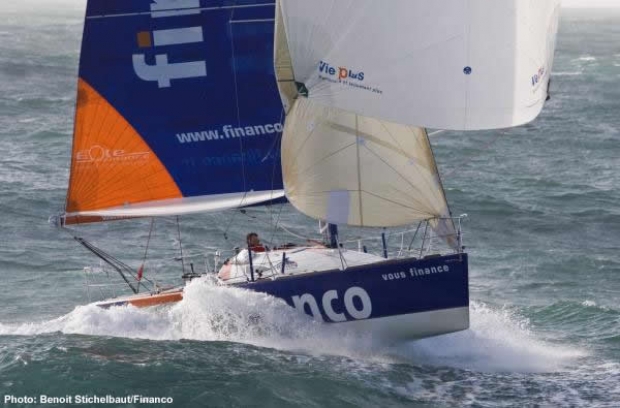
How to win the Solitaire du Figaro
Thursday August 14th 2008, Author: James Boyd, Location: United Kingdom
In the pantheon of the Solitaire du Figaro there are three big names: Michel Desjoyeaux, Jean le Cam and Philippe Poupon, all of whom have won the effective world championship of solo offshore racing three times. However, at the end of this year’s Solitaire a new figure is on his way to joining them.
33 year old Nicolas Troussel this year participated in his eighth Solitaire du Figaro and won it for the second time, having previously achieved this feat two years ago. This year while many of the stars such as Alain Gautier, Michel Desjoyeaux and Loick Peyron are off on other projects, he was still up against some solid competition such as past winner Eric Drouglazet, former ORMA 60 skipper Antoine Koch, 2005 Mini Transat winner Corentin Douguet and a wealth of Figaro stalwarts like Gerald Veniard, Gildas Morvan, Nicolas Berenger, Thierry Chabagny, Fred Duthil, Jeanne Gregoire and Marc Lepesqueux, etc.

“I am very happy,” Troussel told thedailysail of his second win. “It was a difficult race with good skippers and I am happy because it was objective this year and it is very good when you achieve your objective.”
Now living in Rennes, Troussel says he has sailed pretty much all his life. In his youth he cruised with his parents out of Morlaix on Brittany’s north coast on their boat and has fond memories of spending his summers in the Scilly Isles and Channel Islands. While his brother got to learn sailing in dinghies, in his youth he preferred tennis, although he frequently sailed with his family and friends.
He began racing locally in Morlaix in classes such as the Beneteau First Class 8 and the Melges 24 and, as he puts it, after that he graduated up to racing around Brittany and then around France, winning his class at SPI Ouest France when he was 20 and competing in events such as the Class 8 Europeans and winning the Melges 24 European circuit in 1998.
While his experience was in crewed racing, he admits his eye had been on the Figaro for a while before he got the opportunity to do it. “It was a dream for a long time. Just to do the Figaro is very very good and it is a good objective.”
He was fortunate that in 1998 he won the Solo Telegramme Cote d’Armor, an event where first prize was sponsorship for a Figaro campaign (a similar prize launched Franck Cammas’ career and many others in France) and Troussel says that the following year he went professional. He has competed on the Figaro circuit since, missing just one Solitaire over this period, in 2000. In fleets generally around 50 strong, he finished eighth on his second attempt and generally posted fairly lowly results in the Solitaire, however he finished second in the Trophee BPE singlehanded transatlantic race in 2001 and won the Transat AG2R with another Solitaire winner Armel le Cleac’h.
It is really only the last three years that he has reached the upper echelons of the Figaro class - in 2005, the year before his first Solitaire win he finished 23rd… His game may have been raised over this time as he hung on to the coat-tails of his AG2R co-skipper when le Cleac’h took over as skipper of the Foncia ORMA 60 trimaran and subsequently the IMOCA Open 60 BritAir. Troussel competed in the ORMA circuit in 2005 and last year raced the Transat Jacques Vabre with le Cleac’h two handed on BritAir.

The Solitaire is in many ways an unusual race. It is still scored on accumulated elapsed time rather than points per leg (as formerly accumulated elapsed time events such as the Volvo Ocean Race moved to some time ago). “It is a good system. For me it is better,” says Troussel when we ask him about this. “The Tour de France cycling has it! It allows you to have a good race with options, because with a points system we would have no options because we would just cover the other boats, so it would be less tactical.”
He is right of course. On races scored on points, how quickly you sail a leg is of no importance - the only thing that matters is that you beat your opponent. On accumulated elapsed time all that matters is how quickly you sail each leg. But this does mean that it takes one leg where the leader sails into better breeze towards the end and is off or someone takes a flier that reaps big dividends, to win them the whole event.
This latter example is how Troussel won in 2006. On the second leg across the Bay of Biscay from Spain back to France by he headed east when the majority of the fleet went west. As a result of these smart tactics he finished 2 hours 15 minutes ahead of the second placed boat, a margin that enabled him ultimately to win the race overall.
This year Troussel effectively won the race on leg one, when he fought through the light conditions that dogged the early part of the leg and was first to the new breeze, that resulted in his winning the first leg by 5 hours 33 minutes. As he described it: “After 24 hours of calm conditions at the beginning of the leg when I think a lot of people got tired and slept, I really pushed myself because the forecast showed there was going to be better conditions further out to the northwest. So I forced myself and pushed and pushed and managed to get a few miles ahead and then I just reached it first. I positioned myself northwest to get there first.”
He followed this up with a second place on leg two but on the final leg finished 18th. But given that the first 32 boats finished within five hours of first place on the third leg, his last leg result was more than adequate and he ended up winning overall by 4 hours 22 hours ahead of Gildas Morvan (who on a points system would have been first equal this year with Erwan Tabarly). In fact the points versus accumulated elapsed time issue was even more acute in the 2006 race when Troussel won despite Gerard Veniard winning the three other legs.
This is not to detract from Troussel’s victories. The Solitaire du Figaro is won on accumulated elapsed time and under this system our man has won two races decisively now. Respect.
This year’s Figaro was unusual. Firstly the event was modified back to its origins, with three long legs rather than four shorter ones. Then the weather, it is safe to say, provided the skippers with a ‘complete test’ from the light airs that dogged the first leg (and caused it to be shortened) to the stormy conditions of the third where the boats were effectively sent out on a 400 mile windward-leeward.

According to Troussel he is happy sailing in all conditions. However his technique for sailing his Figaro is differs from the grim images typically associated with those who do well in this event: of staying glued to the helm night and day, come hell or high water and on occasions staying awake for most of the three day long legs.
Over this winter Troussel says that he spent a lot of time getting the trim of his boat sorted out so that it would work well with his autopilot. As he puts it: “All conditions are good for me, but I prefer when you don’t have to be driving the boat all the time and when you can use the pilot and you can go to analyse the meteo and prepare the boat and can sleep.”
At night for example the pilot will usually steer the boat faster. Troussel says he would simply check, helming for a bit and then putting the pilot on and if the pilot could match his speed, then he would leave it in control while he concentrated on the nav, meteo or on trimming or on checking that there is no seaweed attached to his rudder or keel. For he says that while the boat must be sailing fast, the most important thing is to ensure that you “go to the right place” ie that your tactics taking into account the weather is the best.
However this did not always work out. On the third leg, one reason for his 18th place after previously scoring two podium spots was that his wind vane broke and his pilot was no longer able to sail to wind angle. As a result he was forced to helm most of the way home.
Having a young child no doubt has helped train him for sleep deprivation for Troussel reckons that on average he slept around one or two hours each day, all in short catnaps. In fact on a typical three day race he says he will typically sleep for around three hours over the course of the first day and after that (presumably when everyone else is completely exhausted) will not sleep at all. When he does sleep he says he goes down below into relative comfort in order to get “good repairing sleep”. But obviously this depends a great deal on the conditions as he will only sleep when the pilot is steering the boat efficiently.
As to his boat, his Beneteau Figaro 2 is two years old (he won the 2006 event in it) and is owned by his sponsor Financo. In some classes older or newer boats can be deemed to be faster and Troussel says that while some of the older Figaros are lighter, the newer ones built using resin infusion are stiffer and stronger.
The boats carry a limited sail wardrobe, although the manufacturer is open. On Financo he carried a suit from North France with the exception of the big spinnaker which is from Incidences.

Equally vital to his project is the preparation of his boat and in this respect he has his shore crew Yann Cecile to help him, Cecile previously having worked in this role with two past Solitaire winners, including Armel le Cleac’h.
In addition to the preparation of his boat, training remains vital and Troussel does this from the famous school in Port la Foret, where he also undetakes the centre’s relentless fitness regime.
Having two Solitaire wins under his belt Troussel is now hoping to move up to the IMOCA Open 60 class, as his friend le Cleac’h has done. He intends to mount a project for the 2012 Vendee Globe. “This second win I hope will be like a launch pad for that, so if I am back here next year it is because I haven’t managed to get a Vendee Globe project going!”
Given that so many skippers in France have been able to move up to the 60ft classes following one win in the Solitaire, Troussel having two under his belt must make him a hot property for sponsors considering the solo non-stop round the world race after this next one.
Most Read
Most Commented
Comments
Businesses

Pro businesses
-
-
United Kingdom
-
United Kingdom
-
Editor's choice
Member blogs
-
 Ned Collier Wakefield: MOD70 round BarbadosWell that was intense. 12 hard fought for seconds for the win. In idyllic conditions, Tony Lawsons MOD ...
 -
 Mini Transat leg 2 reportThe second leg of the Mini Transat started on 31st October, just over a month after ...
 -
Leg 1 reportI’ve been working towards the Mini Transat now for three years. In 2013 I was part ...
Business blogs
-
 The Island Sailing Club in Cowes, Isle of Wight, is delighted that Prince Michael of Kent ...
 -
Peta Stuart-Hunt chats with the 25 year-old British solo sailor Lizzy Foreman before she sets sail ...
-
The 2015 Student Yachting World Cup (SYWoC), an ISAF-recognised event hosted and run by students for ...
Editor's Choice
All time favourites...
-
 Three legs down into Ian Walker’s
 -
 Winning all but two races at
 -
 For the first time in its
Latest Comments
Add a comment - Members log in