
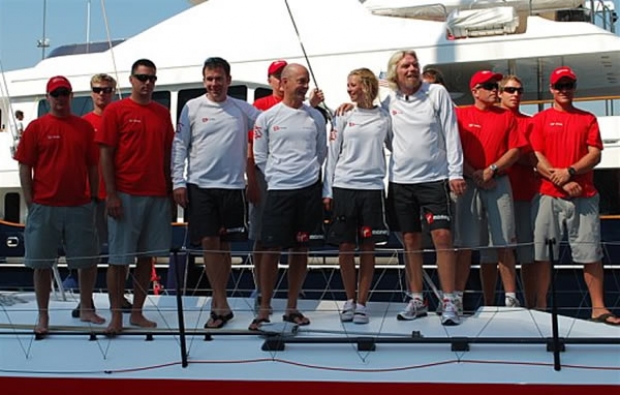
In white (left to right): Mike Sanderson, Alex Jackson, Holly Branson and Richard Branson
Waiting for the green light
Wednesday September 24th 2008, Author: James Boyd, Location: United Kingdom
One of the most positive pieces of news this year is that Richard Branson is to join forces with Mike Sanderson, Alex Jackson and the Speedboat team for their 100ft supermaxi’s imminent transatlantic record attempt. At present
Virgin Money, as the boat is now known, is in Newport, as the team await an appropriate weather window to attempt the eastbound passage from New York to the Lizard.
At the weekend Mike Sanderson gave us the low down on the project: “It has been something we’ve been working on for a couple of months, but these things always take time. It was always going to be nice to find a sponsor for the boat, although it wasn’t high on the agenda, but if something fitted it would be a bonus.”
The deal came through TeamOrigin initially following direct contact between Sir Keith Mills and Richard Branson. “They thought it was fantastic. There is so much history and prestige for the Atlantic record," says Sanderson of the Branson/Virgin reaction to the proposal. "I’d like to think it is not as life threatening as trying to go across in a balloon and there is an opportunity for him [Branson] to do it with his kids. Sam and Holly do a lot of sailing and Holly is a doctor, and we’ve always taken a highly trained medic on the boat.”
Having claimed the Atlantic on board the fastest powerboat in June 1986 and by hot air balloon the following year, Branson was to have made the crossing by sail with his old friend the late Steve Fossett back in 1999 on board the maxi-catamaran PlayStation, however a weather window never materialised.
While the Speedboat graphics were very cool-looking, Speedboat is now emblazoned in Virgin red which Sanderson says is all vinyl on the hull. “We have a 600sqm red code zero with Virgin on it which looks pretty spectacular.”
Rather quietly Speedboat started out on an attempt on the transatlantic record back in July, but had to return home when she broke one of her daggerboards. This has now been replaced with the spare, which Sanderson says is stronger as it is reversible. “The problem is that according to our calculations the daggerboard shouldn’t have broken so until we can work that out we haven’t ordered a new one. We are going to do some more load testing. The boards’ angle of attack is adjustable hydraulically so we can work on trying to get some loads out of them and we can put some sensors on them.”
They have recently spent a week training and re-familiarising themselves with the boat. To date their top speed remains from their sea trials in Auckland when they hit 28 knots and Sanderson admits they have still to ‘light the boat up’ but enthuses about how effortlessly the speed comes: 20 knots in 13 knots of breeze is a matter of course. “We came back from New York, bore away to bring the boat up to Newport and put a fractional code zero and a staysail on and had guests driving doing 21 knots and they were blown away.”
With a Volvo Ocean Race starting imminently, exactly what crew will be on board will depend upon when they set off. They will go with 20-24 crew but have 35 with “their phones switched on”. “We need to good team but getting the right weather is key,” says Sanderson.
The crew line-up is set to include Alex Jackson’s regulars but the majority will be from TeamOrigin and looks set to include both Ben Ainslie and Iain Percy. “Ben is keen. Percy is keen as well but after he said he thought might get seasick for the first two days, I wasn’t quite so sure that’s what we needed! It would be great to get them along. Obviously the thing with Speedboat is that fast helmsmen can sail her fast, they are well rewarded.” Ainslie will have benefited greatly from having sailed on Neville Crichton’s Alfa Romeo supermaxi but Sanderson says the experience will be rather different: “He’ll find it a bit further to walk between the wheels! And hopefully she is a bit more bow up when we are going at high speeds.”
Despite having brokered the deal Sir Keith Mills won’t be on board for the record attempt. “He came to the launch in New York. He has been instrumental in putting this deal together. He and Richard [Branson] know each other well. Keith will come and do some sailing with us when we do a regatta or something. I’m not sure how Richard has managed to put the time aside, because I know Keith certainly can’t. We were talking about stand-by times and we worked out that Richard can get her the fastest because he is the only one with his own jet - and his own airline..!”
The window for the record attempt is September and October. This was when they broke the fully crewed monohull record previously on Robert Miller’s Mari Cha III and Mari Cha IV and is the optimum time of year weather-wise, although several multihull records have been set mid-summer on this course.
So in the meantime they and their routers at Commanders Weather will wait for the optimum conditions. “We want to go across with a pretty big low pressure behind us that is coming after a big high pressure, so that we get flat water, because the one thing that will slow this thing down the most is waves,” says Sanderson. “They become quite uncomfortable when they start shovelling through it rather than being able to rip along. That is what we had with Mari Cha IV in 2003. You need a stable high so that the low can go across the top of it and the idea is that if the high is nice and wide then there is more chance that the low can go into the English Channel. If the high is narrower then there is more chance that the low will either detach and head off north of Ireland or go over into the Bay of Biscay.”
But mostly the depressions that regularly trundle eastward across the north Atlantic emanate from mainland North America before they head out across Newfoundland. As a result one of the hardest parts of the necessary meteorological scenario is to be able to leave New York in decent pressure.
The time to beat is Mari Cha IV’s record of 6 days 17 hours. With some scenarios, Sanderson says the routing is showing them making the crossing in as little as five days. He admits that their time on the 140ft schooner-rigged Mari Cha IV could have been quicker – they spent one day of it going upwind .
“The computer says Speedboat is faster than Mari Cha IV everywhere. The thing with Mari Cha IV is that length goes a long way in things like record attempts. When you are doing a sail change on Mari Cha the thing still trucks along doing 18 knots, whereas Speedboat is more like a Volvo 70 and you are doing 12 knots.”
A significant difference between the two attempts is that Mari Cha IV’s record was carried out with an army on board to man the twin rigs and grinders. Speedboat has all-powered winches. But given that all of the new generation supermaxis are in this configuration perhaps the powered winch record will become the more dominant of the two records. Sanderson points out that the situation is already blurred: when Charlie Barr set the record of 12 days 4 hours back in 1905 during the Kaiser’s Cup Transatlantic Race, his 185ft LOD three masted schooner Atlantic was fitted with steam powered winches.
“At the end of the day the fastest monohull across the Atlantic is the fastest across the Atlantic. What’s in the record book and what everyone worries about can be two different things. I just think of it as raising the bar. It is not like having powered winches on a 12m where you are pumping down the waves or something. These are used to pull the sails up and down, you are apparent wind sailing so these sails are on a self-tailer anyway. And these 100 footers – this is my first experience of powered winches - they are so much cooler boats because of the power winches as you can sail the boat faster. We did that New York YC Annual Regatta and we only sailed the boat at 75% because it was brand spanking new, but it was 2 mile windward-leewards and he hoisted 980sqm of cuben fibre out of the hatch. Imagine if you had to tell your grinders you were going to do that four times!”
For Sanderson, a personal goal for Virgin Money in addition to rebreaking the transatlantic record is to extend the monohull 24 hour record. On their transat record they broke the 500 mile barrier for monohulls on Mari Cha IV but with Virgin Money, Sanderson is hoping they can tick off 600 miles in 24 hours. But the transatlantic record is paramount, the 24 hour record a bonus.
Virgin Money’s program post-record attempt will depend very much on when they arrive in Europe. Competing in the Rolex Middle Sea Race is looking increasingly unlikely, but there remains the possibility of competing in the Spice Race down to Grenada but owner Alex Jackson is most keen on competing in next year’s Pineapple Cup from the Fort Lauderdale down to Montego Bay, Jamaica. This could then be followed by the RORC’s new Caribbean 600 race, Antigua Sailing Week and then through the Panama Canal up to Los Angeles to compete in the Transpac and maybe then go on to do the Rolex Sydney Hobart at the end of 2009, says Sanderson.
Whether Virgin Money’s sponsorship of the campaign continues beyond the imminent record attempt is still up for discussion. “It is an on-going thing depending upon what everyone wants to do,” says Sanderson. “Alex and Virgin and all of us will sit down sometime soon and we’ll work out what everyone wants to do.”
More photos of Virgin Money on page 2....

Most Read
Most Commented
Comments
Businesses
Pro businesses
Editor's choice
Member blogs
-
 Ned Collier Wakefield: MOD70 round BarbadosWell that was intense. 12 hard fought for seconds for the win. In idyllic conditions, Tony Lawsons MOD ...
 -
 Mini Transat leg 2 reportThe second leg of the Mini Transat started on 31st October, just over a month after ...
 -
Leg 1 reportI’ve been working towards the Mini Transat now for three years. In 2013 I was part ...
Business blogs
-
 The Island Sailing Club in Cowes, Isle of Wight, is delighted that Prince Michael of Kent ...
 -
Peta Stuart-Hunt chats with the 25 year-old British solo sailor Lizzy Foreman before she sets sail ...
-
The 2015 Student Yachting World Cup (SYWoC), an ISAF-recognised event hosted and run by students for ...
Editor's Choice
All time favourites...
-
 Three legs down into Ian Walker’s
 -
 Winning all but two races at
 -
 For the first time in its
Latest Comments
Add a comment - Members log in