
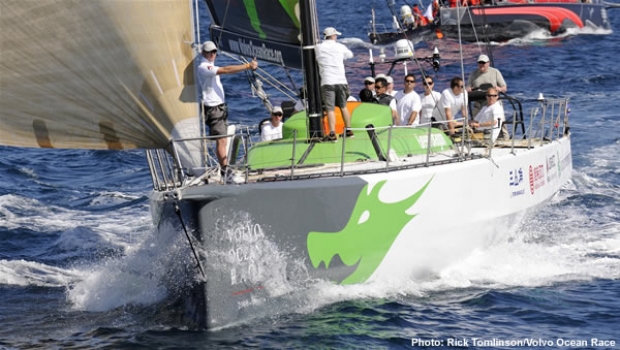
Walker's first round the world
Sunday October 5th 2008, Author: James Boyd, Location: United Kingdom
Just 10 months on from Ian Walker and Jamie Boag announcing their Reichel-Pugh designed McConaghy-built Volvo Open 70 campaign, so the Green Dragon team are in Alicante in the final throws of preparing for this coming Saturday’s start of the Volvo Ocean Race proper.
Yesterday they got their first points on the board, ending up fifth after the two in-port races, including a third in race one, not a result skipper Ian Walker was particularly enamoured with: “I like to win, so I am not jumping up and down with joy, but there were a lot of positives,” he told thedailysail. “We only really did one bad manoeuvre when Telefonica tacked on us. That was caused by the back wind from their sails, which backed our Code 0 which made it hard to tack - it was a very small thing, but it completely parked us up.” Another lesson learned in the small amount of time they have had to work up and learn about their new craft. “We made some good starts, crew work was pretty good, but we didn’t really have the legs and caught the wrong side of the shifts at times. It was pretty hard out there, but it was good to be fighting it out with the Ericsson boats.”

Puma and Green Dragon were the only boats to fly Code 0s upwind and in race two Puma particularly was able to do a horizon job on the fleet upwind under theirs. Walker feels that the Puma Code 0 may be more upwind orientated than theirs. He adds that it was a marginal call - they only hoisted their giant masthead sail for the second beat of the second race when they had ground to make up on the competition. This they succeeded in achieving until they had to manoeuvre. “When it is that shifty it is quite risky because you can’t tack on the shifts,” says Walker.
Generally the in port was a big ask for the 12 sailing crew even with the additional horsepower of Cup grinders Freddie Carr and Julien Cressant. “It is a 1.6mile beat, so a boat handling fest really. Certainly in a breeze, when you hoist the spinnaker it is two minutes until the layline. So if you can’t get the spinnaker up in two minutes…! It is pretty tight - it is shorter than a TP52 course and you have a boat 18ft longer, twice the weight, 50% faster up and downwind and then you have got 30% less people…” says Walker. “And it is not like a normal boat where you have a tactician watching everything unfolding. You are having to make pretty split-second decisions without even really knowing where you are on the course. Sail selection is a big deal. You can’t change sails during a race, because it takes so long and the courses are so short that everyone is out of breath the whole time! So getting the right sails up is important.”
It also takes time to prepare for the In Port races, changing the boats to ‘inshore mode’, removing halyards, removing all the inventory of offshore safety gear they are allowed to and fitting more inshore gear down below for packing kites, etc. Then changing them back again afterwards. Plus there is the crew training. “It took us three days to get within 100 yards of the leeward mark!” recounts Walker of how their inshore training went last week.
While they have had less time on the water than most of the other teams, Walker says that they had have the opportunity to try their boat in most conditions now. “We hadn’t had much light air until we got here. And we’ve had quite a lot of wind against tide, choppy, boat breaking-type stuff, but not having to slow the boat down upwind type weather. But I am reasonably happy: The boat is still in one piece. We’ve had one structural thing but we repaired that in two hours. (Some capping came off the top of a panel which we bonded straight back down). Otherwise - touch wood - it has been alright.”
The crew has been coming together well. While the likes of Ericsson in particular have been at their base focussing 100% on how to make their new VO70s go fast, within the Green Dragon team there have been a few sporadic absentees such as navigator Ian Moore who has been away winning the Audi MedCup with Quantum Racing and some of the crew who sail with Mike Sanderson on the Speedboat/Virgin Money supermaxi. “I have chosen a bunch of people who I’d want to go and have a beer with in the pub,” says Walker of his crew selection. “Everyone has their own qualities and things that are important to them. Damian [Foxall], Neal [McDonald] and Ian are all crucial and they have different styles and approaches to the thing. Justin [Slattery] of course has winning experience with ABN. He has been able to short cut a lot of our manoeuvres. But I can’t single anyone out. The young guys have done well, they’ve all done well. We haven’t had a crossed word since we started, although I’m not sure we will be a happy ship if we did two weeks at sea and were last.”
Although he has been sailing with them continuously since the summer, only recently announced was their sole Chinese crewman and media representative Guo Chuan. Chuan was on board Qingdao Clipper for the Clipper round the world race and before being signed up by Green Dragon had his heart set on next year’s Mini Transat – even having completed the first step, the 1000 mile qualifier. “Anyone who can do 1000 miles in a Mini is good enough to sail with us,” says Walker. “He is having to come to terms with the media side, which is quite demanding. He is a key part of our getting our team and our program and the race out on TV in China and the Far East. Obviously having someone on board who can write and talk in Chinese, probably more than doubles the audience of the race. That is important for the race and for us.”
However at present there are no other Chinese sailors on board. “We have trialled other Chinese guys, but it has been hard because we have so little time,” says Walker. “And China don’t have the background of offshore, but they have built up the Olympic team very rapidly, so it will only be a matter of time. Hopefully Guo will be able to go on from this and run a full-on Chinese effort in the future.”
Personnally throughout the summer for Walker there has been a major question mark over his fitness due to a back condition. He says it has only been quite recently that he has receovered. “I have been throttling back all summer - I didn’t have surgery, but I had some painkilling injections. To be honest I am just happy to be fit again and to take part a bit more.”

Having raced in the Olympics and in the America’s Cup and most of the world’s most competitive classes, Walker has been having to make the transition into an offshore sailor, but seems to be taking to it well. “I’ve been trying to stay up late and trying not sleep too much – I’ve gone for days without changing my underpants and trying not to wash! Neal [McDonald] has taken me under his wing. He keeps telling me is that the best thing about offshore sailing is that you don’t have to brush your teeth for a week. So obviously I am trying to work on having bad hygiene and bad personal habits! It helps not having my wife here! I think I quadrupled my amount of offshore sea miles. I am enjoying it. One the things is that if you can enjoy it when you go out there for five days on your own, then sailing for a couple of weeks when you have the excitement of the competition, then it will be three times more interesting. On board the boats are relentless and you can always make the thing go faster.”
Aside from the inevitable dose of spotty botty to look forward to, he has had to learn some more practical offshore skills too. For their delivery trip down to Alicante Ian Moore was away on the Audi MedCup and Walker himself navigated them to the Volvo Ocean Race start port in the south of Spain. “It was my first big test - but we found it!”
Come the race proper Walker and the Green Dragons will spend most of the time racing dots on a computer screen, rather different from the contact sport he is used to. However he is adamant he won’t miss this - in fact quite the contrary: “We will be finding out about where everyone else is every three hours, but if I had it my way we’d have much longer periods of not knowing where people are. You can get away from people more in the Fastnet, when it is dark. On the other hand you can go a long way in three hours on these boats!”
Since arriving in Alicante the boat was hauled for a two week refit at which time their new Green Dragon branding was added and some optimisation work took place. They only got back on the water mid-September, when they spent 10 days looking at new sails before setting up in inshore mode.
Looking ahead the million dollar question will be - how will their Reichel Pugh VO70 perform against the bigger budget teams fielding two boats and which have benefited from considerably more design, build and preparation time compared to them?
“Obviously anyone who has had the time and money to build two boats will have refined their second boats,” says Walker. “With the time and budget Ericsson have had, they should have a big advantage. If they don’t have an advantage they have done something wrong.
“Puma has a nice paintjob! I think it is slightly lighter air-moded than our boat. Pretty conservative rig like us. Pretty similar to us in a lot of respects. I’m sure they will have a good sail program.
“Telefonica should have an advantage except that they have put their boats in the water so late. They have obviously gone heavily down the low windage route, headfoils, no jumpers - but there are a lot of things on that boat which are a lot lighter than ours.
Their boats stand-out in terms of innovation. There are lots of good ideas on them, but they also look like the boats least able to sail outside of the Med, but maybe we’re wrong.” A key feature of the Farr boats is their open America’s Cup V5 boat cockpit. “There is a lot of good thinking in that in terms of windage and moving the sails around. If you can move the stack without having to lift them over everything - if you can slide it across the floor underneath all the pedestals, it is a big advantage. It can take you 40 minutes to gybe in a breeze… There is a lot of very clever thinking on it.”
Walker’s observations about the Telefonica boats highlights a necessary gamble they have taken with their own boat. While the Volvo Ocean Race might seem like any other, this time around it is very different – the complete course is a quarter longer again, the longest round the world race ever staged, and is on a new and, for at least one third of the race, unfamiliar course. The most worrying part of the course is the leg to Qingdao where typically the wind will be strong and on the nose. And all this takes place within a tighter schedule, the stopovers substantially shorter than in previous races.
“If you break your boat on the way to China and you get there a week later because you’ve had to motor you might not have time to fix it and miss the next leg - then how are you going to catch the race up? Even the first leg, last time round they had a month in Cape Town and there were boats which just made it and they literally finished their boat the day before the leg restarted. This time we have got 12 days in Cape Town. We have two weeks less.”
While all the hotshot teams have boats where everything on board has been parred down to the maximum in order to achieve the ultimate objective of maximum bulb weight, a necessary penalty they have taken for being late to the game is that Green Dragon have had to take some weight hits and as a result their bulb is not maximum weight.
“We have tried to keep things simple and reliable and we’ve paid for that in some keel weight. But we’ll wait to see who gets around the world without a major problem. If you look at our program, because we were the last to start building our boat we’ve had the least time since we launched the boat, but because of that we couldn’t afford any downtime. If we’d have had to rebuild our boat - as I’m sure some of these teams have had to - we would have lost half our time on the water. So it was an extra three weeks sailing versus an extra 50kg in the bulb or whatever it is. We will have paid a price I’m sure. We could have built a better boat if we’d had more time and had two goes at it, but that’s not where we are.”
As to the controversial on-going Ericsson 3 keel issue, Walker’s view is that all he wants is a level playing. “I think right now it is a pretty level playing field. The point is that they have been made to fill the voids in their keel and that is all that I really wanted to see – to have the keel the same as the rest of us. One of the problems is I’m told that in the past a lot of things were swept under the carpet with the Volvo Ocean Race. Before I understand there were a lot of boats that might not have conformed but due to time pressure or commercial pressures or whatever it was easier just to not deal with it. I am pleased that in this instance everyone is being up front and saying this is what’s happened. The measurers are being fair, but are also being very strict. We have gone to them for a number of things and asked ‘will this be alright?’ and almost all the time it has been ‘no, you’ve got to fix that, or you’ve got to change that’.” Walker reckons that boats should be issued with certificate far earlier than they are at present (48 hours before the In Port).
Finally the thorny subject of money. We understand that the Green Dragons are still looking for 1.5 million Euros to complete the Volvo Ocean Race, however as Walker puts it, they are not the first team to have started the Volvo Ocean without the full budget in place. "It is not a particularly easy world economy right now…”
Most Read
Most Commented
Comments
Businesses
Pro businesses
-
France
-
France
-
-
United Kingdom
Editor's choice
Member blogs
-
 Ned Collier Wakefield: MOD70 round BarbadosWell that was intense. 12 hard fought for seconds for the win. In idyllic conditions, Tony Lawsons MOD ...
 -
 Mini Transat leg 2 reportThe second leg of the Mini Transat started on 31st October, just over a month after ...
 -
Leg 1 reportI’ve been working towards the Mini Transat now for three years. In 2013 I was part ...
Business blogs
-
 The Island Sailing Club in Cowes, Isle of Wight, is delighted that Prince Michael of Kent ...
 -
Peta Stuart-Hunt chats with the 25 year-old British solo sailor Lizzy Foreman before she sets sail ...
-
The 2015 Student Yachting World Cup (SYWoC), an ISAF-recognised event hosted and run by students for ...
Editor's Choice
All time favourites...
-
 Three legs down into Ian Walker’s
 -
 Winning all but two races at
 -
 For the first time in its
Latest Comments
Add a comment - Members log in