
Taking the Volvo Ocean Race forwards
Wednesday October 8th 2008, Author: James Boyd, Location: United Kingdom
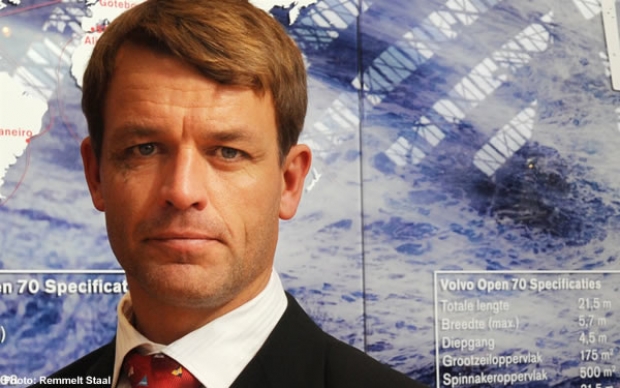
Back in February former Innovations Kvaerner and djuice skipper Knut Frostad took over the reins of the Volvo Ocean Race from out-going CEO Glenn Bourke. Obviously at that late stage Bourke had put together the pieces for the 2008-9 race, sticking with the Volvo Open 70, although to a new version 2 of the class rule, but with a dramatically different course for the first time taking in India and the Far East, and concluding in Russia.
Following Sunday’s very welcome early announcement that the Volvo Ocean Race will take place again in 2011-12, for the next race Frostad will finally get to make his own mark on an event he has been a fan of since his youth. While he is clearly brimming with his own ideas, Frostad has instigated a gathering of the clans this coming Sunday, the day after the teams set sail for Cape Town, in order to brainstorm the future of the event as well as to engender interest and dialogue. Those attending are primarily sailors or team representatives from all walks of the professional sailing community – existing Volvo teams, America’s Cup teams, the French Open 60 and former ORMA teams along with industry heavyweights such as OC boss Mark Turner.
“A couple of Vendee skippers said they are coming,” says Frostad. “I am working very hard in France - I have been sailing a lot there and it is time for France to be involved in this race. They have all the knowledge of these races and they are one of the few countries who could design, build, sail and equip one of these boats completely with a national team. We’ve studied the French business environment as well and certainly France has a big interest in Asia, so we think the Asian involvement this time will open some eyes. Gitana and Groupama are sending people, etc. Then we have invited people from the Open 60 world, TP52 teams, AC, Offshore Challenges, and other people, some sponsors from other teams.” In total 105 people will be attending.
Interestingly the conference is focusing on sailors and their input. “We need to listen to the sailors,” Frostad tells us. “The sponsors are very important, no doubt about it, and we have brought a lot of sponsors, who are not in the race, down to Alicante already just to showcase the race to them, because sailing needs to be showcased and there are certain CEOs out there from big corporations who have never heard about it, they have barely know about the sport. When they see it they think ‘wow, this is great’. But there are very few syndicates which happen where the sponsor wants to do the race, but doesn’t have a sailor. With this you need to have sailors who really want to do it and find it attractive.”
Frostad believes that one of the keys to the success of his event is ensuring that all the top sailing heroes - the Coutts, Cayards, Daltons, Spithills, Kosteckis, etc – are clamouring to take part in the Volvo Ocean Race and a principle aim of his is finding out how to make this happen. “It’s the same with all events – ‘if he is there and he is there, then I have to be there’. That happened in Valencia last time. But at the same time it can get smaller for the same reason. What would happen if Team New Zealand left the America’s Cup? There would be a big hole even if they aren’t the biggest team. ‘If they aren’t there, why should I be there?’ We want to find out what it takes to create that effect so that most people are interested in being here.”
Placing so much emphasis on the sailor’s viewpoint is very different from Glenn Bourke’s approach or indeed the approach of many other race organisers. Constantly for the organisers of the Volvo Ocean Race there is the toss up between pandering to the desires of competitors and to sponsors, which are often not the same. A classic example is the route – left to their own devices one imagines sailors would prefer the Volvo Ocean Race to be on the original course, primarily through the Southern Ocean. While the race this time visiting India and the Far East, has been driven by purely commercial reasons.
However Frostad says the route is not only a compromise position between what sailors and sponsors are after. “There is a third position as well. You also have those cities who can put up a great show and those who can’t. I think if you ask all the CEOs in the world what is the best commercial route, I don’t think Alicante would be included, because commercially it is not a big place, it is not a big commercial centre of ‘tension’. But we have learned that the local motivation for hosting and staging a major event and how important the event is for the city is essential to create a good spectacle. Did it matter if this race started in Alicante or Barcelona? In Alicante it is a major event, in Barcelona it would take years probably to become the major event, because they have all kinds of other events that you are competing with.”
Glenn Bourke’s goal was for every stopover port to also field a boat in the race. Thus the Telefonica represent Alicante, Ericsson Stockholm, Puma Boston, Green Dragon Galway and Team Russia St Petersburg. Another campaign from Singapore failed to get off the ground. Frostad agrees this is a good policy but doesn’t think it is essential. “Obviously one of our ambitions is to generate more media coverage and there is no doubt what generates most coverage is a local team, even more than the port. When you have a Swedish team you get coverage in Sweden even regardless of whether you have a Swedish port or not. We had Swedish teams in the past with EF Language, way before we had Swedish ports and they generated a fantastic amount of coverage.” He would prefer a wider spread of countries be involved.
Frostad also would like to correct the notion that this year’s Volvo Ocean Race ‘isn’t going to the Southern Ocean any more’. While the new course may avoid the Indian Ocean segment of the Southern Ocean (generally felt to the least enjoyable part of it) around 80% of the routing for the monster leg from Qingdao round Cape Horn to Rio sends the boats south heading directly for the Southern Ocean expressway before they turn east.
“Now they have looked at the route in depth, they are realising it is quite a fascinating route and it will be quite challenging. The navigators are going to be more excited when they leave Cape Town than they have been for a long time. What is going to happen on that leg? That type of conservatism in our sport is what has been hindering development.”
And yet there is also an argument that constantly changing the format of events means they lose some of their historical gravitas. The Route du Rhum for example has run on the same course, from St Malo to Pointe a Pitre, Guadeloupe every four years since 1978. When you approach the finish of that race skippers know they are in the same spot where Mike Birch in his little trimaran famously overtook Michel Malinovsky’s giant Kriter monohull back in 1978. That kind of thing brings a tear to the eye of race pundits and active, enthusiastic punditry is essential to the health of any sport. But what is the essence of the Volvo Ocean Race? That it is the premier crewed round the world race. In this respect the present format still qualifies.
Another significant change Glenn Bourke made to the present event is reducing its cycle from four years to three. The idea behind this was that four years created too long a lull between events, but in reality three or four years between races makes no difference. Looking at the bigger picture – the three year cycle will bring chaos to the grand prix racing calendar which otherwise, with the exception of the America’s Cup, works on a four year cycle. The only way to prevent the lull happening is to create a circuit of events for the Volvo Open 70s between round the world races as has been attempted in the past with the Volvo Baltic Race. But the circuit between events needs to mean something, it must be competitive and attract the top crews, boats and sponsors.
“We might look at that in the future,” says Frostad of a possible change back to a four year cycle. “But we also realise that just to start a new event, it takes a long time to build up. Let’s say we change class - you take a few steps back, before you go forward. We don’t believe we are in a position yet to take steps backward. We might look at including racing between the races, which could be combining our class in known events in 2010.”
So what is his view on the present Volvo Open 70? “The most important thing for me is that it is an attractive class for the sailors to race. That development has to be driven with the sailors because they are experienced in how it is to race them - is it too hard, not too hard, are they reliable/exciting enough, etc? There are tweaks we’ll always have to make to them because there will be some smart [new] things coming out that will just make sense whether it is furling sails, etc. But cost is an issue and we have to be very aware of that.”
Frostad doesn’t reckon campaign costs for the teams have escalated since last time, although he admits building boats is more expensive due to higher material costs. We doubt that this is the case for the bigger teams. Compared to the last race, the build-up time prior has been shorter but while the overall duration of the race is much the same, the pace of the race is more frantic with shorter stopovers and thus shore teams have got larger. This time there is also one more stopover – the race comprising 10 legs and six in port races on a 37000 mile long course, compared to nine legs and seven in ports last time on a 31000 mile long course.
Frostad points out that it is still possible to compete on a tighter budget, comparing Green Dragon to Brasil 1 last time, while Delta Lloyd is lower still. The prospect of campaigning an old boat, like Delta Lloyd (the former ABN AMRO One), is a fantastic development for the race. Compared to their VO60 predecessors, VO70s are built in carbon rather than Kevlar and don’t go as soft even after a round the world race. If this is combined with a tight box rule and developments in the box rule between races being limited so that it is relatively straightforward to upgrade boats, then this could become a popular, relatively low cost route into the race in the future. Frostad hopes that there might be three or four boats making their second lap in 2011-12.
Another good development for this race is that, finally, there has been some repeat business for the campaign sponsors. Both Ericsson and Telefonica (which fielded the movistar boat last time) are back this time. So what does Frostad feel is the attraction of his event to corporates? “One of the most important things is that it is a very unique arena. If you are in soccer or Formula One you are in competition with 500 brands and all the big brands in the world are there. The Volvo Ocean Race is a unique, romantic race, and it is just about to be discovered - I say that because we are just seeing now that the biggest corporations in the world are beginning to look at the event. Telefonica are the world’s biggest telephone operator outside of China. Ericsson is one of the biggest in their business. Puma is no3 or 4 in the world in sportswear. Last time ABN was one of the first of the really big ones. Before, it wasn’t the really big worldwide brands. It is a sign that the event is beginning to mature and be discovered.”

As a former journalist and competitor Frostad is particularly interest in the new media spots within each crew. This role is something he has kept a close eye on since taking over as CEO as when he joined, he says, most teams seemed to be employing cooks… The media crewman on each boat is not allowed to take part in the sailing of the boat and must be on hand to capture the action when it unfolds. The end result has the possibility of turning the Volvo Ocean Race into a ‘reality TV’ show, but Frostad says they must be careful how this is done. On the one hand he points out that if crab fishing in Alaska can be turned into a fantastically popular TV series, then surely they must be able to do the same with their race? At the same time the event is first and foremost a yacht race and that and reality TV are not entirely compatible. “We can try and make reality TV of cooking and sitting on the toilet, but it is not going to sell. What is going to sell is the performance, the speed, the results, the racing, the intensity, the manoeuvres and how well they do them, etc.”
The success of this will certainly be down to the co-operation of the crews and how effectively the on board media person is successful in capturing the action. “It is going to take time,” admits Frostad. “If you look at the media crew and the skippers we are working with - it is very clear. The younger sailors understand this much better than the older guys. When I am talking to Iker Martinez and these guys about it, they think it is very cool. They love YouTube and Facebook. So it just takes time. One of sailing’s biggest challenges apart from the whole structure of ISAF is the conservative nature of the sport.” Frostad cites the snowboarding world which has become a vastly popular sport for the simple reason that some of the top snowboarders focus on making films of what they do.
One of the most interesting developments for this race is Frostad’s approach to the media side of the event. Typically sailing events always try to dumb down the media content in order to cater to a wider non-sailing audience. Frostad wants to dive much deeper into the technical detail. “In the UK how many soccer experts do you have there? 5 million? How many play soccer at all? But they know everything about it, the strategy of the coach, because soccer doesn’t underestimate their audience. Is sailing too complicated for the world? Everyone says it is too complicated, sailing is difficult sport, show more sunsets and dolphins. But we have to be gutsy. We can’t just dismiss sailing as a complicated sport. We are a small sport but we have to be brave and try.”
One development is tactical analysis. The Volvo Ocean Race command centre in Whiteley receives all the data coming back from the boats including boat speed, wind speed and angle and from this it is possible to develop polars for each boat. With this information it is possible to carry out routing for the boats so that those following the race can compare the routing with where the boats actually go –all fuel for the race pundits, which is to be presented on the race website.
“People say it is going to be too complicated but I did a presentation to 10 people who had no clue about sailing, and they were saying ‘that is just like the stock market’. They understand you can simulate it and see the risk. If it was only about explaining the rules, and one why one boat gets disqualified it won’t work, but to explain the weather and how to sail strategically through weather and manage risk, going for gains and losses…”
Another development that must happen in the future is real time position reporting. At present positions are published publicly and to the fleet once every three hours (up from last time). Frostad says that they looked at this this time but the system wasn’t reliable enough.
We feel, as we always have, that an approach is needed that will equally entertain and inform sailors and non-sailors alike. The TV shows in the past have certainly focussed too much on crews at play in stopover ports when they should have been concentrating on the sport and the action on the water. And the different media through which the race is communicated also offer different opportunities. The TV will always have the ability to reach a wider audience and should therefore be dumbed down to a degree so that it can attract people into the event, whereas with the website, as surfers have consciously to navigate to it, there is a good reason for it to be more technical.
Most Read
Most Commented
Comments
Businesses
Pro businesses
Editor's choice
Member blogs
-
 Ned Collier Wakefield: MOD70 round BarbadosWell that was intense. 12 hard fought for seconds for the win. In idyllic conditions, Tony Lawsons MOD ...
 -
 Mini Transat leg 2 reportThe second leg of the Mini Transat started on 31st October, just over a month after ...
 -
Leg 1 reportI’ve been working towards the Mini Transat now for three years. In 2013 I was part ...
Business blogs
-
 The Island Sailing Club in Cowes, Isle of Wight, is delighted that Prince Michael of Kent ...
 -
Peta Stuart-Hunt chats with the 25 year-old British solo sailor Lizzy Foreman before she sets sail ...
-
The 2015 Student Yachting World Cup (SYWoC), an ISAF-recognised event hosted and run by students for ...
Editor's Choice
All time favourites...
-
 Three legs down into Ian Walker’s
 -
 Winning all but two races at
 -
 For the first time in its
Latest Comments
Add a comment - Members log in