
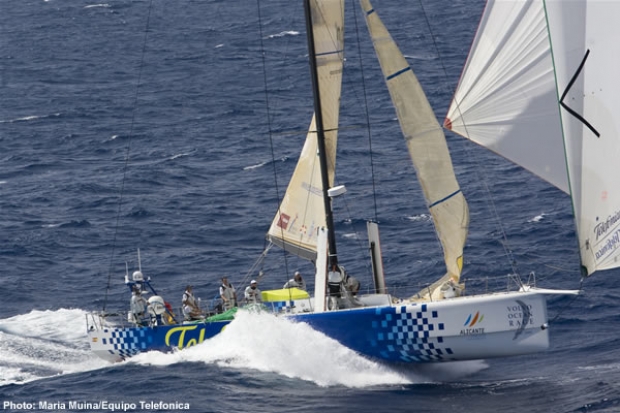
Farr back in the driving seat
Thursday October 9th 2008, Author: James Boyd, Location: United Kingdom
Having won all the previous Whitbread Round the World Races and the subsequent Volvo Ocean Races on elapsed time or handicap since 1985, failing to continue their legacy in the 2005-6 race came as a considerable blow to Farr Yacht Design. With
movistar,
Brasil 1,
Pirates of the Caribbean and
Ericsson, the Annapolis-based design gurus had all the strong contenders last time, but were convincingly out designed and developed by Juan Kouyoumdjian, Mike Sanderson and the dominant ABN AMRO team.
Had the Farr office lost their touch? Certainly at the time they had been undergoing some personnel changes with Bruce Farr and his long term engineer partner Russell Bowler still involved but in the throws of easing the business side of their operation across to a new generation led by Patrick Shaughnessy, who since the beginning of this year has been appointed President of Farr Yacht Design.
“In the last race obviously we were pretty disappointed with the results and we tried to spend a period of time looking at the way we worked, the work that we did, the people we worked with and were pretty critical of the way it all happened,” admits Shaughnessy. “Then we tried to stop beating ourselves up and do something about it.”
Part of the issue was the way they worked. Having become the dominant design house in the round the world race for almost two decades, they were typically designing boats for numerous teams.
“What was happening previously when the teams kept us very distant from them so that we couldn’t be part of all the decision-making that was happening inside the teams,” says Shaughnessy. “This time we wanted to work exclusively with a team, to be integrated within a team so that we could be part of it the whole way through: we could affect all the decisions, and ensure that when you finished doing the design work you aren’t finished with the job. The job is winning the race.”
While this may have been partly prompted by Ericsson Racing Team’s announcement that they had signed an ‘exclusive’ deal with Juan K, the only way forward was for the Farr office to do the same and they duly signed with Telefonica and Bouwe Bekking, who had had the most unfortunate race in 2005-6 when movistar lost her keel mid-Atlantic and the boat had to be abandoned.
“Historically it had worked because the other competition was weaker and the race hadn’t matured to the point where it had attracted the style of budget that the ABN program had,” continues Shaughnessy on why they had to change their approach. “Once it had attracted that style of budget our work style previously was exposed on a number of levels.”
Up until the last race Farr would typically get ahead of the game by funding their own R&D which teams could then buy into as and when they acquired funding, but as Shaughnessy puts it, this resulted in their carrying out less work than a big team (ABN AMRO) would do. “Then when the separate teams got the design information they felt the need to compete against each other within the same design package. So the goal within one of those teams would be to create a ‘lighter Farr boat’ and with those decisions some of them were good and some were bad. In any case we weren’t part of that because they were afraid it would be communicated to the other teams.”
With the new Telefonica boats one gets the impression that Farr have stopped sitting on their laurels and have genuinely pulled out of the stops. Telefonica Blue, skippered by Bouwe Bekking, and Telefonica Black, skippered by leading Tornado sailor Fernando Echavarri, are by far the most innovative boats in this year’s Volvo Ocean Race.
Following the success of ABN AMRO One and the further tightening of the Volvo Open 70 rule in its second version, so the sweet spot of the box is now clear: maximum beam, maximum sail area, but most importantly maximum keel and bulb weight but minimum overall displacement. Through judicious work by the team and the builders of the two boats - King Marine with Telefonica Blue and Southern Ocean Marine with Telefonica Black - the boats have achieved all these goals (which several others in the race haven’t).
“The largest process change was the access to a real R&D budget allowed us to research significantly more work than we had previously,” says Shaughnessy. “The key thing which happened in this research evolution was the real development of the CFD tools to the point where you could produce better results than the tank. So CFD has evolved into a primary design tool rather than the supporting design tool that it once was.” We remember hearing this exact same statement from Juan K prior to the last Volvo Ocean Race.
Creating an accurate model of a VO70 has huge benefits for designers as it allows a legion more designs and very specific parameters within a design to be trialled virtually. The only limitation is computing power. “You can run a matrix that is complete that would have been cost-prohibitive before. And we can research speeds and conditions that aren’t available in the tank.”
While this kind of technology has been developed heavily in the America’s Cup, the code being used for V5 AC boats with their long overhangs and heavy displacements was generally not suited to immersed transom, high performance and relatively light displacement VO70s, while existing CFD code for power boats and other high speed craft could handle a VO70’s speed but not boats that heel and have five appendages. So much of the code has had to be developed in house.
During the process tank testing became secondary, used to validate the CFD work. But while for the last Volvo Ocean Race they only tested one model and focussed primarily on appendage configuration, this time they tank tested many more [Shaughnessy won’t specify how many] models, albeit at a smaller scale.
“We set out right from the beginning to have a minimum weight boat and a maximum weight keel. I think in the end when the story’s all told of this race you’ll find that there aren’t many teams that have achieved that. So it is a challenging goal. In fact we achieved it so well that we were able to come back and strengthen a lot of critical areas with the spare weight we created inside the boat. It is one of the areas where maybe the race should examine that in the future. To make that an easier goal would certainly create safer boats.” Shaughnessy says they achieved minimum weight of the overall boat by “100s of kilos”.
But achieving their weight targets has come at the price of good looks, both Telefonica boats having boxy cabin tops which culminate in an alarming point at the forward end - good for shifting water and windage, but not for foredeck crew sliding aft at a rate of knots as green water pours over the deck. Their hull shape is highly convoluted with a more pinched in bow thanks to the use of reaching strakes (more on this later) with a curved gunnel evolving aft into a pronounced chine in the hull and an angular gunnel aft.
Brutal-looking but light cabintop with sharp-looking bowman unfriendly forward end
Novel cockpit
The most striking about the Farr design, as well as being one of its greatest weight savings, is the cockpit which appears to have come straight out of an America’s Cup boat with no side decks, the cockpit sole extending out to the hull. Surely this isn’t suitable for an offshore boat? Surely this will just pick up water on the leeward side just as the Kiwi America’s Cup defenders did in 2003?
Having sailed on Telefonica Blue last week, this novel cockpit arrangement gets the full dailysail thumbs up. With the three pedestals in the middle the primary winches are mounted on separate islands and the arrangement allows the headsail trimmer to sit down to leeward with half a metre of hull and then the guard rails above as security, without the feeling that they are about to get washed overboard with every wave. While it won’t be suitable offshore, racing inshore the crew, including the grinders, sit on the cockpit sole as they do on Cup boats - all good for reducing windage.
But the main advantage ofthe cockpit arrangement is what this means for the laborious stacking of sails. While the stack on the other boats is precariously perched on the side decks, the arrangement on the Telefonica boats allows the stack to be lower and when the boat is heeled this means it is further outboard and contributing more to the righting moment. “And it keeps the windage down,” says Bouwe Bekking. “Normally the stack goes all the way up to the lifelines and with this you can stack it nice and low and you can sit on the top of the stack as well and you are still safe. The other thing is it is easy to get the stack from one side to the other side and you can even gybe and can basically leave the stack partly on one side and you can only have to move two or three sails over, because the sheets can go over the top of it, so it is very easy to manoeuvre. Plus it is so easy to trim the headsail - you can sit to leeward of the winch and if you have to do any work to leeward you can just walk up the leeward side, because you are always safe. Whereas if you are heeling a lot and you have a normal side deck you would think nine out of ten times you wouldn’t walk up the leeward side. With this it feels really safe.”

Trimming to leeward - far too safe
It also dramatically lows the centre of gravity. Shaughnessy explains: “With the cabin and the whole of the deck, one of the driving design goals was weight but also VCG [vertical centre of gravity]; to lower the centre of gravity of the whole deck package. So in our analysis work, the camber and extra surface around the cabin and all those sort of things were all exchanged for lower weight and VCG. Our total deck will have a significantly lower CoG than some of the other boats. And all of that in turn pushes harder on the interior of the boat and we've worked awfully hard with the sturtcures inside the boat under the full cockpit width to create….There are some pretty nice structures inside the boat that allow sails to be shifted really easily. For sure the deck concept pushes on the interior quite hard.”
So what about water being scooped up to leeward? “The fears we had about cockpit drainage are surprising because when water does come into the boat down the windward sidedeck, or even the leeward sidedeck, it has much more path to escape now. While before it would have been funnelled through a very small cockpit area, now it is very spread out so it is evacuated all down the leeward side,” says Shaughnessy. “In fact it drains so fast it is ridiculous. It drains much faster than a typical cockpit and it is not under your feet. All the water is draining to leeward of the crew.”
An obvious downside of the lower stack in the cockpit is that there is less protection to weather and Shaughnessy acknowledges that the Telefonica crews will certainly have to go for full faces masks earlier. “But in most of those conditions it is heinously wet so only a matter of degrees of heinous wet…”
The wetness is not helped by the strakes forward as well which do a nice job in increasing buoyancy forward but shed water sideways which then has a tendency to blow upwards before the crew get to ‘wear it’. “It makes it a bit wetter, but it stops the boat less so you go faster,” as Bouwe Bekking bravely puts it .
“Sailing on the boat it is even better than we thought initially,” summaries Shaughnessy of the cockpit arrangement. “So the ease of movement around the boat and the ability to shift the sails…it is funny because some people say it isn’t safe, but it is so much the contrary. To be able to go directly to the clew of the sail on the leeward side and to have the lifelines at chest height rather than knee height I think is extraordinary.”
Structural development
Mark Bishop, who handled the structural engineering in house under Russell Bowler’s beady eye, also managed to save weight in the structure, that was then returned to the structure in order to beef it up where required.
“We had usability goals for the boat to improve the way sails are shifted internally and to locate the weight in the structure such that it reduced moment of inertia in the boat,” says Shaughnessy. “I haven’t seen too much on the interiors of the other boats but I can say that inside our boat the shifting of sails has significantly improved the way sails are shifted internally and the structure is much more forgiving. Perhaps a criticism of our previous boats was that they were intricate to the point that they were difficult to detail accurately on the builder’s side. And they presented too many critical areas that were ripe for failure. This style of structure we have now is much more forgiving both for the builder level and the user: The boats aren’t quite so rigid they are a little bit more forgiving at sea. You get that back immediately from the guys –Bouwe says that now we can sleep. Before the boats were so rigid it was impossible to sleep. It is the future of structural design is to present something that is a little bit more forgiving. We are asking the guys to push the boat really hard in tough conditions and they have to have the confidence to do that. If we give them that confidence with the structure and with things like the bow strakes and ease of handling and try to build their confidence then they can push the boats quite hard.”
To save weight further the Telefonica boats also have some cute deck gear. Under Volvo 70 class rules, measurement takes place with anything that is removable removed. And so on the Telefonica boat the jammers are removable, sitting in garages.
Spray rails - here to stay
As is the case with the Team Russia boat, the Farr designs have what they call ‘reaching strakes’ (rather than Team Russia who call theirs spray rails) running down each side of their bow, a device also fitted on some of the Farr Open 60s. “We are trying to promote a high speed bow up reaching attitude,” Shaughnessy explains their purpose. “It is making the boats easier to handle and therefore lets them sail on the big gear a little bit longer and in certain conditions it is showing such an enormous drag reduction.” The strakes in turn also allow the bow to be finer and more seakindly. While the strakes on Team Russia are much more pronounced and end suddenly, on the Farr boats they meld back into the hull.
Shaughnessy is utterly convinced of this powerboat style technology being suitable for fast racing yachts and says he would fit these and/or the under transom trim tabs seen on the Gitana Eighty and Paprec Virbac Open 60 in a heartbeat (they are prohibited under the VO70 rule - but perhaps not for next time?)

Reaching strake and downward pointing bowsprit
So this technology is here to stay? “Yes, I think on boats of all types. A feature like strakes on the bow - if that is feature that you can add that adds controllability and adds comfort to the team operating the boat and you don’t have to adjust it or actively do anything, it is just there and it helps you, then that is something that could be good for everybody. On powerboats, these are features that are commonplace - trim tabs, strakes on the bow… As they become more like power boats, then we have to adapt some of those things for higher speed craft.”
Much more work remains to be carried out on this technology. While the Volvo rule allows the strakes (hollows) within 7m of the bow, Shaughnessy says that without this rule they would terminate further aft. And although they are well proven in powerboat design, powerboats don’t have to contend with the heeling issues of sailboats. “We have to look at heeled conditions and how they are contacting the waves… When you can accurately test all of those things, then you can see why scientists get excited.”
The new course effect
While on the one hand version two of the Volvo Open 70 rule has tightened up the box significantly, the new course has required all the boats to have a more rounded performance. Interestingly while the average wind speed and angle is similar to the last race, the conditions are a lot more spread out and there will be legs, such as Singapore to Qingdao which are expected to be upwind in a breeze. Shaughnessy feels this is good as unlike previous races it means that more of the different designs in the race could have their day.
Stronger upwind potential is most evident in the increasing size of the daggerboards, but there remains huge variation between the boats - the Farr designs, as is the case with their Open 60s, have more vertical boards (more inclined when the boat is heeled) and this seems to be a route Juan K has taken this time with the Ericsson boats while on Puma the boards are humungous with a longer cord than the other designs. There also seems to be variation in the weight of the boards - some can only be lifted by five or six people, whereas the Farr boards (we have witnessed this) can be lifted by three.
“I don’t think anyone should be bragging too much about the lightness of their appendages, until we see how they go,” says Shaughnessy cautiously. “Even rudder sizing - the boats vary in just blade area by enormous percentages. I’d say we definitely have the smallest rudders. There are some rudders in the fleet that are more than twice as big as ours.”

Weight of the boards seems to vary between boats
Sans jumpers
Another Cup-style development can be seen aloft on the Telefonica boat, where their masts are jumper-less. The rig program was led by Cup designer Scott Ferguson who examined all the solutions before the team opted for the jumper-less arrangement. “He did the numbers and it become more and more promising and we built one and put it on Brasil One and we were really happy with it and we made a big improvement with these ones,” recounts Bouwe Bekking. There is more structure in the top of the mast but you save the weight of the jumpers but the benefit is a massive reduction in windage. “And you don’t get the sails caught up and the jibs go round the rig nicer and light air gybing you don’t have to worry about hooking your spinnaker behind the top spreader. Of course it is a bit harder if someone has to go to the top of the rig because there aren’t a lot of places to hang on…”
Obviously the main issue is managing this while maintaining adequate stability in the top of the mast. This could mean that the boats with jumpers may be able to keep their big gear up for longer than the Telefonica boats.
While the boats feature C6 carbon rigging, the top mast backstay/runner/checks arrangement is also novel with the top mast and running backstays combined and an adjuster at the hounds so that the top mast backstay can become a runner and vica versa.
Windage
Again, this like the lack of jumpers and the extreme deck layout, are to reduce windage. “Even our sheer treatments, although we have quite angular and plain deck features, the initial topside treatments and sheer treatments are a superior windage solution to what the other boats are carrying," says Shaughnessy. "But in the rig definitely we have worked hard on windage.”
Another unique feature is what Shaughnessy calls their ‘forestay pyramid’ which effectively raises the height of the forestay attachment point. This is a way of optimising the J (base of foretriangle). “The thing that is limiting the size of the headsail is the forestay’s distance from the shroud plane. So by raising the forestay its attachment point so it is effectively being pushed away from the shroud plane.” This gains 50mm foot length while at the mast end of the J measurement there is a further gain thanks to a bump in the front of the mast section that gains a further 50mm.

Check out the bow pyramid - very different from the sunken, low windage arrangement on the other boats
As to overall performance - there is no doubt that the new boats are faster all around. “I’d say the boats last time ended up looking like they had a very strong light wind bias, which wasn’t necessarily our intention, but it was certainly where their performance was best,” says Shaughnessy. “One of the things about our race model last time, was that that concept of boat we designed accumulated more points later in the race in order to eventually win and that model may have been psychologically wrong. The teams dealt away their strengths to try and address their weakness in their sail development and how they handled the boats and that layered on top of failures created a difficult psychology for sure.” This he hopes they have addressed with the new boats.
Shaughnessy reckons the new Telefonicas are faster on all points of sail and every wind strength that the last generation boats, light weather performance enhanced by the new Code 0s.
Bouwe Bekking agrees: “At least from the numbers we’ve seen so far compared to the old Movistar, it is nearly everywhere. In under six knots the old movistar might be quicker, but you could see when we sailed against the old Brasil, we sailed circles around her.”
So if there is a boat likely to do ‘an ABN AMRO One’ in this Volvo Ocean Race, we think it may be Bekking's Telefonica Blue. Shaughnessy sums up: “The thing for us was to look across the whole boat and innovate everywhere. Usually when you design something you get to the end and you can do it a bit better. We didn’t want to do that. We wanted to end it and think it was the end all, be all. We were pretty proud of our Volvo Ocean Race history and we weren’t very happy with how the last one went.”

Most Read
Most Commented
Comments
Businesses


Pro businesses
Editor's choice
Member blogs
-
 Ned Collier Wakefield: MOD70 round BarbadosWell that was intense. 12 hard fought for seconds for the win. In idyllic conditions, Tony Lawsons MOD ...
 -
 Mini Transat leg 2 reportThe second leg of the Mini Transat started on 31st October, just over a month after ...
 -
Leg 1 reportI’ve been working towards the Mini Transat now for three years. In 2013 I was part ...
Business blogs
-
 The Island Sailing Club in Cowes, Isle of Wight, is delighted that Prince Michael of Kent ...
 -
Peta Stuart-Hunt chats with the 25 year-old British solo sailor Lizzy Foreman before she sets sail ...
-
The 2015 Student Yachting World Cup (SYWoC), an ISAF-recognised event hosted and run by students for ...
Editor's Choice
All time favourites...
-
 Three legs down into Ian Walker’s
 -
 Winning all but two races at
 -
 For the first time in its
Latest Comments
Add a comment - Members log in