
Volvo Ocean Race form guide
Friday October 10th 2008, Author: James Boyd, Location: United Kingdom
The million dollar questions are - what will happen in this Volvo Ocean Race and who will win?
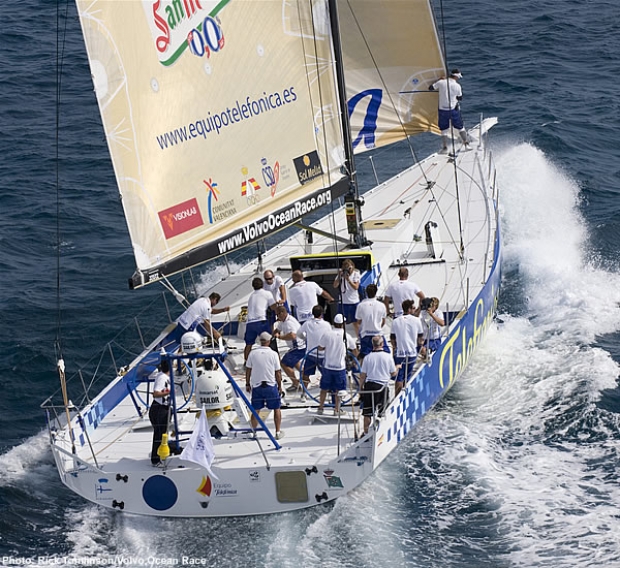
The general feeling at this stage is that the podium is likely to be occupied by Telefonica Blue, Puma and Ericsson 4, but there seems to be differing opinion as to their order. All have their pros and cons.
In theory the two two boat teams, Telefonica and Ericsson Racing Team, should be favourites. Ericsson has mad most of the all-important preparation time. As a team Ericsson have experience of the last race. In fact Atlant, Richard Brisius and Johan Salen’s management company behind Ericsson Racing Team, have experience dating back to Paul Cayard’s race winning EF Language campaign in 1997-8. Ericsson were first of the 2008-9 race teams to announce and not only signed up winning 2005-6 race designer Juan Kouyoumdjian but also were able to acquire Mike Sanderson’s race winning ABN AMRO One as their test bed, along with several of her crew in Kiwi race veterans Brad Jackson, Dave Endean and Tony Mutter.
Atlant’s recent campaigns have developed a reputation for undergoing skipper changes early on in the race but this time they seem to have taken the sensible move of getting this out of the way before the race has started, with John Kostecki resigning in August 2007 and being replaced by former Brasil 1 skipper and multiple Olympic medallist, Torben Grael.
Ericsson Racing Team were first to launch a new generation boat for this race in Ericsson 3 while Ericsson 4 was the last of the new generation boats to launch (similar timing-wise to the ABN AMRO campaign last time). As was the case with ABN AMRO too, both their boats have been constructed by Killian Bushe and his own dedicated team in a facility based next to Ericsson’s HQ in Stockholm.
Grael’s ‘international’ team on Ericsson 4 only has two Volvo first timers in bowmen Ryan Godfrey and Phil James, both filling the two mandatory under 30-year-old spots in the crew.
Particularly impressive about the Ericsson campaign has been their training regime. Aside from the skipper change early on, they have maintained a regular crew and both squads have been based in Lanzarote where they have had the opportunity, like no other team, to sail regularly in strong conditions for more than a year now. Certainly in big conditions we suspect the Ericsson boats to be the ones to beat.
The only posisble chink in the Ericsson 4 armour is the split in the crew between Kiwis - including watch captains Brad Jackson and Stu Bannatyne - and the Brazilians, Torben Grael having imported two of his Brasil 1 crewmen Horatio Carabelli and Joao Signorini when he joined. This should not be a problem if all goes according to plan, but what if it doesn’t?
But in terms of their boats, we don’t think that Ericsson 3 or 4 have made the same significant leap that the Telefonica boats have this time.
The Spanish Telefonica team, like Ericsson, are back for a second bite of the apple with a two boat team. Telefonica Blue in particular looks special with a hungry skipper in Bouwe Bekking, keen to make amends following the movistar disaster during the last race. He has the support of an equally hungry design house behind him in Farr Yacht Design, who have an exclusive arrangement with the team. In our opinion the Telefonica boats are the most evolved of the new generation boats and we suspect they will prove quickest of the latest crop of VO70s. The question mark over them at this stage is one of reliability - they have had relatively little time to test them - as Bekking put it this morning, just three months to Ericsson’s seven - and they appear lightly equipped compared to the competition.
In comparison to Ericsson, the team have had their base in Alicante where they have been training with their modified former Brasil 1, but in conditions more Mediterranean and decidedly less gnarly. One wonders how they will fair in big conditions?
The Telefonica crews also seem to be light on past Volvo experience, instead preferring to bring on Spanish Olympic or America’s Cup sailors over salty sea dogs with past Volvo form. On Telefonica Blue for example Bouwe Bekking, Jono Swain and Pepe Ribes are old hands while Simon Fisher and helmsman Iker Martinez did the last race, and the other half of their crew are newbies, although admittedly heavy hitters including Alinghi’s Barcelona Olympic 470 Gold medallist Jordi Calafat and Martinez’s 49er Gold medallist crew Xabi Fernandez.

We suspect that in terms of their boat Puma is in a similar place to the Telefonica boats: it is in the ball park except without the design flare and 40kg short of the all-important maximum keel weight and 130kg off minimum overall displacement. While successful in the America’s Cup, TP52s and before that the Mediterranean IMS fleet, this will be the first foray into offshore race boats of any sort for the boat’s designers, Botin & Carkeek, who have had to deal with the unfamiliar prospect of large waves and winds of over 10 knots (we jest of course, but there is an element of truth to this). The new Puma boat, il mostro, is known to have had a numbers of issues particularly with their giant daggerboards since launching. Have they ironed out all the bugs in their boat? This remains to be seen.
Where Puma score big time is in crew calibre and experience - as a group they are the oldest and wisest in the race. Skipper Ken Read has rounded up his dirty dozen (10 to be precise) who between seven of them have 15 laps of the planet in this race and countless America’s Cups, although in Volvo terms this record is eclipsed by Ericsson 4 with 16 races between the crew. But on Puma for example one of the three newbies is Olympic, America's Cup and Mini Transat star Jonathan McKee. Read’s star line-up includes Andrew Cape, on his fourth race in this role after Tokio, Toshiba and movistar/Ericsson, Rob Salthouse who last sailed this race on Tyco in 2001-2 and has three America’s Cups under his belt with Team New Zealand. Jerry Kirby, 52, is the race’s oldest bowman and sailed with Read on Chessie Racing and did the whole lap with Paul Cayard on Pirates of the Caribbean as did Justin Ferris (who was also on EF Language and ran the sail program for the winning illbruck program in 2001-2 - a useful chap). Frenchman Sidney Gavignet is on his fourth lap after La Poste, Assa Abloy and, significantly, the last race winner, ABN AMRO One.

We would love to believe that Ian Walker and his Irish-Chinese Green Dragon Team could ultimately end up on the podium. If maximum bulb weight and minimum displacement do indeed prove to be all-important then they are some way from hitting the targets - 460kg under with their keel and 120kg over minimum overall displacement. However if reliability proves to be key, as could well be the case given the longer race course combined with shorter stopovers and some new potentially heinous legs like the upwind slog from Singapore to Qingdao, then the Green Dragons could be in good shape. Their boat certainly felt robust when we sailed it in 35 knots… A podium would be a fine performance given that they were one of the boats latest to be announced, designed, built and launched and all on a limited budget.
Behind Puma and Ericsson 4, Green Dragon has the most seasoned crew in the race. While Walker is new to round the world racing and navigator Ian Moore worked mainly ashore for illbruck, his watch captains are the much travelled Neal McDonald (on his fourth Volvo after the Silk Cut, Assa Abloy and Ericsson campaigns, skippering the latter two) and Irish hero (following his Barcelona World Race win) Damian Foxall, on his third Volvo. Also in the mix is leading bowman Justin Slattery who also comes with crucial ABN AMRO One pedigree and Aussie toughnut Anthony Merrington (ex SEB and Pirates) and Tom Braidwood (ex SEB and Ericsson).
While in past Volvo Ocean Races we have come used to two boat teams where the B boat usually ends up as one of the back markers, expect this not to be the case with Telefonica and Ericsson’s second boats. While previous two boats campaigns may have claimed their boats as being equally resourced on this occasion it appears in fact to be true… In both cases, while they may not have quite the rock star crew of their ‘A’ boat, if they are a little off pace at the start, expect them to up their game rapidly over the course of the race.

This is particularly true of Telefonica Black, essentially an identical twin to Telefonica Blue, where the crew features venerable navigator Roger Nilson, the most capped Volvo hand in this race, setting out on his seventh race, but only skipper Fernando Echavarri, Santi Lange and Jaime Arbones who have done one race or part of the race before. The other six crew are first timers. Already we have seen the potential of Telefonica Black, winning the practice race last week.
Although Ericsson 3 is a previous evolution of Ericsson 4, it too has very similar potential. The Nordic crew has a similar set-up to Green Dragons - their skipper Anders Lewander and navigator Aksel Magdahl are sailing the race for the first time but they have highly experienced watch captains in Magnus Olsson (this is his sixth Whitbread/Volvo) and Richard Mason (ex Assa Abloy and Ericsson - a Kiwi by birth, Mason is an honorary Swede by nature of living there and having married a local). However Olsson and Mason are the only crew on board to have done the race before, although the crew includes considerable talent such as Sydney 49er Gold medallist Thomas Johanson and Swedish Cup sailors such as the towering Anders Dahlsjo and Jens Dolmer.

Of course the main issue that has dogged the Ericsson campaign is the saga over Ericsson 3’s keel cavities and the severe points penalty imposed by the jury for failing to comply with class rules. This issue remains outstanding and we haven’t heard yet whether the jury will reopen the case. In the mean time the team have a brand new foil in build in Italy and are hoping to fly this to Cape Town to be fitted there, but the psychological damage on the team could well have taken its toll.

Team Russia is something of an unknown quantity. Backed by Russian Oleg Zherebtsov, who has made his fortune as founder of the Lenta chain of hypermarkets around the St Petersburg area, Team Russia is the only private-funded boat in this race, indeed the first privately funded Volvo Ocean Race entry since George Collins’ Chessie Racing back in 1997-8. Again they have a crew that is almost entirely new to sailing in this race, including skipper, Austrian Olympic Star sailor Andreas Hanakamp and Dutch navigator Wouter Verbraak, but with old hands such as Spain’s Guillermo Altadill (sailing his fifth race) and Danish former Olympic Finn and Soling sailor, Stig Westergaard (ex djuice dragons), who are the watch captains. Again there is considerable talent in the ranks which include America’s Cup sailmaker Jeremy Elliott, 49er Olympic silver medallist Rodion Luka and Mini and Class 40 sailor Nick Bubb. Sadly it was announced yesterday that due to a recent death in his close family Zherebtsov will be unable to sail the first leg.
In terms of physical numbers the Russian boat Kosatka is not great - more than a tonne light on combined keel weight. However the boat has its unique spray rails, the powerboat-style wedges running down either side of her bow, and this could turn her into a weapon, albeit a wet one, when running.

And finally Delta Lloyd - the former ABN AMRO One: interestingly this boat has had to be tuned down in order to conform to Version 2 of the Volvo Open 70 rule. She isn’t quite as wide as the latest designs and it would be fascinating to see how competitive she could be round the world for a second time given adequate work up time and budget. We suspect she’d be up there. However new owner Ger O’Rourke has been pressed for time, is short of budget and while the boat might show some of its former glory later in the race we suspect she will be back marker until then.
Generally in the 2008-9 Volvo Ocean Race, we suspect the boats will be much closer, the racing more competitive and it is unlikely there will be a runaway leader of ABN AMRO One proportions seen in the last race. But if there is, we suspect it will be Telefonica Blue. If it lasts the course. For reliability, more so than ever for the reasons stated earlier, will be the key and it will be down to Mother Nature and the conditions she deals the fleet, as well as the preparation of the teams and the robustness of their structure that could dictate the outcome.
Given the new course and the large variation in conditions between legs now we suspect we might see a number of different winners - a welcome change from the last races. Due to the course change, for the first time, this Volvo Ocean Race may not be won overall by the first boat into Cape Town.
By don’t take it from us. What does previous race winner Mike Sanderson think? The former ABN AMRO One skipper is far too politically conscious to share his podium thoughts for this race, but given his association with designer Juan K there is no doubt the boat he would like to be on: Ericsson 4. “There are so many things the guys have done that we talked about in the last race. We decided that if we had our time again we would have had gone less stern immersion and gone to max beam,” he says.
The fundamental difference between Ericsson 4 and Telefonica Blue is that while both have maximum bulb weight, Ericsson 4 is not minimum overall displacement.
As to the Farr boats Sanderson says: “I don’t understand their cockpit layout. On our boat [ ABN AMRO One] we were stacked from the bottom of the floor to the underneath of the bunks. We had minimum face room between each bunk to the deck and then the deck stacked with sails. Obviously their calculations show that the boats are faster without the windage and with the weight inboard. And I am also really worried about the water to leeward. I can see a steady steam, 250mm deep and 8m long or whatever – that is a lot of water and a lot of weight.”
As to Puma, Sanderson reckons their program looks polished. “Obviously they had the white ABN boat and they have Sidney Gavignet and Chris Nicholson who did a lot of sailing with us on the black boat. It looks to me that they have the most helmsmen which I am a big fan of.”
He also thinks the Irish look good: “The Irish have gone from strength to strength with Ian Moore and Justin [Slattery] and Neal Mc[Donald]. My big worry with that boat is - is the bulb heavy enough? I just know the attention to detail that we had to go to with the build of ABN AMRO One and I know how compromised it was to get that big bulb and then the new rule was based on that keel weight and bulb package - so it is a big ask to build a boat quickly in a yard and hit those weights.”
Sanderson summarises what is required: “It is going to come down to come down to keel weight, reliability, drivers and sails.”
And so our form guide:
| Pos | Boat | Boat performance | Crew performance | Reliability | Handicap | Magic | Total |
| 1 | Telefonica Blue | 10 | 8 | 8 | 0 | 4 | 30 |
| 2 | Puma | 8 | 10 | 7 | 0 | 3 | 28 |
| 3 | Ericsson 4 | 9 | 9 | 8 | 0 | 1 | 27 |
| 4 | Green Dragon Team | 6 | 8 | 9 | 0 | 3 | 26 |
| 5 | Telefonica Black | 10 | 7 | 8 | 0 | 3 | 25 |
| 6 | Team Russia | 6 | 6 | 7 | 0 | 4 | 23 |
| 7 | Ericsson 3 | 9 | 6 | 8 | -2 | 1 | 22 |
| 8 | Delta Lloyd | 4 | 4 | 7 | 0 | 3 | 18 |
Most Read
Most Commented
Comments
Businesses
Pro businesses
Editor's choice
Member blogs
-
 Ned Collier Wakefield: MOD70 round BarbadosWell that was intense. 12 hard fought for seconds for the win. In idyllic conditions, Tony Lawsons MOD ...
 -
 Mini Transat leg 2 reportThe second leg of the Mini Transat started on 31st October, just over a month after ...
 -
Leg 1 reportI’ve been working towards the Mini Transat now for three years. In 2013 I was part ...
Business blogs
-
 The Island Sailing Club in Cowes, Isle of Wight, is delighted that Prince Michael of Kent ...
 -
Peta Stuart-Hunt chats with the 25 year-old British solo sailor Lizzy Foreman before she sets sail ...
-
The 2015 Student Yachting World Cup (SYWoC), an ISAF-recognised event hosted and run by students for ...
Editor's Choice
All time favourites...
-
 Three legs down into Ian Walker’s
 -
 Winning all but two races at
 -
 For the first time in its
Latest Comments
Add a comment - Members log in