
Odd man out
Wednesday November 5th 2008, Author: James Boyd, Location: United Kingdom
We promise to come up with our form guide to the Vendee Globe by the end of the week, but it will prove particularly difficult this time around with 30 boats entered, 20 of them new and among the new boats, many not really having lined up with the rest of the fleet...
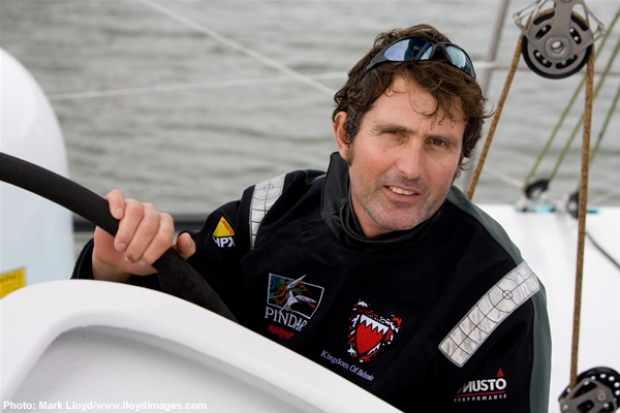
In this respect one of the biggest unknowns will be Brian Thompson and his newly rechristened Bahrain Team Pindar. Within the Open 60 solo ocean racing world both are unknowns. Thompson has completed in the Mini, OSTAR and Route du Rhum before but as he puts it “hasn’t been solo sailing since he was 18 like a lot of the French guys” while other than the Artemis Challenge round the island race in August, which the boat comfortably won, Bahrain Team Pindar hasn’t lined up against the competition in anger.
As a design, the Juan Kouyoumdjian-designed Bahrain Team Pindar is out on a limb - while typically Open 60 design philosophy is to go for absolute minimum weight (some boats are less than 8 tonnes all-up this time) with the capability of increasing displacement by as much as 50% in the form of water ballast when it is required, Bahrain Team Pindar is closer to 11 tonnes, deliberately the heaviest boat in this Vendee Globe, as Juan K echoes his VO70 design philosophy maintaining that stability is king. Bahrain Team Pindar is powered up in 8 knots of breeze, at which point she requires full keel cant, so the occasions when maximum stability is not required are rare and at this point she makes up for her stickiness by having the largest sail plan.
With humungous twin daggerboards, Bahrain Team Pindar is also expected to be a weapon upwind. This will bode well for her return leg up the Atlantic that is typically on the wind or close reaching. As ever Thompson attempts to play down the potential speed advantage the boat has: “We have good upwind pace, but if you are out of touch with the leaders it probably won’t help you at all. If you are in the leading pack you could feel quite good. So I think you have to concentrate on the beginning of the race at this stage and get to Finistere and down past the high pressure in good shape. I am very intrigued how we are going to go in the trade winds. It will be spinnaker up, so it won’t be our best condition but if we can keep up with the others and then you have the SE trades after that which is definitely our weather.”
While the high stability heavy weight approach seems to work a treat in the Volvo Ocean Race, the significant difference in this event is that it is singlehanded. In theory a lighter boat requires less power and crucially smaller sails to drive it so that a singlehander can sail it more efficently. But bearing in mind that manoeuvres are generally few and far between in a non-stop round the world race where you can be on one gybe for a week, perhaps this won't be such an issue?
To give some indication of the beast he is in charge of, Thompson sailed a lot with Ellen MacArthur on her Kingfisher Open 60 and points out that with two reefs in, Bahrain Team Pindar has more mainsail than Kingfisher had at full hoist… And yet, by virtue of the fact that the boat is also has the greatest stability, the most beam, heaviest bulb, etc he points out that her sail change numbers are much the same - going to first reef in 18 knots. With a rig that towers 30m off the deck, at least a metre more than the closest competition in this Vendee Globe, Thompson reckons that with one reef in, Bahrain Team Pindar’s mainsail is roughly the same size as the other boats’ mains in this race at full hoist, with perhaps another 20sqm in reserve. “It is good to know that you have that additional gear,” he says.
So on paper, Bahrain Team Pindar is widely acknowledged as being the fastest Open 60 in this Vendee Globe. The questions remain - is Thompson personally up to the job of being competitive in this huge boat and is the boat reliable enough?
Dealing with the latter question first - certainly last year reliability, particularly with the rig, was not good. The rig at the time could be canted fore and aft and came tumbling down during the 2007 Artemis Challenge. That spar was repaired and restepped in time for the Transat Jacques Vabre, only to fall down again… Since then, over last winter and this spring the mast has been replaced by another, more robust affair.
So does Thompson feel confident with the new towering spar? “Yes, because it is by far the fattest rig in the fleet," he says. "So sideways inertia, if that is the right term… is very high. The chord - most boats are about 625mm cord length and we may be 650, but they may be 285mm across and we are 375. That gives you way more strength when you rotate it. When you rotate it, it doesn’t start bending alarmingly. On the Stars & Stripes cat, for example, it was very aerodynamic, but when you rotated it it went all out of shape. This is more of a Club Med rig: Not so aerodynamic, but it is not heavy because the natural shape of it is quite strong.”
The sapr on Bahrain Team Pindar weighs around 560kg, the same as the previous one, but due to its size and being structured to withstand the substantially greater displacement and righting moment of the boat is much heavier than the spars on some of the competition. Thompson reckons some of the fixed rigs to weigh less than 400kg. Even some of the lighter weight wingmasts with deck spreaders Thompson reckons to be around 450kg. But it is also stronger and heavier due to the 'belt and braces' approach they have been obliged to take with the new rig after last year's disasters. Thompson says that with the new rig they have a bigger Harken mast track and cars than they had on the old rig and the more robust (but heavier) Facnor locks than the Karver ones fitted on some of the other boats.
On the topic of locks and halyards Thompson says: “A lot of boats have the staysail and storm jib on the same halyard and a lot don’t have a fractional halyard. Foncia probably didn’t go for one to save weight - you are not using the fractional halyard in the Atlantic at all, so that’s a lot of the race you’d never use it.”

On the boats such as Bahrain Team Pindar and Hugo Boss that do have fractional halyards this allows them to fly A5s and A6s, specialist sails for the Southern Ocean. “Going along the dock it is surprising how many don’t have fractional halyards,” says Thompson. “So heavy air downwind they are on their genoa which is quite near the top of the mast.” The advantage of being able to use fractional sails is that they lower the centre of effort of the sail plan. Without them, as Thompson puts it “for the mast it is more of a strain, because it might be two or three reefs and genoa, so if you stuff your bow in a wave the top of the mast wants to go forward and doesn’t have the main pulling back against it.”
So despite having only successfully raced the boat once in the Artemis Challenge, how confident does Thomson feel competing in Bahrain Team Pindar? “I think I will be better at the end," he admits. "I haven’t done any racing in it, which is the only time you are going to push it to the max. My longest sails were on qualifiers were you had to finish it. So they were a delivery in the way - you learn about the systems and manoeuvres, but you’d change a bit earlier than if you were racing because you can’t afford to take any risks as you had to finish to qualify within a time frame. But from the way it is set up compared to other boats, the sails are quite similar to ABN sails, the rudders and daggerboard and bowsprit are straight from ABN so you know that that has been tested by other people. The keel system is pretty much ABN as well, so that gives you a lot of confidence.”
While he lacks race time, there have been moments when the boat has been pushed to the limit. “One sail back from Plymouth we had a crew on board and we got to the Isle of Wight from Plymouth in six hours. That was our Tokio experience. We went through Portland Race in 25 knots of wind…”
He has also seen hideous conditions - upwind in 45 knots several times during her Vendee Globe qualifier.
Personaly, one significant advantage Thompson has over many of the other skippers is that he is used to racing maxi-multihulls, taking Doha 2006 to victory in the Oryx Quest, racing non-stop around the world on PlayStation, etc, so moving from a 100ft multihull to an Open 60, even one as enormous as Bahrain Team Pindar, is a significant change down.
“I do find it much easier. You don’t find it strange that it takes you 15 minutes to grind the main up and you don’t feel that you are losing that much time doing it. You just accept it. You have to look at the big picture and you know you have to maintain the boat. Sailing a 60ft monohull is a bit like a big multihull fully crewed - not the same pace but the same attitude. You might look at a cloud and have the same rationale about how to treat it, as you might have in a maxi-cat - ie I don’t think I should risk that it blows another 20 knots or you might say that looks okay, I think we can survive that with the sails we have got up by adding some water ballast or something, while in the Volvo you might just go for it and just deal with it. And because the boat is so wide it feels very safe. You are not at very high heel angles a lot of the time, so you don’t feel like you are going to fall off.”
Bahrain Team Pindar is a kind of monomaran. And yet when the boat sails heeled, suddenly her waterline gets very narrow. However being a monohull rather an a multihull, Thompson won’t have to treat the boat quite so tenderly. “You do push it harder and harder when you go to sleep and things like that. I think I know where the limits will be, but everyone will be looking at others going ‘they are going two knots faster – they must have more sail up’ and everyone will rethink how they are going to sail during the race, especially during the Atlantic.”
Unlike some other boats around at the moment, with Bahrain Team Pindar Thompson says he hasn’t experienced any problems with her chine (on some significant lee helms develops when the chine digs in). “I don’t really notice that it is any different, except that the wake really comes out of the back of the boat beautifully,” says Thompson. “With this boat they did a lot of computer modelling and tank test modelling.”
Personally while the majority of his sailing has been crewed, Thompson says he is okay with singlehanding. He has competed in the Mini Transat, OSTAR and Route du Rhum and enjoyed it. “I haven’t done all my life like a lot of the French guys, but on the Mini I felt I caught up and I think I feel quite good about the singlehanded side. I don’t think I have ever had a problem with that. Whenever I went off by myself, sailing or bicycling I enjoyed the freedom and keeping my own company.”
Over the last months Bahrain Team Pindar has been through a quick refit when the bottom was repainted, the appendages painted orange, the Fleet 77 satcom installed along with solar panels, wind generator and emergency rudder system. There followed a month of corporate charter and two weeks of solid training where they ended up in Lorient. From here they spent two days two boating with Hugo Boss (pre-collision). “It would be nice to do a bit more training with other boats,” says Thompson. “The wind was quite light most of the time, so we worked on our light airs polars and crossovers, which was really good. I can see the benefit the French boats have had to have trained so much in Port la Foret. It would have been nice to have had a wider range to have tested in. We know a lot about 10 knots now…”
So who was faster? “It seemed that when it became more stability conditions we were a little bit faster and in light air running Hugo Boss was perhaps a little bit faster, so according to form. Heavy air downwind I think he is going to be an absolute weapon because his rig and his keel are a long way back and is has a lot of flair in the bow, so the boat naturally sit bow up.”
Generally one gets the impression that Thompson is quietly confident about his boat’s speed, although he says they haven’t had much chance to test her against other boats particularly downwind. “Downwind - we’ll have to see. My gut feeling is that we’ll be competitive but not faster. We are heavier than the other boats for the same length, so when you are not using your righting moment like VMG running some boats are two tonnes lighter, so you can’t imagine it would be an advantage.” But seeing that fully powered up is 8 knots of wind, we suspect they might not have too much to worry about.
Watching how Bahrain Team Pindar performs against the competition will be one of the things to watch in this year’s Vendee Globe. For if Juan K’s design philosophy is right, then it means everyone else is wrong and it could be back to the drawing board for the IMOCA fleet…
More photos on page 2....

Most Read
Most Commented
Comments
Businesses
Pro businesses
Editor's choice
Member blogs
-
 Ned Collier Wakefield: MOD70 round BarbadosWell that was intense. 12 hard fought for seconds for the win. In idyllic conditions, Tony Lawsons MOD ...
 -
 Mini Transat leg 2 reportThe second leg of the Mini Transat started on 31st October, just over a month after ...
 -
Leg 1 reportI’ve been working towards the Mini Transat now for three years. In 2013 I was part ...
Business blogs
-
 The Island Sailing Club in Cowes, Isle of Wight, is delighted that Prince Michael of Kent ...
 -
Peta Stuart-Hunt chats with the 25 year-old British solo sailor Lizzy Foreman before she sets sail ...
-
The 2015 Student Yachting World Cup (SYWoC), an ISAF-recognised event hosted and run by students for ...
Editor's Choice
All time favourites...
-
 Three legs down into Ian Walker’s
 -
 Winning all but two races at
 -
 For the first time in its
Latest Comments
Add a comment - Members log in