
40th anniversary
Thursday December 4th 2008, Author: James Boyd, Location: United Kingdom
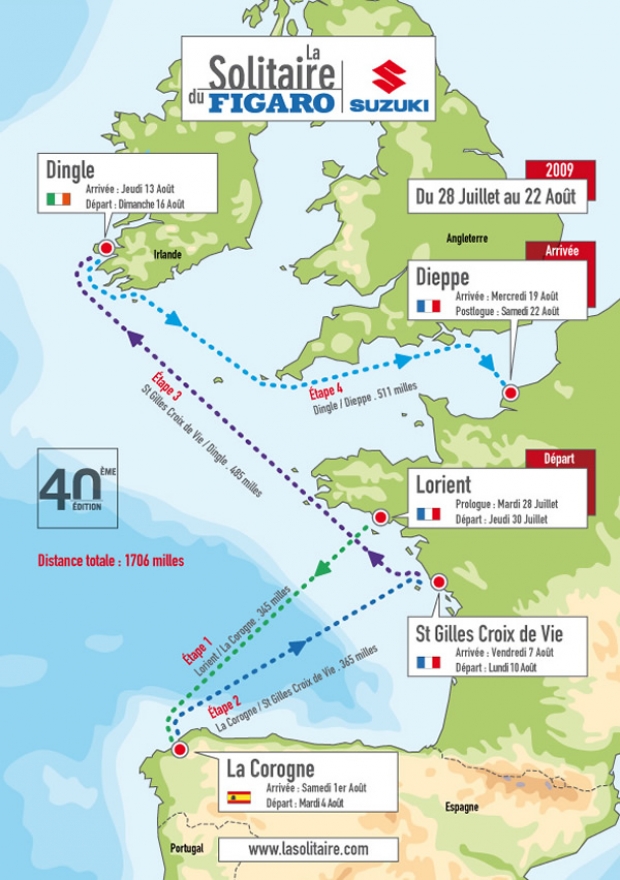
In 2009 La Solitaire du Figaro celebrates its 40th anniversary and a remarkable history. Since 1970, 538 sailors have taken part in the unofficial world championship of singlehanded offshore racing and there will be more newcomers in 2009. In this landmark year, the race sticks to the traditional format with a 1,706 nautical mile course set between France, Spain and Ireland on the Atlantic Ocean, the Irish Sea and the English Channel.
Lorient - start town of the 40 th race
Sailors, supporters and visitors will make the most of the historical setting of the Keroman Submarine Base from 23-30 July. The famous WW2 submarine silos are home to several of the top French offshore raicng teams, such as Banque Populaire.
On 30 July the start gun will be fired off the coast of Lorient: marking the beginning of a short but difficult leg in which racers will be tested from the outset. After negotiating the Pointe du Pen Men west of the Île de Groix, the Plateau des Birvideaux will be left to starboard. The fleet will then have plenty of time to tackle the Bay of Biscay crossing as they head for La Coruña.
“345 miles long, the first leg will be all-action. The Bay of Biscay could prove to be very demanding,” warns Race Director, Jacques Caraës.
Faithful to the ethos and history of the race, Galicia in northwest Spain, once again hosts the race. It will be the 11th occasion La Coruña has hosted La Solitaire du Figaro. The stopover is appreciated by the competitors who always make the most of the easygoing way of life and the warm and friendly Spanish welcome.
A sprint to the Vendée…
The second leg will see the fleet race 365-miles to Saint Gilles Croix de Vie on France’s Vendée coast and also home of Beneteau. This is a 290 mile easterly crossing of the Bay of Biscay, via the Racon buoy off Saint-Nazaire, before they then leave Île d’Yeu to starboard.
The third leg will see another long tactical leg up to Ireland On 10 August, the skippers will set sail for Dingle, 485 miles away. En route the competitors will have to negotiate their way around the islands off the Breton coast before crossing the English Channel and Celtic Sea, before they reach the finish. It is the fourth time Dingle have hosted La Solitaire du Figaro.
And finally, the last leg of the race takes the boats on a 511 mile leg to northern Normandy with the conclusion of the race in Dieppe, the first time the race has visited there.
Following a run west down the southern Irish coast, the Fastnet Rock will be left to starboard before crossing the Celtic Sea. The skippers will then be left free to pass the Scilly Isles as they before. The course will take the boats along the south coast of the UK to the Isle of Wight from where they will make the crossing to Dieppe.
“This edition has a very special flavour to it - it was important for the organisers to offer the singlehanders a race course true to the 39 past editions of La Solitaire du Figaro," says Caraës. "Although this format remains a 'classic', it features many hurdles along the coast and at sea. Each skipper will be free to experiment on the different stages of the route which will require very precise navigation and tactical sailing.”
A look back on the past 39 races…
The single-handed race was created in 1970 following an idea by Jean-Michel Barrault and Jean-Louis Guillemard, journalists at the daily newspaper Aurore. The Course de l’Aurore rapidly became an un-missable event in France.
In 1980, the Course de l’Aurore became La Solitaire du Figaro and in 1990 the first one design was introduced, adding to the competition.
Notably moments in the history of the race were 1973 when a storm decimated three quarters of the fleet. Then there was Patrick Eliès’ [Yann's father} four leg victories in 1979 and the exceptional participation of Alain Gautier in 1980, aged 17. Sadly in 1985 there was the loss of Luc Berthillet, finally found by a Spanish trawler and rookie Laurent Bourgnon’s fine victory in 1988, Philippe Poupon’s third win in 1995, Alain Gautier’s rescue by Nicolas Bérenger in 1996, Jean Le Cam’s third victory in 1999, the 13 seconds separating Armel Le Cléac’h from Alain Gautier in 2003, Michel Desjoyeaux’s third title in 2007... And many other tales of sailors and the sea.
2009 Schedule
Lorient, France
Village opens: Thursday 23 July
Suzuki Prologue: Tuesday 28 July
Start of the 1st leg: Thursday 30 July
Port History
1982: Stop-over, leg victory for Loic Caradec
1989: Stop-over, leg victory for Alain Pointet
1991: Finish town, leg victory for Christophe Cudennec
La Coruna, Spain ( 345 miles)
Organisers arrive: Friday 31 July
Expected arrival of the boats: Saturday 1 August
Start of the 2nd leg: Tuesday 4 August
Port History
1972: Stop-over, leg victory for Michel Malinovsky
1981: Stop-over, leg victory for Gilles Gahinet
1982: Stop-over, leg victory for Patrice Carpentier
1983: Stop-over, leg victory for Lionel Péan
1984: Stop-over, leg victory for Christophe Cudennec
1986: Stop-over, leg victory for Christophe Auguin
1987: Stop-over, leg victory for Gabriel Guilly
1988: Stop-over, leg victory for Alain Gautier
1989: Stop-over, leg victory for Alain Gautier
1993: Stop-over, leg victory for Jean Le Cam
2007: Stop-over, leg victory for Corentin Douguet
Saint Gilles Croix de Vie, France ( 365 miles)
Organisers arrive: Wednesday 5 August
Expected arrival of the boats: Friday 7 August
Start of the 3rd leg: Monday 10 August
Port History
2004: Stop-over, leg victory for Armel Le Cléac'h
2006: Stop-over, leg victory for Nicolas Troussel
Dingle, Ireland ( 485 miles)
Organisers arrive: Tuesday 11 August
Expected arrival of the boats: Thursday 13 August
Start of the 4th leg: Sunday 16 August
Port History
2001: Stop-over – leg cancelled
2003: Stop-over, leg victory for Alain Gautier
2006: Stop-over, leg victory for Gérald Veniard
Dieppe, France (511 miles)
Organisers arrive: Monday 17 August
Expected arrival of the boats: Wednesday 19 August
Closing Regatta: Saturday 22 August
Most Read
Most Commented
Comments
Businesses

Pro businesses
-
Netherlands
-
-
-
United Kingdom
Editor's choice
Member blogs
-
 Ned Collier Wakefield: MOD70 round BarbadosWell that was intense. 12 hard fought for seconds for the win. In idyllic conditions, Tony Lawsons MOD ...
 -
 Mini Transat leg 2 reportThe second leg of the Mini Transat started on 31st October, just over a month after ...
 -
Leg 1 reportI’ve been working towards the Mini Transat now for three years. In 2013 I was part ...
Business blogs
-
 The Island Sailing Club in Cowes, Isle of Wight, is delighted that Prince Michael of Kent ...
 -
Peta Stuart-Hunt chats with the 25 year-old British solo sailor Lizzy Foreman before she sets sail ...
-
The 2015 Student Yachting World Cup (SYWoC), an ISAF-recognised event hosted and run by students for ...
Editor's Choice
All time favourites...
-
 Three legs down into Ian Walker’s
 -
 Winning all but two races at
 -
 For the first time in its
Latest Comments
Add a comment - Members log in