
Atlantic relief
Tuesday January 20th 2009, Author: James Boyd, Location: United Kingdom
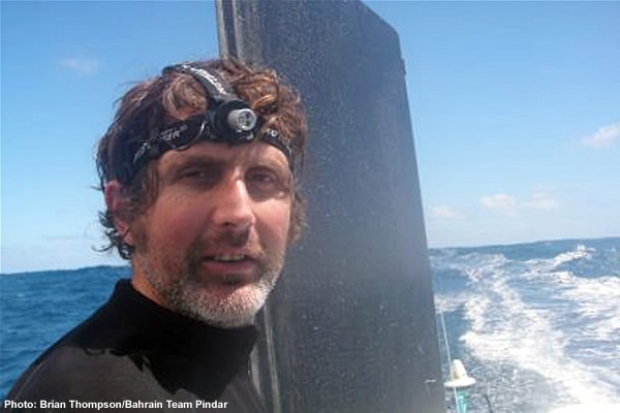
Pre-race one of the top prospects for this Vendee Globe, the dark horse as it were, has been Brian Thompson on his ultra-radical Juan K-designed IMOCA Open 60,
Bahrain Team Pindar. At a time when all of the new generation boats have been getting wider and wider, their rigs more and more powerful, Thompson’s light blue boat was one step ahead again, as one observer put it “like a 2012 generation boat racing in 2008”.
However while there are is much talk of go-faster design features pre-race, oddly once the Vendee Globe is underway, these observations and how they might affect performance seem to be forgotten the relative speeds of the majority of the boats more dictated by the skippers’ performance rather than the boat’s. For as this race has proved a decent skipper seems to have as much chance in a good new boat, given the higher potential for breakage these seem to have, as they do in an older tried and tested boat. Thus for example we have Roland Jourdain in second place in his 2004 generation IMOCA 60, although one that has admittedly been virtually renewed since the last Vendee Globe.
At present Bahrain Team Pindar is negotiating the South Atlantic just ahead of Dee Caffari’s Aviva and Arnaud Boissieres’ two generation old Akena Verandas, the trio of boats tightly packed to the southeast of the mouth of the River Plate.
Yesterday Thompson described the conditions to us: “We have really amazing sailing conditions at the moment, just behind a high pressure and I have been sort of sailing at almost the same speed as it, so there are times when I have got back into the clear skies and then I have fallen back more into the clouds, but there are fairly flat seas and steady winds. So it is almost like sailing a big cat behind a cold front! It is really nice. The systems are moving at 15 knots here, rather than 35 knots in the Southern Ocean. So it is working out really well and the three of us, with Aviva and Akena and myself, are making good time to get north. In fact they are only about 80 miles behind me, but they are probably in quite different winds, reaching in 25-30. I am more downwind in 20-25.”
While the conditions in the South Atlantic have allowed them to make good progress north, it is just a matter of time before they are nailed. “I don’t have too much weather info, because I am down to just the Iridium phone. I am going to get into the high a little bit and there’ll be some light airs for 36 hours or so, but hopefully I can wriggle through that into southeasterlies or easterlies for a while and then there is another transition zone until you get to the real trade winds. So it is a bit like the double doldrums of the India Ocean!”
For all three skippers in getting out of the Southern Ocean they have been able to breathe a massive sigh of relief. The Pacific in particular seemed interminable, endlessly bombarding the competitors with a string of depressions. But ironically it was their entrance into the South Atlantic where they experienced the worst conditions.
“The Southern Ocean extended into the Atlantic for me and Dee and Arnaud,” continued Thompson. “The biggest storm of the race was in the Atlantic. That was an amazingly well travelled tropical depression. It was off Fiji and went to New Zealand and it ended up going exactly over Cape Horn, the centre of it.”
The biggest gust Thompson says he experienced during this was 65 knots. “I saw a steady 55, and had I not sheltered behind Staten Island, where I saw 50 knots, I think I would have had a lot of wind upwind and then had very powerful and actually more wind downwind - probably well over 60 and a very confused sea state. So I think it was the right thing to do to get to the finish.”


This was the first time in our recollection of the Vendee Globe that boats sheltered to weather a storm, although it has occurred in the Velux 5 Oceans occasionally.
“I guess it is because there are few times you are actually near land, most times you can avoid a storm by going north or south or you don’t have a choice. But I guess Cape Horn you are there and if a massive storm is there too you have got very little option. But luckily, all credit to the race committee, they put all their effort into making sure that all three of us were in the right place. They got Meteo France involved, analysed exactly where we were and we were talking directly to Meteo France about what was happening. They definitely put safety as their main priority. They had Alain Gautier involved and Denis Horeau, the Race Director. They were quite pro-active. Other race committees, so often when boats get into trouble, it is like ‘you decided to go, it is your fault’. This race committee watches every boat 24 hours a day. It is amazing. They are pretty keen that all 12 [remaining] boats make it back to the finish.”
Bahrain Team Pindar’s round the world voyage has been hampered by a lack of time on the water. For example, the Vendee Globe was Thompson’s first major race in the boat following two dismastings that prevented her from competing in the 2007 Transat Jacques Vabre and the return race and then the Artemis Transat last year. While the boat did receive a thrashing on its qualifier Thompson has lacked hours on board and the numerous problems he has had to deal with on board during this race are still teething issues. As a result he has lost a considerable amount of time fixing things when he should have been racing.
“I have spent quite a few days boatbuilding for sure - not every day of course, not even the majority of the days, but quite a few of the days because certainly the big repair I did in the bow, just forward of the keel bulkhead, that took several days to do and several attempts to get it right. That was one where I was south of Australia, and I just went into boat building mode and sailed along quite slowly for a long time. Then there was the one on the transom which was another day lost and then another one further forward in the bow, just forward of the storm jib stay, another longitudinal: So three construction ones. And then all the normal things, that probably all boats have - engine, electronics, rigging. Luckily, I haven’t had, touch wood a keel or rudder or mast issue. A lot of boats dropped out because those big items.”
Obviously the breakages came with varying degrees of severity but Thompson admits that with several he did wonder if he would be able to continue. “Certainly the first one, the big one, needed to be sorted out. Just carrying on in the Southern Ocean, going on to Cape Horn with a boat with two out of the four forward longitudinals broken…certainly some people thought it wasn’t a very good idea, but I think the repair seems really good. I am not saying it is stronger than before, but maybe it is just as strong as it was before. And I have given it a good work out now. The beating into northeast trades, will also give it a good work out!”

While in the Southern Ocean in the downwind conditions Thompson says the fat backsided boat slams like a Volvo Open 70 when they land on waves (he competed in the second leg of the last Volvo on board ABN AMRO One), upwind when the boat is heeled over and the boat is presenting less of a flat surface to the waves, it can be easier on the structure.
Unfortunately with all the issues his boat has experienced, Thompson admits he is not sailing her at full tilt. “I don’t think I am going 100%, just because in the back of my mind…in the right conditions I will definitely go 100%, but it is the slamming, when it does that I tend to say ‘perhaps I won’t fill the water ballast now – I’ll take a reef instead so I don’t load up the structure even more and get to the finish and then fix up the boat and look to carry on with the season to come’. The boat is definitely fast, especially in races like Round Britain and Round Europe, it would be ideal. But I’d say a lot of boats aren’t going 100%. There is a lot of walking wounded around!”
Aside from being the most powerful boat in the fleet, Bahrain Team Pindar is also the heaviest and while Thompson doesn’t feel this has helped him in the Southern Ocean, it should allow him to see more potential from the boat now she is into the Atlantic. “It should be good in the south Atlantic and the north Atlantic. The Southern Ocean is not really its forte - it is just relentless VMG downwind and when most of the top boats weight 8 tonnes and you weigh 10.5, it is different. There is a lot more water to push aside.”
However there are certainly some upsides. Thanks to its tremendous beam and power, the boat feels very stable, like a multihull but without the potential consequences of a very terminal angle of vanishing stability. “In the extreme conditions of the Southern Ocean you feel very safe, because you are very stable,” says Thompson. “There was a big gale before Cape Horn and sailing through it with the keel in the centre downwind and some water ballast in, you are going through some big waves and you never felt you were getting close to being knocked down.”
Saying this, during the Vendee Globe he has experienced a few knock downs. “I’ve had the mast horizontal a couple of times, that was more a Chinese gybe or a reverse Chinese gybe. Actually I have done it several times now and you get used to it, but you just worry you are going to break something. You feel quite comfortable walking along the cockpit side while the boat is at 90 degrees! It is not something you do normally in fully crewed racing that is for sure, it is just another manoeuvre in the singlehanded armoury!”
Also unlike the Volvo is the camaraderie that permeates the fleet and particularly in this race where there have been substantially worse conditions than the last two races and a lot more attrition. “Certainly when one boat is in rough conditions they will be getting lots of emails with support from the other boats,” says Thompson. “Most days I’ll talk to Steve White and Sam [Davies] and Dee [Caffari]. I guess that is all the Brits actually we have left now. I do a lot of phone calls and emails for sure. Dee is very good at sending jokes around. So it is a good group and I’m sure that we will have a good get together back in Les Sables. And I spoke a lot to Dominique Wavre during the race. I didn’t know him that well before, but we got to become good friends from chatting. We spent a lot of time racing in the same waters really, from the Cape Verdes all the way to just past Cape Town, until he retired. I think they tend to do that - they will talk to the boat next to them. Like Vincent Riou and Armel le Cleac’h.”
So what is Thompson’s view on all the attrition? “I guess it is a lot of the top boats that have gone out - the most well prepared boats and I think it is just because it is such a competitive edition and everyone has been pushing incredibly hard, harder than they have ever done before. Only a few of those [new] boats have survived. I guess at the beginning of the race I thought 17 boats could win and of those 17 there’s only three or four left.
“I guess it is down to bad luck - obviously hitting things, issues with the boats, etc. When you push so hard, and you are down below a lot of the time, compared to the Volvo, you can’t always see the big squall coming up from behind or that growler ahead. Also, things happen that load up the boat more than you would fully crewed and just with all the time spent sailing in the Southern Ocean… In fact a lot of boats dropped out in the Bay of Biscay with masts falling down. After the front went through, there were particularly bad conditions reaching into a massive head sea. At the time I thought rigs were going to fall down, because if you went too fast, the loads were massive on the rig.”
We put it to Thompson that to be successful in the Vendee you have to have a profound understanding of the loads your boat’s experiencing? “I wish I could hop on board MichDes’ boat for a while to find out! I am sure he is very much an engineer and he is very aware of the loads and Bilou knows his boat inside out, he can really feel it. I think that must be part of it, but there is an awful lot of luck as well: not to get hit by that squall, like Mike Golding, or hitting the growler. I think especially when they are going at that sort of speed, that close to the edge, it is a case of being on top of it and knowing when to back off just that little bit.”
The fear is that with all the attrition in this race, there will be a massive drive to change the rules in a hopeless attempt to prevent this from happening again. Thompson believes this shouldn’t happen. “It is frightening that the boats were better prepared than they have ever been... I think the weather has probably been stronger than it was before, but it is the nature of singlehanding and the unbelievably competitive nature of this race.”
With 5,700 miles to go, we hope that the remainder of this Vendee Globe will be uneventful ones for Bahrain Team Pindar. There has been enough excitement in this race already.
Most Read
Most Commented
Comments
Businesses
Pro businesses
Editor's choice
Member blogs
-
 Ned Collier Wakefield: MOD70 round BarbadosWell that was intense. 12 hard fought for seconds for the win. In idyllic conditions, Tony Lawsons MOD ...
 -
 Mini Transat leg 2 reportThe second leg of the Mini Transat started on 31st October, just over a month after ...
 -
Leg 1 reportI’ve been working towards the Mini Transat now for three years. In 2013 I was part ...
Business blogs
-
 The Island Sailing Club in Cowes, Isle of Wight, is delighted that Prince Michael of Kent ...
 -
Peta Stuart-Hunt chats with the 25 year-old British solo sailor Lizzy Foreman before she sets sail ...
-
The 2015 Student Yachting World Cup (SYWoC), an ISAF-recognised event hosted and run by students for ...
Editor's Choice
All time favourites...
-
 Three legs down into Ian Walker’s
 -
 Winning all but two races at
 -
 For the first time in its
Latest Comments
Add a comment - Members log in