
Destination Mexico
Friday October 30th 2009, Author: James Boyd, Location: United Kingdom
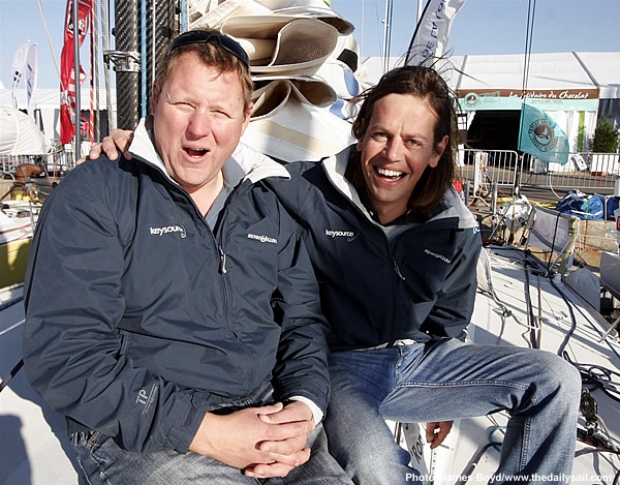
The most committed team to the Class 40 this year has certainly been Mike West and Paul Worswick on
Keysource. They have raced the Grand Prix Petit Navire in Douarnanez, the Transmanche (from L’Abervrach to Plymouth and back), the Semaine SNSM (which they surprised themselves by leading for the first six hours), the more ambitious two handed Les Sables-Horta-Les Sables race, where they finished a respectable seventh in a fleet of 22, the Rolex Fastnet Race, the Class 40 World Championships in the Solent (where they had an unfortunate start line collision), the Mondial in La Trinite where they finished on equal points with the winner,
40 Degrees, and now the Solidaire du Chocolat, where they are rather disappointingly bringing up the rear having chosen the pretty route via the Canaries in the hope of finding the trades.
Mike West bought his Class 40, a Lombard-designed Akilaria Mk1, in May last year, trading up from his J/105 in which he had won the RORC’s doublehanded class in 2007. The boat is the one Florence Arthaud raced in the 2006 Route du Rhum.
“It was a big step up for us,” says West. “We spent a bit of time talking to [Giovanni] Soldini about it and his view was that the Verdier [design] was the fastest boat and he doesn’t think there is much else between the other boats. Our view is that the Akilaria is the best all round boat. It is wide enough to hold up in the breezy stuff and it is great upwind.”
Paul Worswick adds: “The minute he [Soldini] starts cracking sheets he is quick. Around 60-90deg. The Pogos are okay in the light, but in any sort of breeze they’re not. Their hull is round and we have more of a surf board shape. When there’s breeze and heeled they don’t seem very quick.”
West reckons that a competitive Class 40 can be bought secondhand for around 200,000 Euros, which is not uncommon for a 40 footer, only that with the Class 40 you get better performance. Buying one of the original Pogos as a starter boat would be less – around 120,000 Euros.
“I think a lot of it depends on how you approach it and the kind of campaign you want to run,” says Worswick. “If you want to be at the front… at the moment we have Taffeta sails. The guys who are pushing it, they have lightweight inshore film on film sails. You could throw a lot of money at it.”
Keysource is an Akilaria 1, however there are Akilarias and Akilarias. From the manufacturer alone there are three varieties, the Mk1, which at present is the most popular production boat in the Class 40 – becoming the equivalent to the Pogo 2 in the Mini’s Series class; the Mk1.5 (as the Spanish duo were racing in the Solidaire du Chocolat) with the same hull as the Mk1; and the Mk2, as Boris Herrmann raced in the Rolex Fastnet Race and Mistral Loisirs, the recent retiree from the Solidaire. Between the Mk1s there are also variations – it is after all not a one design class. Simon Clarke who campaigns one has chopped the cuddy off his, while there are other variations between the boats. According to Paul Worswick they carried out work on Keysource last winter to reduce weight, altering the water ballast, etc.
Their crew work has also had to take a big step up, although this has come on greatly since they have sailed so much this year. In fact from the way they finish each other’s sentences you get the impression you are meeting an old married couple…
“The major difference between this and the J/105 is that this is one of the most physical boats to sail I think. Everything winch-wise is under-speced. Other boats have much bigger winches…” says West.
Worswick leaps in: “Just trying to wind the jib in is just huge… we have little Harken 46s for primaries. You need something starting with a 5… And all the sails are really heavy and the boat is really powerful…
West: “Off the breeze is fantastic. Upwind is horrible but to be fair only in very heavy sea”
Worswick: “…because it has a flat bottom.”
They have been fortune that professional circumstances have allowed them to put in a full season this year. West runs his own company, Surrey-based Keysource, which designs and builds data centres, with a particular emphasis on efficiency, creating a low carbon footprint. West claims they have designed the most efficient data centre in Europe for a petro-chemical exploration company. Aside from the Class 40 circuit, the boat is also used for corporate purposes. “Sailing is quite an eco-friendly sport so it ties in nicely with the company message,” says West. In September for example Keysource competed in the Silicone Cup for the computing industry.
Worswick was a banker who fell foul (fortunately) from the credit crunch – just three weeks before he got married…. “The timing was great! But there is no money coming in and there’s still money going out. After the Chocolat I’ll have to get my head down.”
According to West the original reason for buying the boat was to compete in this year’s Transat Jacques Vabre, but when the Class 40 organised their own doublehanded transatlantic race, the Solidaire du Chocolat, he entered that instead. To get competitive they realised it was most important to sail the boat as much as possible which is why they have competed in all but one event in the Class 40 circuit this season.
As Worswick explains: “We were looking forward to the Chocolat and the best way to do the basic shakedown was to just go and do all the races, because you learn so much more when you are raking up against these guys and you can meet them and you can find out what sails they are carrying and the best way to sail the boat, etc. We are still learning a lot. We learned loads in the Azores race. We had never done an ocean race before…”
This provided them with the opportunity, for example, to use routing for the first time. “It was about getting confidence in that,” says West. “I suppose we were a bit disappointed because we’d been going a bit better before that, than we’d expected to frankly! So it set our expectation a bit high for that race.” For as Worswick points out their results have been continually improving over the season going from the top half of the fleet to being regularly in the top quarter.
As to how they have found racing as Brits in France in a mostly French class, both have been thoroughly impressed. “It is a nice welcoming fleet, everyone’s friendly,” says West. “For me the main focus was doublehanded sailing. Coming from the J/105 which we doublehanded most of the time, we were quite surprised by how much crewed stuff there has been, but it’s been really beneficial.”
As to the language (they don’t speak French) – “We don’t understand the SIs and the instructions on the water. We get confused. But they are really helpful. A skipper in the class or Muriel [Robin, the highly capable Class Secretary] will look after us. She is really great.”
They have also enjoyed events such as the Petit Navire when they have found themselves on the same race course as the Open 60s. “We were racing against Desjoyeaux and these legends that we read about,” Worswick enthuses. “And they are at the bar next to you and you are sailing on the course with them. How cool is that? There are some good guys in the 40s. There are probably six fully pro boats and the rest are Corinthians of different levels. We’d love to see more of the pros there because it will help us to raise our game. You want to sail against the highest quality fleet possible.”
After all the events they have done around France’s Atlantic coast they have constantly been overwhelmed by how enthusiastic the French public are about yacht racing. This was emphasised when the weekend before the start of the Solidaire du Chocolat the Class 40 fleet docked up the Loire in Nantes before returning down the river as part of a parade, behind the square rigger, the Bellem.
“It was great,” says Worswick. “The Bellem was awesome in itself and you followed behind with your mains up. I reckon about 50,000 people came out to watch because every village turned out. There were groups of people screaming and cheering and it was wonderful, really getting involved – that’s what they do so well over here.”
West adds: “It is difficult to imagine that happening in the UK. They could do it, but I don’t think the commitment is there from the local and county councils, which are the people who put up the money for this obviously. But they love their sailing here and this place [St Nazaire] has been regenerated.”
The charity element of the Solidaire du Chocolat has been a first, with each of the boats having to raise 25,000 Euros for a charity. In Keysource’s case they are backing the World Wildlife Fund. “That is the start of an on-going relationship with them,” says West. “We [his company] are going to become a business partner with those guys. WWF are focussed on utilising IT to reduce carbon emissions – so it is a nice mix for us.”
For the Solidaire du Chocolat they have re-equipped Keysource for this month long, 5,000 mile (or in their case closer to 6,000 mile) race. This has included doubling up on a lot of gear, building in redundancy for items such as the autopilots, the water maker, a fuel cell and solar panels. For example charging is mostly carried out by the main engine with the fuel cell and solar panels as back-up. They have also replaced a spinnaker.
Before the start in St Nazaire they also had a day of weather tuition with the guru Jean-Yves Bernot, attended by many of the English speaking teams. “It was more about how to interpret. If this happens think about this or that or if that happens, etc. He was trying to make us think for ourselves,” says Worswick.
Personally they learned a lot from the Les Sables-Horta-Les Sables race earlier in the year and identified that they needed to improve their sleep management and boat management. “Trying not to go hell for leather all the time - we need to wind it in a bit occasionally. You have to keep everything on the boat working really well. We have been really guilty of being fast out of the blocks, and then exhausting ourselves and then everyone overtakes us…” says Worswick. As to sleep, he says it depends upon the conditions, but if it is stable they will try on this race to get three or four hour long sleeps. If it is 35 knots downwind for 12 hours [chance would be a fine thing in retrospect] then that wouldn’t be possible.
While they may be disappointed with their Solidaire du Chocolat result West and Worswick are uncertain of what they will do after this with the Class 40 circuit heading for the Mediterranean in 2010 and next year’s main event being the Route du Rhum, which is singlehanded, not two handed. “Maybe the Barcelona World Race?” We suggest helpfully.
More photos on the following page...

Most Read
Most Commented
Comments
Businesses


Pro businesses
-
Italy
-
France
-
France
-
Editor's choice
Member blogs
-
 Ned Collier Wakefield: MOD70 round BarbadosWell that was intense. 12 hard fought for seconds for the win. In idyllic conditions, Tony Lawsons MOD ...
 -
 Mini Transat leg 2 reportThe second leg of the Mini Transat started on 31st October, just over a month after ...
 -
Leg 1 reportI’ve been working towards the Mini Transat now for three years. In 2013 I was part ...
Business blogs
-
 The Island Sailing Club in Cowes, Isle of Wight, is delighted that Prince Michael of Kent ...
 -
Peta Stuart-Hunt chats with the 25 year-old British solo sailor Lizzy Foreman before she sets sail ...
-
The 2015 Student Yachting World Cup (SYWoC), an ISAF-recognised event hosted and run by students for ...
Editor's Choice
All time favourites...
-
 Three legs down into Ian Walker’s
 -
 Winning all but two races at
 -
 For the first time in its
Latest Comments
Add a comment - Members log in