
The future of the Volvo Ocean Race
Friday January 2nd 2009, Author: James Boyd, Location: United Kingdom
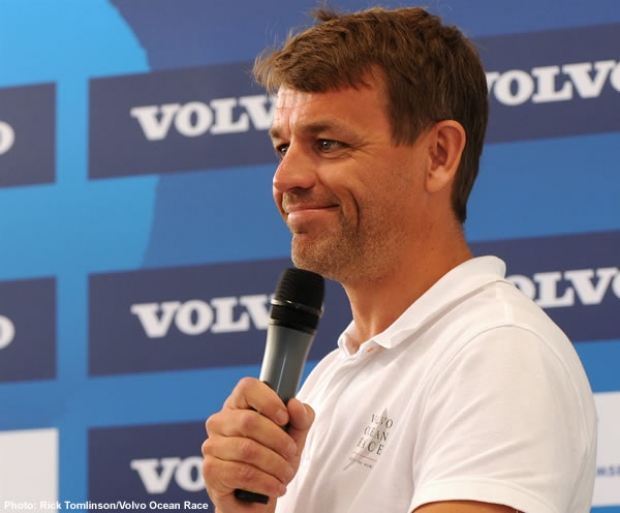
At the World Yacht Racing Forum in December Volvo Ocean Race CEO Knut Frostad was firing on all cylinders. Giving one of the most outstanding presentations, from looking at the short comings of the event to where it must go given the meltdown in the global economy, to getting management consultants, Boston Consulting Group, to carry out a full audit of the event - few were left in any doubt that the fully crewed round the world race is in very capable hands.
Most dramatic certainly is Frostad’s vision about what must be done to the Volvo Ocean Race in order to survive in these hard economic times ahead.
“One thing we achieved with this BCG project is that we managed to get the budgets from the teams,” he says. Because BCG is a consultancy independent of the race and they have a confidentiality policy, the majority of teams in the Volvo have been okay in sharing in some detail their exact costs. “It is fantastic because now we can look and see what we actually save if we cut shore crew or sail program - and we never knew that before,” says Frostad.
At present he says that if you strip all the commercial and marketing aspects of the teams away the biggest teams are spending 25-26 million Euros per boat for the boats, crews, shore crew, logistical support, etc. Whereas the smallest teams like Delta Lloyd are spending 6-7 million Euros. Here comes the shattering news: “With the next race we know that we need to half what the big teams are spending. So 12-13 million Euros. It is not impossible. It is difficult, yes. But we are in a situation where we don’t have a choice at the moment. So we are thinking outside of the box and doing pretty dramatic things.”
This doesn’t mean that the 2011 Volvo Ocean Race will be sailed in Class 40s, nor will it be sailed in one designs. The intention is to keep the Volvo Open 70s only to make them cheaper and to par back team expenditure drastically.
“We have realised that one design itself is not such a money saving thing,” says Frostad. “In some areas it is. Weight is a money saving thing. Increasing the weight of the boats is clear - it is no brainer, we are going to do it. Today we have got it wrong. The teams have been spending a humungous amount of money to get to the weight and most are not even there.”
While Frostad argues in favour of making the boats heavier, there is of course the counter argument that lighter boats are in fact cheaper because less material is required, the loads are less, they can be driven by smaller sails therefore requiring less crew, etc. However going down this route doesn’t seem possible as the intention is to allow existing boats to race next time.
So the plan is to increase the minimum weight limits for the boats and the maximum limit for the bulb weight (which only Ericsson 4 and Telefonica Blue have achieved) and make these targets easy to achieve, which at present they decidedly are not. Thus, no more toothbrushes sawn in half.
“And reducing sails is clear cut too,” Frostad continues. “Not to reduce sails for the race, but to reduce the number of sails you can buy.”
Frostad is imagining a scenario where there are Volvo Ocean Race-licensed sail lofts who might be told for example that they are only allowed to sell a VOR team one suit of sails per year. “To do that you need to be a licensed sail loft which needs to report to us. And if anyone is in breach of that rule that loft will lose its license.”
In terms of reduced inventory Frostad is thinking not so much the race sails as the R&D sails tested in the build-up to the race. However saying this he is considering more of an IMOCA Open 60 set-up for the headsails, that might require, for example, that they all be on furlers. “That is certainly going to reduce the need for crew. The headsail changes are killers at the moment. Maybe we could achieve one person less.”
While there could be one less crewman, Frostad is also looking at bumping up the number of under 30s that each boat must take with them. At present the requirement is two per teams. Next time he thinks it possible there might be three or as many as five. “It is cheaper and it is the future.”
Where Frostad really wants to put the squeeze on is shore side. “Shore crew we are going to cut as much as possible. It goes together with the boat. If we cut shore crew we have to make changes to the boats so we don’t have to service them as much as we do today. It is like the weight limit thing - like where does all this breakage come from? I don’t think it is too difficult. In the worst case scenario we are going to license shore crew as well. You don’t get into the race village without a pass. You have a certain number of passes and they are personal.”
A problem with this Volvo Ocean Race is that it is working on a much tighter schedule than ever before with, for example. two week long stopovers in Cape Town and Cochin, India. “Some thought it was cheaper but the truth is that it is more expensive because we have seen the teams are just flying in more shore crew to do the same job. We have to change the stopovers so either we go for a stopover where you service your boat and it is long enough so you can do it with less people or you don’t service them at all - keep them in the water…”
The cheapest scenario is certainly keeping the stopovers brief but making the boats reliable and robust enough so that they don’t been to be fully rebuilt after each leg.
“The boats are not robust enough that’s clear,” Frostad concurs. “The Ericsson boats seem to be robust, but they had to spend some money to get them there. It shouldn’t be that expensive and difficult to get a robust boat. You can look at it the other way with Team Russia who has made a really robust boat but they are heavily penalised which is unfortunate. That is wrong. We want to keep the present boats racing, so if they can stick another 300kg of laminate in their boats it will probably make them substantially stronger.”
The next race is also likely to have less stopovers.
Another reason for lowering budgets is to simply get more people and more nations into the race. Frostad’s vision is to have a truly international event, as the race once was, so that “we can finally get the big ultimate fight of the century between the offshore sailors in France and the Kiwis, etc.”
He is also keen on nurturing smaller teams, the Delta Lloyds, as like Team Shosholoza in the America’s Cup, they bring so much flavour to the event. “We worked bloody hard to get that boat in the race, but it was one of the best things we did. If you only have the Pumas, Ericsson and Telefonicas, you lose lots.”
Other cost saving measures, and ones that were being discussed at length at the World Yacht Racing Forum where event organisers working together more. “It is crazy - I have known Mark [Turner] for years. We have meeting now and will start working together These two groups, OC and Volvo Ocean Race have been sitting a few miles apart for 10 years not working together, developing everything in parallel - ops rooms, tracking, etc. We can’t keep these two organisations alive - it is very expensive. To give this crazy example, I heard that all the RIBS from ACM are falling apart because they haven’t been maintained and haven’t been used. And we have bought all these new RIBs! And they were just up the road in Valencia. It was a no-brainer.”
His idea for limiting sail testing and licensing sail lofts is one which he wants to talk to IMOCA and the Cup about.
Another area where race organisers, and not just Volvo, might attempt to limit the box is on crew salaries. “The Cup has been a problem for the Volvo and for the French guys as well. It has been a cost driving factor. While Valencia was successful, it was damaging to us, not because of its success but salaries in the Volvo Ocean Race went through the roof and we can’t justify that. They can because of the private funding.” A bowman for example could earn three times as much working for a Cup program than he could in Brittany.
Frostad thinks much can be learned from the offshore racing scene in France. “Look at Jean-Pierre Dick’s team - they have a shore crew that has worked together for ten year and J-P is probably being paid as much as a boat builder in the Cup. He is successful and he is loving it. Okay he is not driving a new BMW, but it is sustainable and Volvo has to go right down to that level. If it means losing some of the top names, it means losing some of the top names. For me it is much more important to get Jean Pierre Dick into the race than keep the top guys. The French guys can also help us a lot with the event when it comes to their passion for the event, the atmosphere and their philosophy. And we can help them commercialise and internationalise what they do. At some point it becomes too expensive to justify in the French market.”
Back to the present and with the arrival in Singapore, so Team Russia has been forced to pull the plug on their campaign for financial reasons. There is a possibility of them rejoining the event later and one imagines that every effort will be made for them to compete in the final leg into St Petersburg.
“It is a direct consequence of the stock market crashing,” says Frostad. “It is unfortunate, because they had a good budget to start with. Had they known what they know now in advance they would have planned differently. We are trying to help them. It might be that we can get them back in later in the race.”
The whole Indian experience was an amazing one. Firstly the leg up the Indian Ocean from Cape Town proved considerably most exciting than many had anticipated, proving to be a leg of all colours, from starting out crashing through the Southern Ocean before heading north and the lottery of the Doldrums.
“The guys said that if they had continued to Australia it would have been about who didn’t break,” says Frostad. “But it was very interesting with the Doldrums and nerve wracking and hard to come back for people and finally we got the stealth play to work with Telefonica Black. It was a joke up until then, but finally it worked. It had some merit.” Fernando Echavarri’s team had gone into stealth mode in light winds on the final run towards Cochin and made up considerable ground tacking along the shore while everyone else was offshore.
And then there was the Cochin stopover itself. Initially it had proved something of a nightmare as the contractors were very very late in getting the race village completed.


“For me it was an amazing experience. In India you expect a lot of people, but they were interested in the event. They didn’t come for the music. They came to see the boats and the crew and ‘touch it’. That was very cool. I have been to places before with the race, like Florida where people are not really interested in the sport, they come for the bars. And the journalists and the media were crazy - I have never seen more cameras in my life. And they were asking questions - how did you deal with piracy, the Doldrums, no wind, how fast do you go, what are you eating, how many people do you have on deck - they were learning so quickly.”
While Telefonica Blue won the third leg into Singapore, the class act of the event certainly seems to be overall leader Ericsson 4. So is Torben Grael’s team going to do an ‘ABN AMRO’? “I wouldn’t say that. They haven’t been leading whole legs like ABN AMRO did. The first leg you had five boats leading. Ericsson 4 only led after the gate, the last third of the race and it could have gone differently. It is clear if you have stronger, heavier legs they will remain superior for the rest of the race I’m sure. The whole boat is set up for it. Anything else and it is pretty open.
“I think Puma is going to come back strong. Puma and Green Dragon will escalate and get better and better. The thing is - Mike Sanderson did some smart planning with ABN, which we have seen that Ericsson has duplicated, which is understanding where it won and lost. Traditionally everyone said that the Volvo or the Whitbread was won in light airs but it doesn’t seem like it is that way now.” The Ericsson boats seem to make substantial enough gains in moderate breeze and up to make up for any shortfall when the going gets light. And they seem to be very powerful upwind, which could bode well for the next leg up to Qingdao.
The Volvo Ocean Race fires up again on 10 January with the Singapore in-port race followed by the start of leg four to Qingdao, China on 18 January.
For the full transcript of what Knut Frostad said at the World Yacht Racing Forum - click here
Most Read
Most Commented
Comments
Businesses


Pro businesses
-
Italy
-
United Kingdom
-
France
-
Editor's choice
Member blogs
-
 Ned Collier Wakefield: MOD70 round BarbadosWell that was intense. 12 hard fought for seconds for the win. In idyllic conditions, Tony Lawsons MOD ...
 -
 Mini Transat leg 2 reportThe second leg of the Mini Transat started on 31st October, just over a month after ...
 -
Leg 1 reportI’ve been working towards the Mini Transat now for three years. In 2013 I was part ...
Business blogs
-
 The Island Sailing Club in Cowes, Isle of Wight, is delighted that Prince Michael of Kent ...
 -
Peta Stuart-Hunt chats with the 25 year-old British solo sailor Lizzy Foreman before she sets sail ...
-
The 2015 Student Yachting World Cup (SYWoC), an ISAF-recognised event hosted and run by students for ...
Editor's Choice
All time favourites...
-
 Three legs down into Ian Walker’s
 -
 Winning all but two races at
 -
 For the first time in its
Latest Comments
Add a comment - Members log in