
Transat Jacques Vabre preview
Saturday November 7th 2009, Author: James Boyd, Location: United Kingdom
The biennial Transat Jacques Vabre, setting sail tomorrow afternoon from rainy, miserable Le Havre in northern France, is a very different affair to the event that has gone on since it began as the ‘Route du Café’ in 1993. The offshore racing world’s top doublehanded transatlantic race very nearly turned into a lemon when a year ago the Class 40s opted to organise their own transat clashing with the TJV. Meanwhile the Open 60 class association, IMOCA had chosen not to include it in their calendar. And the ORMA 60 multihull class had naturally self-destructed. This left a collection of 50ft multihulls of assorted ages…and little else.
Fortunately by popular demand IMOCA did an about-turn on their decision and reinstated the event and the 50ft multihull class is no longer simply a motley collection of 20 year old boats, but includes two (three up until the moment the starboard float snapped off Herve Cleris’ Prince de Bretagne ) brand new trimarans built to the ‘Multi50’ rule - effectively dumbed down ORMA 60s with 75% the performance, but costing half the price. More on this next week.
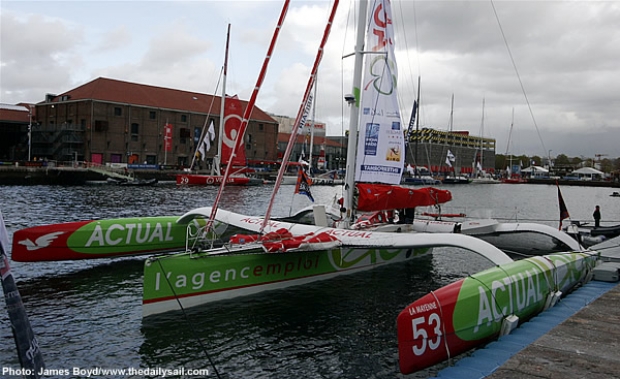
So this year’s Transat Jacques Vabre includes a highly competitive fleet of 14 IMOCA 60s (which we reviewed here) and effectively a 50ft trimaran match race between Franck-Yves Escoffier and Figaro/Mini sailor Erwan Leroux on Escoffier’s VPLP-designed Crepes Whaou!, the St Malo fisherman’s third trimaran to bear this name, and the new Guillaume Verdier-designed Actual of Yves le Blevec, winner of the 2007 Mini Transat and former boat captain of Bruno Peyron’s Orange maxi cats. Le Blevec has as his crew multihull veteran crew Jean le Cam, who back in the 1980s was the Formula 40 champion, and over the intervening years has raced a series of ORMA 60s, won three Solitaire du Figaros and this decade he has been better known for his Bonduelle and VM Materieux Open 60s (le Cam doesn't yet know if his sponsor will stump up for a new boat since he lost his last one off Cape Horn in the Vendee Globe).
This year’s race, for the first time since 2001, isn’t concluding in Salvador de Bahia, but is heading for the little known east coast of Costa Rica and Porto Limon in central America. The course requires the IMOCA 60s to leave the Dominican Republic to starboard, making for a course of 4730 miles, while the 50ft multihulls must leave Barbados to starboard, a course that is 320 miles longer. Either way the route is in fact very similar to that of the war torn Solidaire du Chocolat with the great circle taking the fleet directly through the middle of where the Azores high should normally be. Of course the Azores high won’t be over the Azores and initially next week at least is heading towards the Portugese coast cutting off any potential trade wind option in the same way as it did when the Class 40s passed this way three weeks ago. However options there will still be aplenty, as Alex Thomson sums up: “When you look at the routes for this historically over the 15 days, and the 15 days before and 15 days afterwards for the last 30 years, the most northern route takes you up to Newfoundland and the most southerly takes you down to the Cape Verdes. And it all looks kind of equal.”
Weather (see maps for the next five day courtesy of Expedition and Predict Wind on page 2...)
The good news however is that the 30-40 knot headwinds being forecast for the start early on last week have subsided. The depression generating these has slipped further south and should be over northern France come tomorrow’s start. In its wake it is forecast to leave northeasterly or northerly 15-20 knot winds, making for a fast reaching start and flight west down the Channel for the boats. The question is at Ushant does one turn left and head for Cape Finisterre and on down towards the potential trades or continue out westwards into the Atlantic?
Telefonica Blue navigator Simon Fisher, who is in Le Havre working with the W Hotels crew of Alex Pella and Pepe Ribes says that over the last week the routing has continuously taken the boats north, out into the Atlantic, and this continues to be the case.
Hugo Boss skipper Alex Thomson agrees with this assessment: “because the high is blocking off of Portugal. So even if there was a gap to go down there then it is massive, like 1000 miles more to sail that route. It’d have to be pretty windy and be looking good for the trades down there. At the moment the trades aren’t looking good either. So it looks like we are going to have to do a little Transat and at the same time look at how to get down, because at some stage you have to get down. When you get to the Dominican Republic it is going to be light VMG downwind with possibly some very light stuff at the end, as by Costa Rica you are getting into the ITCZ.”
Legend Yves Parlier, winner of this race in 1993 and again in 1997 (with Eric Tabarly) and who has taken over from Guillermo Altadill as skipper of another Spanish boat, 1876, reckons that the trade winds route is still an option and they will have to look at the situation again on Monday once they are out into the Western Approaches.
The concensus from those we spoke to indicated that they would head west out into the Atlantic and head south considerably earlier than the routing was telling them.
New partnerships
A particularly nice feature of the Transat Jacques Vabre is that it is doublehanded, and thus more competitive as a result. It also brings together some interesting combination of crews.
For example while Pete Goss took Raphael Dinelli along for the ride in 1997, after he’d rescued him in the Vendee Globe the previous year, this year we have Dee Caffari and Brian Thompson sailing together after the two had competed directly against each other in the Vendee Globe, Thompson boatbuilding Pindar around the world, Caffari’s Aviva crippled by a severely delaminated mainsail.

Caffari explains: “I think knowing at the end of the Vendee that the next big race was going to be a two handed race and potentially the Fastnet as a two handed race, I was considering who there was to sail with and keep my progression going, so someone at the next level who I can sail with and learn from. I was really lucky with the timing. The decision from the sponsor came very late to do the TJV [during Cowes Week in August] but at the time I was stood right next to Brian. I sailed so close to him in the Vendee that we almost sailed together so now I just had to get him on board the same boat!”
Joffe Brown and the Aviva shore crew have been busy refitting the boat ready for what is potentially its last race in the yellow of the former Norwich Union insurance giant which is their sponsor (they are currently looking for a new backer to take them on to the 2012 Vendee Globe). And obviously they have a new mainsail.
For Dee, confidence-wise there is nothing like completing a Vendee Globe to ‘learn your boat’ but her round Britain record with the likes of Sam Davies and Miranda Merron was particularly an eye opener. “When the girls jumped on and we went for the round Britain it was literally that chance to push the boat all the way. So now I am more confident with what the boat can do,” says Caffari, who is now talking about how she can finish at the front of the fleet or at the very least first Brit. “In the first few days we need to stay in touch with everyone, so be within hours of the front of the fleet if not at the front rather than a longer distance behind. And with Brian’s experience and expertise at making the boat go fast there is no reason why we can’t be a winning combination. I think it is definitely doable and I am every excited.”

For Thomson, the obvious observation is that moving from the mighty Juan K-designed Pindar, to Aviva, should be a bit like going dinghy sailing. “Actually it doesn’t feel very different,” he says. “It is still a very powerful boat with a powerful sail plan and still tough to sail and satisfying too. It doesn’t feel that different. I am used to quite a few Owen Clarke boats having sailed Kingfisher and Ecover 2 too. It is very very well sorted and Dee knows the boat inside out.”
Both are looking forward to the opportunity of sailing doublehanded, so that they can push the boat harder and function better as human beings - there is nothing like sleeping down below when you know there is someone capable in charge of proceedings up on deck. Thompson reckons it taxes the crew in a different way compared to solo sailing: “In a way it is much harder work because the time you are awake you are driving a lot, which takes a lot of concentration and you are out in the elements, whereas solo you’d be relying more on the pilot and spending more time below. So you are less physically tired solo whereas two handed you are more active. You’d be changing sails more and doing more trimming and doing more trimming.”
For Alex Thomson the news is better, fantastic in fact, on the sponsorship side with Hugo Boss renewing for another four years.
 “That is good news,” says Thomson. “That has been the focus this year - proving the value and trying to make sure they remember. There is a new CEO at Hugo Boss so it has been his decision at the end of the day. The nicest thing for me is the new guy coming in, looking at what we have done for the last four years, and he has turned around and said ‘you are doing a good job’.”
This is Thomson’s third Transat Jacques Vabre, his first being with Josh Hall ten years ago, his second with Roland Jourdain when he had acquired the latter’s ex- Sill Open 60s.
How does he think he will get on this time? “If it is a northern route, which will mean upwind fetching and some reaching, then it is going to hopefully favour the more powerful boats [such as Hugo Boss]. If it is VMG downwind then a boat like ours is going to struggle. And we are still moded. We haven’t really changed the boat from the Vendee. We have a new Code 0 and a few new sails but it is in the same mode basically.”
While this is Dee Caffari’s last race with her sponsor, this is Thomson’s last race with his present Finot-Conq designed Hugo Boss, having recently bought the former Pindar. “It is a good boat still,” says Thomson, wearing his yacht broker’s hat. “The boat is designed for me and there is a bit of a connection with it, but I believe there is more potential in the other boat. I still believe that this boat should have won the last Vendee and can still win the next Vendee. But if you believe power is the right way to go, you have to go and get the most amount of power.”

An individual who we definitely hadn’t anticipated being on the start line of this year’s Transat Jacques Vabre (and he hadn’t up until about three weeks ago) was Yves Parlier. The last time Parlier sailed an Open 60 was when he returned from his epic 2000 Vendee Globe, having rebuilt and restepped the mast on Aquitaine Innovations off the south of New Zealand.
After taking over from Guillermo Altadill on Loick Peyron’s ex- Gitana Eighty Parlier says he only came to Lorient to see the boat for the first time two weeks. “We sailed the two afternoons in Lorient, the delivery via the Fastnet for the qualification and one other sail one afternoon here!”
Will that be a problem? “Yes, a little bit…” But he adds: “This route is very complicated and there are a lot of possibilities and options, probably a lot more than if we went to Salvador de Bahia. And all the boats are fast and the skippers know the boats. The race could be very open - I hope…I would like to win, but I think it will be very difficult and for me, if I am in the middle I will be happy.”
While Parlier is still very green when it comes to sailing what is certainly one of the fastest Open 60s in the fleet at present, Pachi Rivero, his co-skipper (pictures on the let above) competed on board during the Istanbul Europa Race, winning the first leg into Nice.
Obviously the latest generation IMOCA 60s are vastly more powerful affairs than even his 1996 generation Aquitaine Innovations. “For the boat that I am sailing, it is a bit between a classic monohull and an Aquitaine Innovations. It is heavier and more powerful and downwind Aquitaine Innovations used to sail with the bow up, surfing. With this kind of new boat the boat is more level and you push a lot of water. You go a good speed, but you need more sail. It has good speed upwind, but I think it is more difficult to sail it alone because you need a good sail at the right moment otherwise the boat doesn’t heel which is slow, with big drag. Canting the keel is very good for that, and all the grinders and the winches are good. Luckily the sails are very light and the halyards on our boat are very efficient.”

Another unexpected face in the race is well known Spanish Volvo Ocean Race sailor, Pepe Ribes (above left), who is sailing W Hotels, previously Jean-Pierre Dick’s Farr-designed Paprec Virbac 2, sistership to 1876 with former Mini sailor Alex Pella.
For Ribes this is not expected. He was trying to get sponsorship for a Barcelona World Race project with Pella well before the start of the last Volvo Ocean Race. This has now come to pass.
Ribes and Pella both sailed in the Istanbul Europa Race, when Dick was taking the boat its last race as Paprec Virbac 2 (with his new Verdier design in build at Cooksons). “It was very good, we had Damian Foxall on board with Jean-Pierre [Foxall having won the last Barcelona World Race with Dick],” says Ribes. “We learned how to sail the boat a little bit, how they organised themselves for races, etc. I think we did 7,000 miles on the boat. It is good enough to know the boat, but it is not enough to be at the level of the fleet here, which is the best sailors in IMOCA at the moment. Our learning curve is at the bottom. We have one year to get to the top. Our aim is to sail the Barcelona World Race competitively, so this is preparation and our first race.”
Despite competing in the Istanbul race, however they have only sailed doublehanded for five days.
Obviously Ribes has sailed the last two Volvo Ocean Races, first on board with movistar and then with Telefonica Blue (with a stint at Victory Challenge in between). His perspective on getting on board an IMOCA 60 is surprisingly different from that of another Volvo sailor coming into this race in Artemis’ Sidney Gavignet.
“There are a lot of similarities, but there are a lot of differences too,” says Ribes. “The most amazing thing about this is that it is an open rule. You can do whatever you like. You can change whatever you like and you don’t have to re-measure, you don’t have to tell anyone. For me it is very challenging. For me I have always been involved in Volvo campaigns, in the building and for me the ways of improving the boats in every area are just unbelievable, so it is challenging and we are planning to make some changes to try to make the boat, that was competitive in the last Barcelona World Race, competitive four years later. We’ll change the mast, change the keel and try to lighten the boat a little bit.”
The boat also has an innovative ‘turntable’ system for the nav station/galley down below (see the video here) and we suspect that this will be chopped out in favour of something simpler and lightweight.
“It is smaller, but it is not that much slower,” Ribes continues the comparison with the VO70. “It is quite a fast boat. I am surprised by the performance in the mid-light airs, probably the same performance, because the boat is much lighter than a Volvo 70. Obviously these boats aren’t built to go fully upwind – they aren’t the same strength or the stiffness that a Volvo boat has or the mast of a Volvo boat has. The rule is free for the mast, so you have to make the mast as light as you can to go upwind but then for reaching you don’t mind if you have a stiff mast or not…”
Compared to the VO70 there is a lot more water ballast to play with and they have the added complixity of the trim tab/planning wedge beneath the transom. We presume J-P Dick and Foxall gave a few pointers: “Obviously downwind it is a big advantage because you avoid nosediving – which was one of the problems with Telefonica. With this boat, amazingly, you are in 35 knots downwind and you put the trim tab up and the aft tank full and the boat doesn’t nosedive. The pilot can drive the boat, which for me was unbelievable. Coming to this class the first unbelievable thing was that everything was open and secondly that the pilot can drive the boat. Now I totally trust it. The Virbac team did unbelievable work on the pilot. They had a guy 100% full time on the pilot software. It is unbelievable how well they work. I wouldn’t challenge a pilot reaching. Upwind perhaps, downwind perhaps, but reaching I would challenge the pilot for three hours and then the pilot is faster.”
Unusual about the campaign with Pella is that its sole aim is doublehanding and this is not an instance of a skipper aiming at the Vendee bringing on board an underling for the doublehanded racers. “We are trying to share the roles as much as we can. We are both going to the weather briefing. We both had the weather courses from Jean-Yves Bernot. We are trying to both be at the same level. We both do everything. We each have a forecast time our watches, so he looks at the weather in the morning and I look at it in the afternoon. We try to share everything.”
On board they’ll be running a three hour water system with both up for sail changes.
Ribes acknowledges that the big deal for these doublehanded newbies will be managing the pace. “I think that the weather has been changing and it is going to be quite an easy start, reaching down the channel, so that will help a lot to set the pace on board and put us into race mode. But I think that to find our pace will be the biggest problem. If we are not at the front and we try to push and we might burn out for the second week. At the moment, but We are okay with sails, we are okay with the boat, but we don’t know how to run ourselves on an 18 days course doublehanded.
“It is very hard to tell how we’ll get on,” he continues. “I have always been very competitive when I am with a Volvo team or an America’s Cup but here for us I need to be realistic. Perhaps we are at 25% of out potential. So I have a lot of respect for all of the sailors that are here. I won’t say I will pass any of these sailors now. I don’t know how we are going to get on. I don’t know if we can keep the pedal down like they do all the time.”

Most Read
Most Commented
Comments
Businesses


Pro businesses
Editor's choice
Member blogs
-
 Ned Collier Wakefield: MOD70 round BarbadosWell that was intense. 12 hard fought for seconds for the win. In idyllic conditions, Tony Lawsons MOD ...
 -
 Mini Transat leg 2 reportThe second leg of the Mini Transat started on 31st October, just over a month after ...
 -
Leg 1 reportI’ve been working towards the Mini Transat now for three years. In 2013 I was part ...
Business blogs
-
 The Island Sailing Club in Cowes, Isle of Wight, is delighted that Prince Michael of Kent ...
 -
Peta Stuart-Hunt chats with the 25 year-old British solo sailor Lizzy Foreman before she sets sail ...
-
The 2015 Student Yachting World Cup (SYWoC), an ISAF-recognised event hosted and run by students for ...
Editor's Choice
All time favourites...
-
 Three legs down into Ian Walker’s
 -
 Winning all but two races at
 -
 For the first time in its
Latest Comments
Add a comment - Members log in