
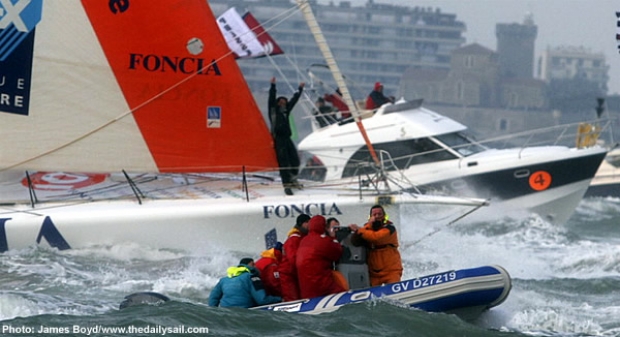
Historic moment
Sunday February 1st 2009, Author: James Boyd, Location: United Kingdom
With an impressive flotilla of spectator, press and sponsor craft falling in alongside him, so today Michel Desjoyeaux entered the history books as the first person ever to have won the Vendee Globe twice. Desjoyeaux already holds the record for being the only person to have won the big four events in solo offshore racing: the Route du Rhum, the Transat, the Vendee and the Solitaire du Figaro (which he has won three times).
At 16:11.08 local time (15:11:08 GMT) here off Les Sables d'Olonne Desjoyeaux's Farr-designed Foncia, cruised across the finish line under staysail and reefed main taking her skipper to his second victory in a new record time of 84 days 3 hours 9 minutes and 8 seconds. This is 3 days 7 hours and 39 minutes faster than Vincent Riou's time in the 2004-5 race. However it should also be considered that Desjoyeaux started 41 hours after the rest of his competitors following his return to Les Sables d'Olonne shortly after the start to fix a water ballast tank that was leaking into the engine compartment and causing a short.
Also the course this year was some 5% or 1,160 miles longer than previous Vendees.With the added ice gates in the Southern Ocean, the total distance he sailed was 28,303 miles making his average speed for his non-stop circumnavigation, 14.02 knots.
His margin on this occasion was substantial compared to what it was when he won the race in 2000-1 when he had British terrier Ellen MacArthur nipping at his heels, eventually finishing 1 day 28 minutes ahead of her. As Desjoyeaux crossed thie line his nearest rival Roland Jourdain was still 1345 miles from the finish line on board his crippled, keel-less boat Veolia Environnement. This equates to a lead of 4-5 days - if Veolia was still sailing at 100%.
"It's incredible..." commented Desjoyeaux on his arrival. "In addition there was a small ray of sunshine as I crossed the finish line. It's magical; it's indescribable... It's really phenomenal. I can't really get my head round it... I don't understand, I'm making the most of it and I'll get my head round it afterwards..."
On restarting after damaging his water ballast tanks he said: "I didn't think twice about it. I said to myself: there's a long way to go. We'll resolve the problem and head out to sea again and then what's history is history. It's not even a beautiful story, it's TOO beautiful".
"The race is won 80% before the start: in the choices made by the team, in the organisation, in the serenity, in the experience, it's a whole bunch of things... The remaining 20%: it's the competition, the race..."
See our guided tour to Foncia here
Le Professeur's race - in detail:
Come the Monday morning after the start, Foncia was holding sixth position, 9.6 miles behind Marc Guillemot's Safran with the southwesterly wind increased to over 30 knots and the seas up 4 to 6 metres. Anticipating the severe weather to come Foncia was furthest west in the fleet. However at 09:19, while 200 miles from the start, Desjoyeaux informed his shore crew that he was returning to Les Sables d'Olonne to fix a leaking water ballast tank cover that was gradually flooding his engine compartment, resulting in electrical problems.
“I had a small leak around a ballast tank cover and I slightly underestimated the scale of it and the damage it could do. Some water has got into the engine compartment… I thought this was just a small amount but this morning, as I ran the engine, there was a smell of burning after 40 minutes…” he reported.
At 0040 GMT on Tuesday 11 November Desjoyeaux managed to surf Foncia into Les Sables d’Olonne despite dangerous conditions in the entrance to the harbour - he sailed in under triple reefed main and storm jib. Engineers from Nannidiesel zoomed down to Les Sables d'Olonne to replace some electrical components on the engine while his store team fixed the leak in the ballast tank.
The issues fixed, by 0600 the same morning Desjoyeaux set sail again on the next tide. Upon finishing Desjoyeaux said that at no point at this stage had he considered throwing in the towel. He says his expectation when he restarted was to be in the top five by the time he reached Cape Horn and he would fight it out in coming back up the Atlantic.
At this point he was 41 hours behind his competitors, who were some 360 miles further up the race course approaching Cape Finisterre. Fortunately Desjoyeaux emerged into more clement conditions than the terrible conditions his rivals had experienced, that resulted in the dismastings of Groupe Bel, Aquarelle.com and DCNS and the structural damage to Hugo Boss. More favourable northwesterlies enabled him to make a substantially faster passage across the Bay of Biscay to Cape Finisterre which he passed on the Tuesday night.
“On the approach to Cape Finisterre, the boat was still really slamming… In fact, that was the case throughout the entire crossing. Even though I got across the Bay on a single tack, I was driving into the sea, which made it pretty violent. The wind had shifted but not the waves, which led to some almighty wave jumping!"
While he had made up time in the Bay of Biscay the elastic attaching him to the leaders expaned on the Friday when he was caught in an area of high pressure off Portugal, while new race leader Jean-Pierre Dick on Paprec-Virbac 2 by this stage was 650 miles ahead of him. However already he had managed to pass Norbert Sedlacek to move up to 22nd place. At its worst the elastic extended to 670.3 miles on the Friday by which time Loick Peyron on Gitana Eighty had taken the lead.
By the middle of the second week Desjoyeaux had clawed his way up to 18th place having stayed to the west of Madeira and the Canaries. By this stage he was back up to 459 miles behind the leader and come the Friday he had gained two more places and was just 273 miles behind Peyron. While he was more fortunate with the weather, there was no question Desjoyeaux was pushing hard - over this week he'd managed to regain 53 miles/day on Peyron...
“I’ve made up a little ground thanks to the nice weather but I’m going to have to keep an eye on when the others get moving again…They didn’t have luck on their side when they hit a wide Doldrums. While they were in there I was coming up on them with a breeze, which has enabled me to catch up with the leading group... It’s certainly enjoyable making up 300 miles on boats which have a 600 mile lead over you, as well as knowing that you’re the fastest of the fleet almost all the time. Even though you know why that is and that you haven’t played a big part in it, it’s still satisfying...
Come 0443 on Sunday 23 November Foncia crossed the Equator and had gained a further place and having himself been slowed in the Doldrums was back to 360 miles from Peyron, who by this stage had broken away from the fleet along with stablemate Jean-Pierre Dick and Séb Josse on BT.
In the South Atlantic, all the frontrunners found themselves nailed by the St Helena which was spanning most of the ocean as they attempted to pass through. This resulted in them all sailing further west than they would have typically. However while the frontrunners felt the worst of this, behind them in the northeasterly trades off Brazil, Foncia was racking up 300 mile days...
“This weather situation is enabling me to make up ground," reported Desjoyeaux at the time. "The head of the fleet must be making 8/9 knots as it tacks upwind with the chop. It can’t be very quick… Meanwhile I’m making 12/13 knots of boat speed the whole time. This is also enabling me to stay on the pace and continue to seek the optimal course."
Three weeks into the race and having taken a more westerly route south to get to the western end of the high, so Desjoyeaux continued to make the fastest speeds in the fleet and on 1 December overhauled Roxy, Bahrain Team Pindar and Temenosto pull up to 11th and the front of the 'second wave' of boats, 226 miles behind new leader Seb Josse and BT.
With the Southern Ocean (40degS) just two clicks away, so Desjoyeax publicly announced - part of the race politics game he is a master of - that he was changing to a special 'Southern Ocean staysail' made from Cuben fibre, a sail he claimed you hoist in 28/30 knots of downwind conditions and you keep carrying until the wind reaches 50 knots - a sail he could really thrash, as he put it.
On 3 December and now heading west in the South Ocean, Foncia overhauled 10th placed Safran but 193 miles astern of Seb Josse and still had some ground to make up to get up to the top nine 100 miles in front of him. However the news was not all good. Hoisting his heavy kite it tore and went overboard, forcing Desjoyeaux to hove to as he recovered the pieces of the torn sail.
The following day, taking a more southerly route through the Southern Ocean, Foncia set a new personal speed best - 30.44 knots. In turn she had closed to 136.4 miles from the race leader but the deluge over the bow has wiped out three stanchions.
As the boats passed to the south of South Africa so Foncia had pulled up with the lead group and on Monday 8th December, a month into the race was back up to sixth place just 90 miles off the new race leader, Jean-Pierre Dick on Paprec-Virbac 2.
Off Crozet on 10 December, Foncia was to the north of lead pack, fighting to relieve Mike Golding of fifth. He did indeed gain fifth place but through more ominous reasons following that sad dismasting of Loick Peyron's Gitana Eighty.
The following day, approaching the Kerguelen Islands, Desjoyeaux reported spotting ice. "It was a long way off but close enough that there was no question. They were modest bergs, not big ones. The first was a good twice the length of Foncia, at around 40 metres; at least that’s how big the bit above the water was."
Mid-Indian Ocean at this point the pace was furious preceeding a cold front. In these conditions Foncia saw a peak speed of 30.44 knots and covered 466.6 miles in 24 hours at an average speed of 19.44 knots.
But the most significant moment of this Vendee Globe came over 15-16 December.
First Paprec-Virbac suffered a collision that damaged her starboard rudder. This allowed Mike Golding on Ecover 3 to pull into the lead, only to dismast the following morning. At 0930 on 16 December while passing Cape Leeuwin, Desjoyeaux pulled into the lead and was never to relinquish it.
While the Indian Ocean claimed a very large number of victims in this Vendee Globe - not just Golding and Peyron but also Swiss competitors Bernard Stamm and Dominique Wavre (and later Jean-Baptiste Dejeanty), Foncia wasn't entirely unscathed, Desjoyeaux having to make a repair to the case for the port rudder which is no longer attached on one side.
Passing to the south of New Zealand, it felt slightly that the wind had gone out of the sails of the Vendee leaders following the carnage. Of the frontrunners, only Roland Jourdain on Veolia Environnement seemed able to keep pace with his Port la Foret neighbour with Seb Josse and Jean le Cam slowly falling behind. Shortly before Christmas Foncia sets another his new speed record on board of 32.37 knots...
In the Pacific and across the International dateline, Christmas Day was an unpleasant one for Desjoyeaux, upwind as he tackled a depression that was edging its way across the course from New Zealand. In addition the issue with his port rudder had worsened.
Desjoyeaux reported: “I was sailing close-hauled in a good 35 knots of breeze and big seas. I was carefully making headway with two or three reefs and ORC. I had raised the windward rudder to the horizontal position and I think a wave hit it. The piece which holds it in the raised position had broken and it was impossible to get the rudder back into its original position. It was now only held by the strut on the side and the upper section. I decided to slow the boat down and we ended up with flattened sails which quickly went aback and I began to go backwards. At that point I saw the rudder go under the boat, then it came back towards the stern and, as luck would have it, the casing gradually returned to its original position. It shook me up to see the rudder splashing about. Miraculously the situation stopped deteriorating at that point. A
few days later, I managed to make the system safe. I even made a support which
enabled the rudder to kick up in the event of impact with a floating object. It feels like I
came close to a catastrophe and even though you’re not frightened during the event, it
creeps up on you retrospectively once you’ve sorted the problem out.”
By the final icegate in the Pacific section of the Southern Ocean before turning south for Cape Horn, the lead in the Vendee Globe had become a three horse race with Seb Josse retiring when a vital part of one of BT's rudders was destroyed. This left Roland Jourdain still in reasonably close contact with the leaders, with Jean le Cam trailing and Armel le Cleac'h and Vincent Riou match racing for fourth place but now 600 miles astern.
On Monday 5 January at 04:10, Foncia passed Cape Horn in 35-40 knot winds, having taken 56 days, 15 hours and 08 minutes to reach there - two hours inside Jean le Cam's record from the 2004-5 race, but having started 40 hours late and sailing 1,160 miles more due to all the Southern Ocean icegatees. At the time he held a lead of 120 miles over Jourdain, 481 miles over le Cam and over 700 miles on Riou and le Cléac’h.
Into the Atlantic there was further issues on board Foncia. While Desjoyeaux had made a successful repair to her damaged bowsprit, but on 8 January as Foncia was approaching the latitude of the River Plate between Argentina and Urugary, her second heavy spinnaker was lost overboard, again during a hoist. Desjoyeaux managed to salvage it but deemed it irrepairable.
There was also a charging problem on board which Desjoyeaux he had managfed to quickly resolve. “I had to change some elements of one of the battery installations which were weak. I have the advantage that I have them in individual units on board. When there’s one faulty one on the four strips of 12 elements, you remove the problem one and you switch it for one that works. When you have batteries cast in one piece, you can’t do that. If there’s a fragile element, your whole battery is up the spout… For the past two days I’ve just been using the automatic pilot and the navigation instruments. I’m being careful but it’ll hold out till the end of this round the world. It’s a system I put in place on Foncia which I’m very satisfied with…"
A relatively fast run up the first part of the Atlantic culminated in it taking a long time for Foncia to reach the northeasterly trade winds, Desjoyeaux preferring to take a more offshore course to the east compared to Jourdain, having dropped back to 300 miles behind but pulling back to 241 miles.
“It’s hot in the Southern Atlantic," reported Desjoyeaux. "28°C inside the boat. I’ve gained around 20 degrees in eight days. The weather’s difficult but we’re making headway.
Unusually Foncia experienced the worst of the Doldrums to the south of the Equator, rather than their normal position to the north of 5degN. Slowed in the Doldrums, Jourdain managed to pull back to with 334 miles of the leader. At 05:14:10 GMT on 20 January, Foncia passed back into the north Atlantic.
With Foncia into the northeasterly trades, the death knoll was sounded for any chance of Roland Jourdain getting back into the mix, as he suffered more than the leader in the Doldrums. After a five day long slog fetch on starboard tack across the trades, Foncia on 27 January was finally able to turn the corner on the Azores high and to head for the finish line.
Jourdain's chances of making any impact on the race leader were destroyed when he discovered the keel to have snapped off on Veolia Environnement and impressively he is still continuing to sail, despite having no lead beneath him - a situation that remains at present with Jourdain still to the southwest of the Azores.

Most Read
Most Commented
Comments
Businesses


Pro businesses
-
United Kingdom
-
United Kingdom
-
-
Editor's choice
Member blogs
-
 Ned Collier Wakefield: MOD70 round BarbadosWell that was intense. 12 hard fought for seconds for the win. In idyllic conditions, Tony Lawsons MOD ...
 -
 Mini Transat leg 2 reportThe second leg of the Mini Transat started on 31st October, just over a month after ...
 -
Leg 1 reportI’ve been working towards the Mini Transat now for three years. In 2013 I was part ...
Business blogs
-
 The Island Sailing Club in Cowes, Isle of Wight, is delighted that Prince Michael of Kent ...
 -
Peta Stuart-Hunt chats with the 25 year-old British solo sailor Lizzy Foreman before she sets sail ...
-
The 2015 Student Yachting World Cup (SYWoC), an ISAF-recognised event hosted and run by students for ...
Editor's Choice
All time favourites...
-
 Three legs down into Ian Walker’s
 -
 Winning all but two races at
 -
 For the first time in its
Latest Comments
Add a comment - Members log in