

The ORMA replacement
Tuesday October 20th 2009, Author: James Boyd, Location: United Kingdom
It has been almost two years since we last caught up with Franck David, coincidentally the Olympic wind surfing gold medallist from the Barcelona Games, who had taken on the task of making a future for the ORMA class following the soaring costs and ultimate demise of our beloved 60ft trimaran fleet. At the time David was promoting the Multi One Design 70 trimaran or MOD 70, an abbreviation that, yes, could work better on the UK side of the channel, with its connotations of camouflage green.
Since then, we are pleased to report that David’s project has the green light thanks to backing of the project by Swiss entrepreneur, Marco Simeoni, who’s IT company Veltigroup currently sponsors former ORMA 60 skipper Steve Ravussin on the D35 circuit on Lake Geneva.
A new company has been set up, based in Lausanne, called Multi One Design SA with a management team comprising Simeoni as CEO, David as Executive Director and Ravussin as Technical Director.
“He really enjoys sailing and he really thinks it is a good opportunity for a new company and a sailing project with multihulls,” says David of Simeoni. “So he is really enthusiastic to come with us on the project. And he comes with a new vision with what we can do with sailing, which is why we have a new commitment with eco-responsibility and we are working hard on that.”

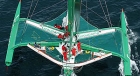
In a nutshell the Multi One Design is a 70ft one design trimaran from designers Marc van Peteghem and Vincent Lauriot Prevost, who most recently have brought the world Groupama III and Banque Populaire V (along with having a big hand in BMW Oracle Racing’s trimaran). Different from two years ago is that boat and circuit are now solely for ‘fully crewed’ teams, which in this case means sailing six up. The circuit will operate on a three year cycle (like the Volvo Ocean Race) with the principle events being annual European Tours with a World Tour in year three. Combined, these will form the Multi One Design Championship. The World Tour is not of the conventional leaving the three great Capes to port variety, but will go west-about, the ‘pretty way’, through both the Panama and Suez Canals (rather like the Clipper Round the World Race of old).
And it should be emphasised that this is no pie in the sky dream – David has the funding to build five boats, the first to be launched in October 2010 and used as a demonstrator. A builder is on the verge of being signed up from a shortlist of five.
To achieve this David says that their company bought all the rights of the MOD project from ORMA, thus solving the fundamental problem afflicting ORMA and in our opinion the principle cause of its tragic demise: an organisation run by skippers and sponsors, lacking consensus on the direction the class should go to resolve its principle issues of escalating costs and an increased propensity for damage and loss. Run by one company means that at last it is possible to make decisions and therefore forward progress.
We put it to David that if traditionally all the big, popular events in France that offered the best return on investment for sponsors were the shorthanded ones like the Route du Rhum, Transat Jacques Vabre and the Artemis Transat – why is the Multi One Design fully crewed? “That is true, but it is true in France. We want now to develop multihulls with international teams and we know that for international teams it is really important to have crewed races,” David confidently counters. “We were also discussing with the French skippers, like Franck Cammas, Steve Ravussin and Loick Peyron and they all also enjoy crewed races. So maybe there are two or three guys who are really happy to go alone in a boat but most of them prefer to go with crew.
“Maybe two years ago it was not good timing, but now it is better. And it is also better timing because the economic situation is quite difficult and our one design project costs less money for a sponsor and for this program they will have more success with the media and more return on their investment.”
Overpowered and limited by length, latter days ORMA 60s were not the ideal solo offshore race boat, although they could have easily have been made safer by adding length while restricting mast height/sail area as designer Nigel Irens proposed and as in practise demonstrated by his and Benoit Cabaret’s extremely successful solo offshore trimarans, such as Ellen MacArthur’s B&Q Castorama (effectively a 60ft trimaran rig under a narrower 75ft long platform) and more recently the record breaking solo 100 footers Sodebo and IDEC.

The MOD70
Compared to the original MOD70 unveiled two years ago, the design of the boat has been upgraded, following VPLP’s work on their offshore maxi-tris.
According to Vincent Lauriot Prevost the length of the floats has increased by 5ft forward, so they are now 65ft long while the main hull remains 70ft LOA. There is no bowsprit, so the main hull is best imagined as being like that of an ORMA 60, but with the gennikers/spinnakers now tacked to the bow – as is the case with the maxi-tris.
The boat also has the cool-looking reverse ‘Dreadnought’ bows as featured on Banque Populaire (and more recently the BMW Oracle Racing floats). “The main advantage is when you look at the volume distribution of the floats, what we like is to have floats which don’t increase drag too much when passing through waves,” explains Lauriot Prevost. “The reverse bow with the Veed-section helps us a lot passing through waves and so we have a reduction in the pitching motion.”
So the fine entry gives the bows a wave piercing quality, rather than lifting the bow up as it goes through waves (a la Team Phillips - Adrian Thompson eat your heart out…!) “We can do it because we have increased the length at the same time,” says Lauriot Prevost.
While this is a one design, it has only been dummed down slightly from what ORMA 60 trimaran crews were once used to. These featured curved lifting foils on the floats and rotating wingmast rigs that could not only be canted up to weather, but could be raked fore and aft. In addition to improve upwind ability there was a America’s Cup-style trim tab on the daggerboard in the centre hull. On the MOD 70 they still have the curved foils and canting rig, as well as lifting rudders, but the trim tab and the mast raking features have been dispensed with, to simplify the boat slightly.
V2 of the MOD70 has a slightly reduced sail area with mast height being reduced to just below 30m (the maximum mast height of an ORMA 60 was 30m). Lauriot Prevost says the overall sail area is a little less than an ORMA 60s. Otherwise the sail plan will be roughly the same, the inventory including two gennikers, one Solent, one staysail, one storm jib and one main.
While the boat is now being aimed at ‘fully crewed’ racing, according to Lauriot Prevost the cockpit layout hasn’t changed much with the now conventional arrangement of the straight aft beam forming the forward end of the cockpit and a curved beam, hanging off this, being used as the base for the long curved mainsheet track as well as forming the aft side of the cockpit. The cockpit features two pedestals.
In terms of performance Lauriot Prevost reckons that compared to an ORMA 60, the MOD70 will be a little slower in light conditions, but better in medium to strong, the crossover being at around 15 knots. So top speeds of 21 knots upwind and 40 reaching (as was the case ultimately with the 60 tris)? “There are some devices we don’t have compared to the ORMA 60 like the trim tab, which will impact on the performance, the extra weight and reduction in the sail: all these things make the boat more conservative, but in terms of longitudinal safety that makes the boat want to pitchpole, we have some extra margin due to the length of the floats, due to the reduced mast height and we should have more margin there than the 60 footers had.”
So the weight penalty has been self-imposed, although all up weight of the MOD 70 still remains a featherweight 6.4 tonnes (in light displacement).
“It is not bad, but despite the fact we have increased the weight, we want to have the same righting moment, so we have reduced the beam in order to have the same range of effort on the rigging and all the deck equipment and so on,” says Lauriot Prevost. Overall beam is around 17.2m (although the official states it as being 16m) which is around 300mm a side narrower than an ORMA 60 like Foncia (although other, such as the former Belgacom, now the newly lengthened Gitana, were slightly wider than they were long).
“Like that we are comfortable with righting moment and the load cases over the range and the mast structure and so on,” continues Lauriot Prevost. “We want to stay in the range we have proved for the past years.”
The weight penalty in fact is only around 300kg, added to the structure to improve its reliability. This is based on what VPLP learned with the ORMA 60 tris and more recently with the maxis.
“Over the past 10 years we have a lot of data about what was wrong on the boats and what was good on the boats, so we know what the critical paths are, and we put an accent on those areas,” says Lauriot Prevost. Thus the core is Nomex but with foam in key slamming areas such as the bottom of beams and the outside and underside of the floats.
As David hinted about earlier, the whole Multi One Design project will be one of eco-responsibility and so the intention is for the boats to carry no fossil fuels (a la Joyon on his round the world record). However this eco-responsibility will also be carried through to the production and promotion processes for the new boat.
Obviously there are one designs and one designs, however the MOD70 looks like it will be a strict one with all the boats coming from one builders and even sails being supplied.
“In fact it costs a lot to control that but each time will earn a lot from that because we will buy in bulk,” says David on the one design nature of his creation. “So for all the teams it will 30-40% less expensive than if it wasn’t one design. That is different plus you get equality on the ocean. It is quite important also for a sponsor and a skipper to know that they can win. When you sell the project to a sponsor you can say it is a winning project.”
A builder for the MOD 70 is to be decided in early November, with a view to start building January.
MOD70s can be bought directly from Multi One Design. To encourage teams to sign up quickly the first five boats will come with a price tag of 2.5 million Euros, going up to 2.8 for hull six to nine and then 3.2 for 10-12. The intention is to only build 12 boats, however this is tied in with a license to compete on MOD circuit.
One of the problems with both ORMA and IMOCA is that teams have different circumstances in terms of sponsors and very often differing views about their sailing programs. However in purchasing a MOD70, the company are wisely tying in teams to compete in their circuit.
“We sell a sports license with the boat so it means that if they don’t do the European Tour or the World Tour, then they will lose their license - except if there is a big problem with the sponsor or something,” explains David. “It means that they won’t be one of the 12 boats any more. So then we will build another one MOD 70 and they won’t be able to sell their boat, so they lose a lot of money. We want to be sure that all the teams will do all the races in the championship and also I think for them it is really important as they will get good investment, because it is one design and if you want to stop after three, four or fives years then you can sell your boat and your place in the championship and there is lots of credibility for the sponsors. We are sure to keep these boats for 10 years, so 2012-2022.”
Obviously the Multi One Design is likely to be stacked up against the Volvo Ocean Race and even with the welcome modifications being made to the VOR, the MOD will still represents a cheaper alternative on more exciting but cheaper boats, lower overall costs and racing around the world on a warmer route.
David doesn’t see it as being a competitor to the VOR as the route of their round the world race is so different, going the opposite way around the world through the canals, with only six legs of eight to 15 days duration. The overall duration is still expected to be six months.
Monohull fans will certainly still prefer the VOR, which also carries the gravitas of an event that has been run since 1973. It obviously also features the Southern Ocean which the MOD doesn’t. “We hope that some Volvo teams can come on the Multi One Championship and also some of the Multi One teams can do the Volvo if they want to sail that or if a sponsor wants to do something different,” says David. “We want only to be unique in one thing and that is to be multihull and oceanic – that is important for us. We think it is a strong concept.”
While most of the sailing calendar works on a four year cycle, the MOD has joined the Volvo Ocean Race in working on a three year one, simply on the basis that four years is too long between races and two years is too little. In addition, says David, sponsors like to sign up for three years. “Each three years you have two European Tours and one World Tour, so it is a good program for a sponsor.”
The first World Tour will be in 2013, following on from the Volvo Ocean Race in 2011 and the Vendee Globe in 2012.
While the boats will be tied up with the Multi One Design sailing program, David says that their calendar will not conflict with France’s all important race for ocean racing multihulls, the Route du Rhum. If a team on their circuit wanted to enter the Route du Rhum sailing their MOD 70 singlehanded, this is also not a problem, although if race organisers, Pen Duick, continue to leave the top end of the fleet unlimited, then David wonders how competitive the MOD70s will be.
“If they decided to change it and they want to have 12 equal boats and all the teams are okay to go on the Route du Rhum with one skipper, who could be different from the skipper for the crewed races, then it would be good for the class. It won’t be in the championship but it would be good for the promotion. With two handed races, like the Transat Jacques Vabre, maybe it will be different. We will discuss with the organisers and it will depend upon if they organise a class especially for the Multi One Design or not,” says David.
As to the teams, Alinghi, Foncia and Gitana attended the recent presentation in Lausanne, with other teams expressing interest obviously from France, but also the USA, New Zealand and Sweden. The first boat, the demonstrator already has a home and will be called the Multi One Attitude, carrying, as David says, the concept of Eco Responsibility. It doesn’t take a huge leap of imagination to see Steve Ravussin skippering this.
“We are really happy because we have worked hard on the project,” says David. “And the boats are really nice. We hope that with the America’s Cup on multihulls and the iShares Cup, the Extreme 40s and the D35s, many people are thinking of multihulls now. So we work hard for that.”
So this vision of the Multi One Design is in fact very similar to the one Gitana proprietor Baron Benjamin de Rothschild had for the ORMA class four or five years ago – placing the emphasis on fully crewed racing with the aim of attracting more international competition, for with escalating costs ORMA racing could no longer remain solely a French pastime. But will it work? Certainly it is different with a grand prix round the world race through the tropics, aboard unquestionably exciting boats and the lower price tag will find favour. But is a large offshore one design a successful formula? Certainly lessons could be learned from another Swiss endeavour, the Grand Mistral, the water ballasted Farr 80 monohull one designs, which as a circuit ultimately proved to be a lemon.
We wish the MOD every success, but at the end of the day while Pen Duick may not be right to leave the Route du Rhum or their proposed singlehanded non-stop round the world race in multihulls unlimited (this is not the 1970s any more…), the prospect of giant 100ft trimarans like IDEC and Sodebo being raced across the Atlantic or round the planet singlehanded fires our imagination considerably more than a fully crewed one design.
Full official presentation here:

Most Read
Most Commented
Comments
Businesses

Pro businesses
Editor's choice
Member blogs
-
 Ned Collier Wakefield: MOD70 round BarbadosWell that was intense. 12 hard fought for seconds for the win. In idyllic conditions, Tony Lawsons MOD ...
 -
 Mini Transat leg 2 reportThe second leg of the Mini Transat started on 31st October, just over a month after ...
 -
Leg 1 reportI’ve been working towards the Mini Transat now for three years. In 2013 I was part ...
Business blogs
-
 The Island Sailing Club in Cowes, Isle of Wight, is delighted that Prince Michael of Kent ...
 -
Peta Stuart-Hunt chats with the 25 year-old British solo sailor Lizzy Foreman before she sets sail ...
-
The 2015 Student Yachting World Cup (SYWoC), an ISAF-recognised event hosted and run by students for ...
Editor's Choice
All time favourites...
-
 Three legs down into Ian Walker’s
 -
 Winning all but two races at
 -
 For the first time in its
Latest Comments
Add a comment - Members log in