
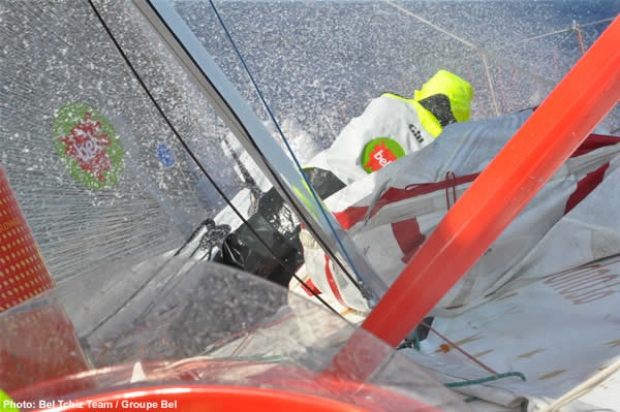
Preparing for tomorrow's gale
Tuesday November 10th 2009, Author: Andi Robertson, Location: United Kingdom
Their strategies may be different, but the unavoidable facts remain that the Transat Jacques Vabre fleet will have to deal with some difficult wind and sea conditions through Wednesday and Thursday as they encounter the first big Atlantic storm of the race. Today crews on both the IMOCA Open 60s and the Multi 50s have been preparing for winds which are forecast to exceed 40 knots at times and big seas.
Seb Josse, co-skipper on BT, the IMOCA Open 60 which has led the fleet throughout the day, admitted this morning that there are no clear cut advantages between the more northerly routing which he and Jeff Curzon have been following, and that of the double Vendée Globe winning Michel Desjoyeaux on Foncia, who last night seized the opportunity presented to maximise his southing with co-skipper Jérémie Beyou, and split away from the southerly grouping.
"It is important for us to manage the boat well so that we get out of this aggressive depression in good shape," said Josse. "In the south it is not immediately obvious that Michel will have weaker winds. He will still have 40-45 knots and contrary waves like us. These are different approaches to the same depression but the conditions will be pretty much the same. There are many different solutions but I don't think that any one is obviously better than the others. We look at them all, the extremes and those like ours".
While Desjoyeaux told today's live radio chat session that his option was principally in search of a little relief from the worst of the forecast conditions, Foncia was still marching hard south, on the wind this evening, theoretically taking a loss in miles and placing in search of the longer term gain.
“It is not going too badly," reported Le Professeur. "We are a little bit lonely over here, not many around us to play with. Whatever, we are where we need to be, given what is forecast to happen. But, we will see, I think that we will suffer a little less where we are. I don't know if we'll go quicker, but there will be less wind and it will be a bit less extreme. We're certain to have some tough hours at times, but we will not be as badly affected as some out in the west.
“We are getting into the SWerly wind and are hard on the wind configuration. And I reckon to be like this for a couple of days.The stealth mode? We failed to use it yesterday and changed our mind and today it is no good because we are now like this for two days. The boat is well set up, all stacked on the same side. And my autopilot, whose name is Jérémie Beyou, will allow me to sleep well. We have eaten well since the beginning and so we are both in good shape."
British pairing Dee Caffari and Brian Thompson on Aviva continued with their strong position, racing through the day in second place, sliding on the afternoon ranking to sixth with a 14 miles deficit to BT. Racing virtually alongside Kito de Pavant and Francois Gabart, only about 400 metres apart during the morning, Thompson highlighted the similarity in speed of the diverse designs before they tacked off to the northwest this afternoon, leaving the Mediterranean pairing, for the meantime, to a more southerly track.
“We have gennaker, staysail and full main, about 20 knots of wind," Thompson reported earlier. "It is quite showery. At the moment we are all on the north side of the trough, maybe with the exception of Michel. I think he is trying to avoid the worst of the weather and come through a little bit further south. That is the kind of thing he did in the Route du Rhum and won. It is not necessarily the fastest routing. If we are slowed down because it is too rough to sail to our potential.
“The question for us is how close to the centre of the low you want to get, to get a lift on starboard because the wind will be more NW the more W you are, but to get W you need to do a lot of beating upwind on port, taking you closer to the low. And also that is not going to take you very close to the mark, that is the trade off really, whether it is better to go on starboard and sail more miles.”
Meanwhile from on board Groupe Bel de Pavant reported: “The barometer is sinking. Some very bad weather is on the way and we don’t have any choice but to head straight into it. We have been playing safe, particularly in our choice of sails and this is working out rather well” sums up the skipper. “We are on the defensive even though we have been in a good position since the start. Our aim above all is to keep the boat in good condition.
“The weather data forecasts a huge low area without any solutions for getting away. To get to Costa Rica, we will have to face a “battle”, so we’re heading for it.There is the solution of heading right down south now, but that brings us to another very violent low pressure area, and just behind, the anticyclone does not sit right and will prevent us from sailing on down. Tomorrow evening, things should be a little better, but the next 36 hours are going to be very difficult. We hope to glimpse a way out around the Azores, but it’s well hidden!
“The best route to Costa Rica passes right through the centre of this low. If we wanted to avoid it, we would have to position ourselves to the southeast and then risk encountering other low pressure areas which are brewing at the end of the week. We prefer to head straight into the gale this evening, knowing roughly what we can expect, rather than later heading into violent winds, less well oriented, without really knowing what will hit us."
Meanwhile the split in the fleet, such as it is, sees a group of five opting for a more northerly routing - nanely BT, Veolia Environnement, Mike Golding Yacht Racing and Aviva - while the southerly cluster now comprises Akena Verandas, Artemis and W Hotels.
Armel Le Cléac'h was forced to observe that perhaps he played his good luck cards in finishing second in the Vendée Globe after suffering no major damage as Le Cléach and his long-time friend Nicolas Troussel have been the first IMOCA Open 60 pairing to be forced to re-route because of damage. They took the tough decision to head for Concarneau very early this morning after a flailing headboard car ripped away 80cms of their mast track. ‘The Jackal' – so named because of his ability to stay the course when others have faltered and pounce late in a race – said that they will make there decision on whether to continue or not as soon as the damage has been fully assessed.
"On board Brit Air there is a problem with the mast track for the mainsail, so we are heading for Brittany to see if we can repair it and set out again," reported Le Cléac'h. "We are going as quick as we can. Last night after the front went through the wind got up and we broached, got into trouble with the mainsail and ripped the track off level with the first reef. The headboard car pulled off and tore the track off the mast. We have to get the mainsail all the way down to re-attach the car and so even then we can't get it above the level of the second reef. We can't sail to the potential of the boat and the repairs we have to do we can't do at sea. We're disappointed that this has happened now because we were very much in the race. I did not have much big damage in the Vendée Globe but maybe now it's our turn in this Transatlantic race. We'll find out tomorrow if it makes sense to set off again. We'll talk with the team and make the decision once we know how long it will take to repair. I think we'll be in Concarneau by dawn."
First to play the stealth card - going into furtive mode - was Yves Parlier and Pachi Rivero on 1876.
In the Multi50 fleet Prince of Bretagne has been forced to head for La Coruna after also suffering mainsail mast-track damage, while Crepes Whaou still leads from the advancing Région Aquitaine Port Médoc.
Most Read
Most Commented
Comments
Businesses

Pro businesses
-
-
United Kingdom
-
France
-
Italy
Editor's choice
Member blogs
-
 Ned Collier Wakefield: MOD70 round BarbadosWell that was intense. 12 hard fought for seconds for the win. In idyllic conditions, Tony Lawsons MOD ...
 -
 Mini Transat leg 2 reportThe second leg of the Mini Transat started on 31st October, just over a month after ...
 -
Leg 1 reportI’ve been working towards the Mini Transat now for three years. In 2013 I was part ...
Business blogs
-
 The Island Sailing Club in Cowes, Isle of Wight, is delighted that Prince Michael of Kent ...
 -
Peta Stuart-Hunt chats with the 25 year-old British solo sailor Lizzy Foreman before she sets sail ...
-
The 2015 Student Yachting World Cup (SYWoC), an ISAF-recognised event hosted and run by students for ...
Editor's Choice
All time favourites...
-
 Three legs down into Ian Walker’s
 -
 Winning all but two races at
 -
 For the first time in its
Latest Comments
Add a comment - Members log in