
Voyage into the unknown
Friday February 13th 2009, Author: James Boyd, Location: United Kingdom
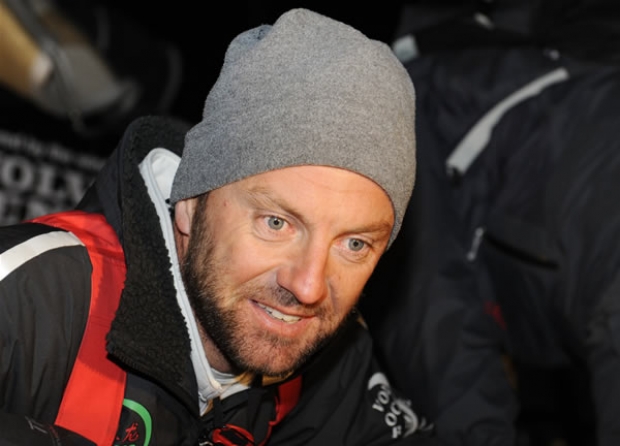
Olympic sailor, turned America’s Cup, TP52 and now Volvo Ocean Race skipper, Ian Walker is embarking on his longest ever offshore passage this weekend with leg five of the Volvo Ocean Race, from Qingdao to Rio via Cape Horn, 12,500 miles long and expected to take 40 days for the Volvo Open 70s.
After an arduous upwind slog on leg four between Singapore and Qingdao, a leg where conditions were so brutal it seriously damaged three boats, two of which are now heading to Rio by ship, one might imagine that the degree of boat work in Qingdao has been immense for the Green Dragons. But according to Walker this wasn’t the case.
“We’ve spent most of the time waiting for the fog to go away and the wind to start, so that we can go sailing!” he says, Qingdao in its usual form, last weekend causing the in port race to be delayed by two days. “When we checked the boat over, we were in quite good shape. We broke the forward bulkhead between the two watertight bulkheads forward. There is one stringer and that is what we repaired at sea and the good news was that we hadn’t damaged any of the hull.” In comparison both Delta Lloydand Ericsson 3 all experienced delamination in their forward panels, thanks to the perpetual slamming upwind.
“We had a new bulkhead made up by McConaghys here in China and it was just a question of cutting the old one out and scarfing the new one in," continues Walker. "That turned out to be not that big a job. We had quite a bit of damage to the foils, when we got them all wrapped up in all the fishing nets, particularly one rudder, but it wasn’t too bad. The shore crew had to put in long hours, but we were back on the water on the Thursday before the in port race and this week it has been a case of getting the boat ready for the offshore and loaded up and checking everything over.”
So was the weather on the leg north to Qingdao as horrific as was made out? “It probably was," Walker admits. "It doesn’t seem as scary, because you are going upwind. It is not like sailing downwind at 25 knots, when you are never quite sure when you are going to wipe out and how. Most of the time you are sailing with storm sails trying to slow the boat down, so it wasn’t scary as such, but there were reasonably big waves and quite strong winds, but it wasn’t too extreme. The hardest thing was just trying to keep the boat slow enough, and once we’d damaged the boat, then it was very un-nerving, because we were that much more scared for the boat and particularly at the top of Taiwan the waves were just square and it was very hard to give the boat a soft route through the seaway.”

So this new route through the Far East, on balance does he feel it is good or bad? “No one likes sailing upwind in these boats for prolonged periods of time, which is what we have done for two legs in a row. On the other hand the stopovers have been very successful and I think it has been good to do this leg, to give the boats a thorough test before we head out and do it in the Southern Ocean further from land. I’m pleased that we did give the boats a good test, so that any problems we’ve had, at the end of the day no one was more than 50-60 miles from land and they could get themselves home and everyone was safe. I think it is no bad thing and I suspect that is something Volvo should encourage people to do prior to the start of the race next time, so that all these issues have been resolved before the start.”
In previous years the fleet has taken part in the Fastnet Race as a shake-down of sorts, but with the event no longer starting in the UK this hasn’t been the case recently.
“Sailing to the Yellow Sea at this time of year in the middle of winter is not ideal,” continues Walker. “Whichever side of Taiwan you go, it seems you are doomed. It is not something you’d choose to do, although it was a good test. I think we were quite lucky with the weather. It could have been a lot worse, particularly the last 400 miles into Qingdao. If we’d had 30 knots northerlies and -10degC, we could have been dealing with seriously low temperatures. So we were actually very very lucky in our approach to Qingdao. We had headwinds, but they were light, and the leaders all reached here. It could have been a lot, lot worse.”
With Chinese sponsors, Green Dragon have the only Chinese in the race on board with them in the form of their Media Crewman, Guo Chuan. With Green Dragon also built in China, their arrival in Qingdao as the local team was a big deal. “It was incredible - I was totally overwhelmed to be honest over the reception,” says Walker of their reception. “Everywhere we go, people are very very friendly and, generally speaking, people know about the Green Dragon and there is quite a lot of excitement. In terms of numbers, India was maybe more impressive, but being the Chinese team we have had a lot of attention paid to us here in particular.”


As to Guo Chuan, Walker says the crew are in the process of nicknaming him 'David', after David Beckham. “Wherever he goes, he just gets mobbed. It is difficult for him because it is the first time he has been home for ages and he wants to see his family, but on the other hand he has a whole load of sponsor and media engagements and he has to get ready for the next leg. So we have to protect him a little bit.”
Tomorrow the fleet set off on the marathon leg to Rio. This will take them back across the Doldrums into the Southern Ocean, round Cape Horn, before returning to the tropics and the finish in Brazil. Potentially the interesting part of this leg is how to get to Cape Horn. Historical routing shows that there are potential courses as widely varying as heading into the middle of the Pacific before cruising down the South American coast or simply diving south as quickly as possible, shaving New Zealand and being first into the Southern Ocean before turning left.
“The reality is that those courses are all driven by different weather scenarios, and we are all going to be in the same weather scenario, so I would imagine the boats will be within a fairly narrow corridor,” says Walker. Another case of all the boats using the same routing software and receiving the same weather forecast information.
But as with the previous three legs, this will be something of a voyage into the unknown for the crews. “It will more like the first leg, but the difference here is that the first place you are aiming for might be two weeks away, so the weather doesn’t go that far. Unlike the previous legs where you are, say, heading for a headland where you turn a corner and it is within three days and you pretty much know the weather for those three days and it is much more predictable, this is much more like the first leg. But even on the first leg everyone pretty much knows where they are going to cross the Doldrums within 100 miles, so you can fix a waypoint and route yourself to there. This is a little bit different, because no one knows the Doldrums here and you are going to be second guessing the South Pacific high two weeks out. So there is more gambling to be done.”
Walker says that one of the big dilemmas will be when and how much to ‘invest in the east’. “You may well want to get east to have a better route in the trades and the Doldrums, but any distance east is going to cost you distance south, which is distance to the mark. And it will probably be faster as well to sail south.”
With a potential 40 day leg ahead of them one would imagine there are certain differences in their preparation for this monster. Going from cold to hot, to cold to hot again and the huge variety of weather conditions they will experience on the way, means that the general purpose sail wardrobe has to come out, but mainly the difference is in how much to stock up for such a long leg.
“It is difficult, because you’d like to say we’ll take more spares, but in many ways there’s more pressure than ever not to take too much weight, because you have got so much food. We are going to be carrying 750kg of food alone! So you don’t want to go too mad on all your spares, but on the other hand you have got to finish the leg. So it is a slightly difficult compromise, whereas on the last leg it was relatively easy: you wanted to take as much weight as possible because you knew it was going to be upwind and predominantly windy. This is a lot more difficult, because you are going to have a bit of everything and it is a long leg and you don’t want to overload the boat.”
In terms of the race as a whole, Walker says that his aim remains as it was before the start: to win a leg and to be on the podium, somewhere, come the finish. “That is what we are still trying to do, but it is hard, because we have got a fundamental issue: that the bulb is too light and the keel is too light, so we are not as fast upwind as any of the other boats, and in particular the leading three or four boats. So that is very difficult for us and it is easy to tailor your thinking, because that is all we have done for the last two legs, is sail upwind. But when you think back to the first leg, and also the second leg when we were in the Southern Ocean, we were reasonably competitive downwind, particularly when it was windy. But without the stability of the top boats it is hard to race boat on boat. So we are looking for opportunities to try and make gains outside of that when we can. But one of the reasons we do have that lack of bulb weight is that we did build the boat quite strongly and you have still got to get to the finish line. So far everyone has had fairly major problems, even the ones topping the leaderboard...”
So if the organisers keep the route similar for next time, as Knut Frostad is threatening, and there isn’t much change to the VO70 rule - will teams reappraise the type of boat they go for for the next Volvo Ocean Race? “It is very difficult, I think everyone would rather be fast and slow the boat when they have to. Maybe Telefonica Blue have gone to a certain extreme of that, having to change their rudders, but I think they will change the rule in a way and I think that probably the designers underestimate the slamming loads in these boats. But everyone is learning. Last time round there were a lot of problems with the keel systems and we aren’t seeing any of that this time round. It is more to do with the slamming loads and the speeds these boats are sailing.”
Personally Walker says that he’s looking forward to the giant leg ahead more than all the others. It sounds like he has been fully bitten by the offshore racing bug.

Most Read
Most Commented
Comments
Businesses

Pro businesses
-
United Kingdom
-
Netherlands
-
France
-
France
Editor's choice
Member blogs
-
 Ned Collier Wakefield: MOD70 round BarbadosWell that was intense. 12 hard fought for seconds for the win. In idyllic conditions, Tony Lawsons MOD ...
 -
 Mini Transat leg 2 reportThe second leg of the Mini Transat started on 31st October, just over a month after ...
 -
Leg 1 reportI’ve been working towards the Mini Transat now for three years. In 2013 I was part ...
Business blogs
-
 The Island Sailing Club in Cowes, Isle of Wight, is delighted that Prince Michael of Kent ...
 -
Peta Stuart-Hunt chats with the 25 year-old British solo sailor Lizzy Foreman before she sets sail ...
-
The 2015 Student Yachting World Cup (SYWoC), an ISAF-recognised event hosted and run by students for ...
Editor's Choice
All time favourites...
-
 Three legs down into Ian Walker’s
 -
 Winning all but two races at
 -
 For the first time in its
Latest Comments
Add a comment - Members log in