
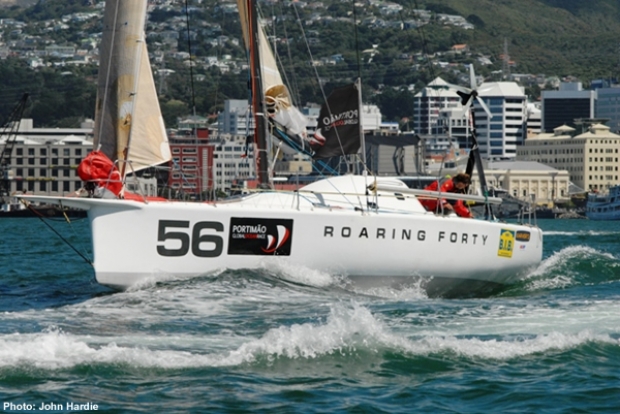
Kleinjans into the lead
Thursday February 26th 2009, Author: Oliver Dewar, Location: United Kingdom
The leading trio in the Portimão Global Ocean Race have converged at 42°S in the Pacific Ocean with the lead currently held by the fleet’s only single-hander, Michel Kleinjans, on Open 40,
Roaring Forty.
Just four miles behind the Belgian solo sailor, Jeremy Salvesen is celebrating his birthday today in style by moving into first place in the double-handed division with co-skipper David Thomson on the British Class 40, Team Mowgli, holding a narrow lead over second place Chilean Class 40, Desafio Cabo de Hornos. While the leading pack are separated by eight miles and the two Class 40s are currently slipstreaming Kleinjans on identical headings, the German duo of Boris Herrmann and Felix Oehme remain approximately 60 miles to the south of the fleet and although Beluga Racer has picked up pace in the past few hours to 10 knots – one knot less than the fleet average - they trail Team Mowgli by 37 miles in the 0620 GMT poll this morning.
Throughout the past five days of racing and just over 800 miles of light and frustrating conditions, each boat in the fleet has tried independently to find the best breeze and finally there seems - almost - to be a general agreement between the teams resulting in the minimal spread of the leading trio. The fleet’s convergence started on Tuesday when Michel Kleinjans on Roaring Forty and Jeremy Salvesen and David Thomson on Team Mowgli had a close encounter as their paths crossed at around 0920 GMT (24/02/09). Slipping south-east behind the double-handed Class 40, solo sailor Kleinjans describes the scene: “I saw Team Mowgli possibly three miles away,” he wrote in his blog. “Then they sent me an email and although I tried to call them on the VHF, I couldn’t get hold of them.”
Currently, Kleinjans and Roaring Forty are approximately 350 miles northwest of the western end of the Portimão Global Ocean Race southern limit: a line of latitude at 45°S streching for almost 4,000 miles across the Pacific below which the 40ft fleet are forbidden. This limit is implemented to shelter the fleet from the most ferocious winds and mountainous seas in the Southern Ocean and the first Pacific low pressure system is forecast to pass through the exclusion zone on Friday and Saturday. However, on a more local level, the breeze for the fleet should turn southerly later today providing good reaching conditions and the Germans - isolated in the south on Beluga Racer - may well feel the new wind first.
Although it is now very much ‘back to business’ for the fleet with the breeze building, the recent calm weather provided the teams with time to ponder an enormous number of subjects. “We’re in the middle of nowhere, racing through the most uninhabited zone on the planet,” writes Felipe Cubillos. “Without any wind, the sea is like a mirror and at night, the millions of stars are reflected, mixing with uncountable numbers of jellyfish that live in the ocean on the surface.” Witnessing this optical union between the distant cosmos and simple cellular sea life triggered some introspection on board Desafio Cabo de Hornos. “During my time at university in Chile, some of my contemporaries were inspired by their tutors and developed intellectual pretensions,” recalls Cubillos. “But for me, my love of sailing surpassed my passion for books on philosophy and the study of all things metaphysical.”
Despite turning towards seamanship rather than scholarship, the vast expanse of the Pacific Ocean has touched the Chilean skipper. “However, one thing has stuck in my mind: the infinite size and diversity of creation and the random nature of the universe,” he reports. “Today we have complete silence, tomorrow there may be deafening noise. Today, everything is peaceful and calm, but tomorrow all hell may let loose and we’ll be at war with the elements. In this immense solitude, it is a great comfort to know that you are all following our progress and supporting us.”
Most Read
Most Commented
Comments
Businesses

Pro businesses
-
-
-
United Kingdom
-
Italy
Editor's choice
Member blogs
-
 Ned Collier Wakefield: MOD70 round BarbadosWell that was intense. 12 hard fought for seconds for the win. In idyllic conditions, Tony Lawsons MOD ...
 -
 Mini Transat leg 2 reportThe second leg of the Mini Transat started on 31st October, just over a month after ...
 -
Leg 1 reportI’ve been working towards the Mini Transat now for three years. In 2013 I was part ...
Business blogs
-
 The Island Sailing Club in Cowes, Isle of Wight, is delighted that Prince Michael of Kent ...
 -
Peta Stuart-Hunt chats with the 25 year-old British solo sailor Lizzy Foreman before she sets sail ...
-
The 2015 Student Yachting World Cup (SYWoC), an ISAF-recognised event hosted and run by students for ...
Editor's Choice
All time favourites...
-
 Three legs down into Ian Walker’s
 -
 Winning all but two races at
 -
 For the first time in its
Latest Comments
Add a comment - Members log in