
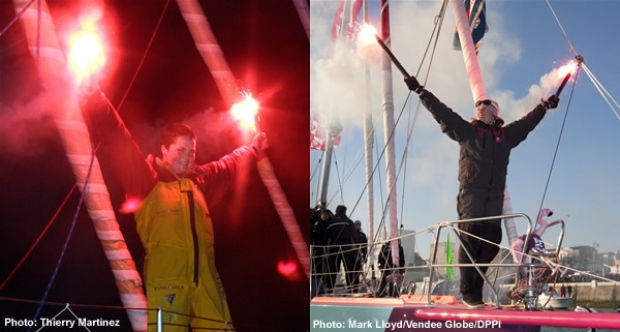
Sam v Ellen
So solo offshore racing has a new star in Sam Davies (if she wasn’t already) and with this comes inevitable comparison between Sam and Britain’s no.1 player in this the toughest part of our sport - Ellen.
For both sailors, the Vendee Globe was responsible for putting them on the map. Eight years ago, Ellen did the unimaginable - she, and she alone, had the audacity to challenge the legendary Michel Desjoyeaux in the final stages of the race. Ellen reeled MichDes back in coming up the South Atlantic and into the Doldrums Kingfisher and Le Professeur’s PRB were neck and neck. With this the Offshore Challenges PR machine went into overdrive, sparking up interest in the UK media that hadn’t been seen in the sailing world since the likes of Sir Francis Chichester and Robin Knox-Johnston’s completed their laps of the planet decades earlier. Unlikely Ellen, from landlocked Derbyshire in the centre of the UK, who had only started racing singlehanded three years earlier, had challenged the master. She finished second, but such was the achievement of ‘la petite anglaise’ and the degree of media embrace, that on both sides of the Channel it decidedly overshadowed Desjoyeaux’s win.

For Sam Davies, the effect has been similar albeit to a lesser extent this time. Like Ellen she has embraced France - she speaks French, she has lived in Brittany for several years and is as comfortable here as she is back in Blighty. Despite the best efforts of PR company Pitch, the media deluge for Sam hasn’t been nearly as intense as it was for Ellen. The unique, spectacular Les Sables de Olonne spectator turn out at a freezing breakfast time on Saturday seemed as enormous as it had been for race winner Michel Desjoyeaux two weeks earlier. And yes, Sam was on the front pages of the Sunday Times and Sunday Telegraph in the UK, but for Ellen eight years ago all the TV stations had sent outside broadcast trucks down to Les Sables d’Olonne, while the national newspapers sent not only their yachting correspondents, but also their top sports feature writers. Sam has been a superb story, but Ellen eight years ago was truly a phenomenon.
For both Ellen and Sam, their paths towards the Vendee Globe were similar, only for impatient Ellen it was decidedly fast tracked. Having competed in the Mini Transat in 1997, Ellen went straight into bigger boats winning the Open 50 class in the 1998 Route du Rhum, sailing the Transat Jacques Vabre with Open 60 legend Yves Parlier the following year, as her own Kingfisher - conceived uniquely in the Open 60 world, even today, by an America’s Cup style design team of Owen Clarke/Rob Humphries/Alain Gautier and Giovanni Belgrano of SP Systems - was under construction in New Zealand.
Sam, who originally entered professional yacht racing as the nipper on Tracy Edwards’ Royal & SunAlliance Jules Verne Trophy maxi-catamaran back in 1997, also competed in the Mini Transat, but not until 2001. Unlike Ellen, Sam then bit the bullet and moved to France to take on the one design elite of the Figaro class. For three seasons she was in fact part of the Turner/MacArthur Offshore Challenges empire, campaigning their Beneteau Figaro with backing from Skandia. However with the Skandia sponsorship over, in January 2006 Sam achieved every teenage girl’s dream when she was taken on board by clothing company Roxy, who had previously funded Anne Liardet’s 2004-5 Vendee Globe campaign. While Roxy backed Sam’s Figaro campaign in 2006, they also graduated up in terms of their Open 60 assets by purchasing the 2000-1 and 2004-5 Vendee Globe winner PRB, with Davies taking over from Liardet as its skipper come the 2007 season.
So from Mini to Vendee Globe took Sam seven years, compared to the three it took Ellen. Sam is two years older than Ellen, who was just 25 when she sailed the Vendee, compared to Sam who is now 34.

As individuals Sam and Ellen share many attributes. They both have a strong practical bent, that we believe is key to getting them to the finish line successfully in the voyages they have done. With Ellen, this was handed down by her woodworking teacher father, while for Sam her father is an engineer and she followed in his footsteps, picking up an engineering degree at Cambridge. It should be remembered that on Royal & SunAlliance, Sam was the rigger.
Both are highly intelligent, yet Ellen has this terrifying innate ability to learn, to suck up and retain information, while Sam has taken longer and been more methodical, effectively qualifying herself all along the way, either with her degree or through the ultimate solo sailing school that is the Figaro class.
Both share family backgrounds that were inventive and pioneering. Ellen grew up in Derbyshire to teacher parents, got into sailing during her teens through her aunt, famously saved her dinner money to buy her first boat, a 21ft Corribee, worked for a sailing school on the Humber before she sailed Iduna around Britain singlehanded. From Portsmouth, Sam comes from a maritime family – albeit not a yacht racing one. One grandfather was a submarine commander, while the other was a builder of aluminium powerboats and her parents always had boats – they are now retired, have sold up and gone cruising. Their yacht is a recently built replica of Nina, a 1927 vintage 59ft transatlantic race winner from America’s Cup designer of the day Stirling Burgess and this is currently parked opposite Roxy on the Vendee Globe pontoon here in Les Sables d’Olonne.


Sam’s mother Jenny recalls that her eldest daughter got afloat for the first time when she was week old aboard their 20ft motor cruiser. “A year later we were pottering around the Solent with her. So she learnt to walk at sea. We had to take her ashore for dry land practice. She was very happy. She was never scared.
“When she was four we bought a 28ft sailing cruiser and I thought ‘I wonder how Sam will take to being tipped on her side?’ But she didn’t bat an eyelid. She was quite a reserved child and I wondered if it would frighten her. But not a bit, she was never frightened, she loved going fast, she took to it, well, like a duck to water.”
However Sam and Ellen are also very different. During Ellen’s various exploits she seems much more of an emotional pendulum, whereas Sam has proved much more even keeled, with an abundance of one predominant emotion - profound happiness - derived from her feeling ‘privileged to be out there’ and just genuinely enjoying the experience. That simple. Sam’s constant and unflabbable perkiness are a stark contrast to the tears and “It’s so hard” that one remembers from Ellen’s first solo non-stop round the world trip eight years ago. There was no kissing of the boat when Sam stepped ashore on Saturday morning.
A fundamental difference is that while both tried supremely hard on their respective Vendee Globes, one gets the impression that Ellen very much gives up part of her soul whenever she does a race or a record attempt like this, where for Sam it is more like another amazing day in an amazing office. Part of the immense toll these events take on Ellen is certainly down to having to deal with the intense media attention she always seems to attract, the by-product of her amazing achievements but also through her wearing her heart on her sleeve.
But in Sam’s case her even temperament is perhaps also down to her being older and having done the ‘hard yards’ and gained the experience and resulting confidence. Prior to the Vendee Globe, she had been through the Southern Ocean previously on Royal & SunAlliance, until they lost their rig in the Pacific Ocean, while the tricky solo sailing aspect was beaten into her after long, hard years in the Mini and Figaro classes. Ellen too had been through the Southern Ocean on her delivery trip back from New Zealand and was prepared for this.
Both also have extremely good teams behind them, Ellen with Mark Turner and the other talented assortment of individuals at OC, while Sam has her own handpicked team led by Project Manager, Xavier David, including her long term ‘preparateur’ from the Figaro class, Erwan Lemeilleur and with round the world veteran Philippe Monnet lurking in the background as the man who brought Roxy into sailing. The Roxy Sailing set-up is less the corporate entity of OC and more an extremely tight family unit.
So what would make the Vendee Globe 2012 for us would be a showdown between Ms Davies and Ms MacArthur. Don’t hold your breath for this to happen, in Ellen’s case at least, but it is interesting conjecture to wonder who might win that particular race?
For her part Sam says she will surely be back in most probably a new boat designed by Guillaume Verdier. The ‘conversation’ has yet to happen with Roxy. “I think they really want to stay together with me and I would love to stay with them. Their idea is to try and find a co-sponsor, but at what level I don’t know.”
Speaking to Sam, one gets the impression that with a Vendee Globe successfully under her belt and a still hard to conceive fourth place in the bag aboard an eight year old boat, she has now graduated from solo offshore racing school. “For once I'm prepared to put as much energy as possible into trying to find money to be able to do 2012. I am happy to sacrifice some races in order to be able find the money to be able to build the boat.”
A good indication of the quality of a solo offshore racer is the state their boat is in when it arrives back. For example it was interesting to note that PRB when she returned from the past two Vendee Globes has been in great shape, especially compared to Desjoyeaux’s war-torn Foncia this time. On the dock here Armel le Cleac’h’s BritAir is also in good shape, with the exception of the movable sprayhood that was taken out by a wave in the Bay of Biscay on the way in and once again Sam’s Roxy.
As she puts it: “the solar panels - thank God they have rusted otherwise no one would have believed I’d sailed around the world, because the boat is in such good condition.”
But the real acid test is the state of the sails. “The sails are amazing! I was pushing it and especially in the Southern Ocean, because I don’t have a small genniker or a small spinnaker or anything, so I basically went around the Southern Ocean mostly with my solent, sometimes the staysail. Even when there was tons and tons of wind I never took it down, because the boat was quite happy sending it really fast. I was quite surprised the Solent was in such good condition for going upwind. And the main is perfect still. The spinnaker - I didn’t spinnaker in the Southern Ocean I don’t think, but when I used it, no problems."
Sam says she was forced to be very careful with her big downwind sails because Roxy only has one masthead halyard for them. Considering that there was only one of them and that she felt sure that at some point she would have to dump the whole lot overboard, she took a replacement halyard, sheets, tack line, etc. However a week into the race she realised that she hadn’t take the necessary pulley and furling swivel. “So, if I had lost that it would have been no more genniker, no more Code Zero, no more spinnaker. So I realised that I had to be very very careful and no leaving the big sails up too long and no taking risks of losing that block, because I would have been a bit handicapped.”
However more serious potentially was the worsening condition of Roxy’s rudders. These are kick-up and mounted recessed into the transom scoop, as they have been since the boat was built. On one of these, the precise titanium rod used to locate the rudder in its box broke off as Roxy was outbound in the South Atlantic and with the whole of the Southern Ocean ahead of her, Sam was forced to repair this.
“It was really annoying, because it was all bolted together, so whenever the rudder kicked up you had to unbolt the whole thing, get it in the right place with tape, then drop the rudder down, then get into the scoop at the back of the boat with the spanners, and when the boat is going downwind with little sail up, because you’ve just hit something and kicked your rudder up, then it steers all over the place and you are there with your head and your hands in the water, because the waves are breaking into the scoop because you are going too slowly, so the waves are coming in. So you have everything under water trying to bolt the thing back up again and the thing is steering, and there were a couple of times when I nearly crushed myself, when the pilot did a big steer…”
Roxy’s rudders are held on by gudgeons and pintels. Later in the race the bearings within the gudgeons had completely worn away. “On the starboard rudder at the bottom of the Atlantic I had no bearing left, so it was making a lot of noise and flapping around at the back of the boat. And it is a titanium gudgeon and a titanium pinlet, but I was thinking if that is doing that all the time, then it is possible the pin could just sheer off and then I’d have no rudder. So I worried about that all the way around the south. Then on the way back up the Atlanti, as soon as I was on the other tack, I kicked the rudder up to relieve it from some stress for as long as possible. Then I realised that the other one had worn itself just as badly, and so badly actually that the top of the pin sheered off. Luckily the top of the pin is the bit just to pull it in and out, but it also stops the pin dropping through and falling out and luckily it sheered off just leaving a bit so that it didn’t drop through.
“In light wind because you can hear it and you can feel it vibrating. So helming was a nightmare because the rudders just decided where they wanted to go. So it was nicer to leave the boat under pilot than it was to steer it.”
So apart from the rudders and a number of smaller items, Roxy effectively went around the world without incident, scoring another top four in the Vendee Globe. The boat should now perhaps be treated with the same reverence that the late Eric Tabarly's Pen Duick 1 was treated with in the early Vendees.
“This boat was conceived by the same person by the same person who conceived the winning boat this year,” says Sam. “Is that a coincidence that there are a lot of very good thought processs and engineerings [in her]? And Vincent [Riou] worked for Mich, so it kind of safety and it kind of stayed in the family and we haven’t changed it.”
By way of example she cites the way the alternators are built into the engine so that if you have to change one it is easy to re-tension the belt.
Since the last Vendee Globe, there were a few modifications to the boat, the most significant being replacing MichDes’ original twisting single central daggerboard to a more conventional twin asymmetric arrangement. However there are aspects of even this amazing boat that Sam would have liked different and these are going on the shopping list for the 2012 machine.
“I felt that I missed a fractional halyard. I would have liked to have had a small kite or a fractional genniker, because I made a Code 0 to use in the breeze as a downwind sail, but the trouble is that when there is breeze, then you risk to face plant/nose dive and I didn’t want to put too much load at the top of the mast. It is supported, but it would be nicer if when you face planted that you had the load on the hounds. So I did a lot of sailing on the Solent where I could have had a small genniker. Apart from that - everything on that boat is really well thought out.”
“And NKE have done a really good job with the autopilot. It is absolutely amazing. I never once wiped out or perhaps only a couple of times, with waves. But I didn’t have to go on deck – the pilot got the boat going again. And I never once got scared about Chinese gybing. And when I spoke to Brian and Johnny, who struggled the whole time about where the boat was going, that was a really big relief - to be able to just send it through the night as fast as you can.”
Roxy’s fixed rig stood up well to its second lap of the planet. Sam says an oddity of the rig is that it replaced MichDes’ original rotating mast and although it is fixed now, it remains stepped on the ball for the first spar. “Vincent kept the ball to keep the compression loads exactly in line with the mast and not to have any sheer in the foot which is quite nice for the, mast but you have to block your mast from twisting.” During the race carbon piece beneath this blocking piece delaminated.
Sam says that aside from her plans to continue in the IMOCA Open 60 class, she also would like to return to the Figaro. This year she will be joined there too by Michel Desjoyeaux, and we understand a rapidly recovering (he is now down to just a stick to help him walk) Yann Elies. But as to 2012, a fourth place in an eight year old boat will be one hard task to better.
Businesses
Pro businesses
-
France
-
-
United Kingdom
-
Editor's choice
Member blogs
-
 Ned Collier Wakefield: MOD70 round BarbadosWell that was intense. 12 hard fought for seconds for the win. In idyllic conditions, Tony Lawsons MOD ...
 -
 Mini Transat leg 2 reportThe second leg of the Mini Transat started on 31st October, just over a month after ...
 -
Leg 1 reportI’ve been working towards the Mini Transat now for three years. In 2013 I was part ...
Business blogs
-
 The Island Sailing Club in Cowes, Isle of Wight, is delighted that Prince Michael of Kent ...
 -
Peta Stuart-Hunt chats with the 25 year-old British solo sailor Lizzy Foreman before she sets sail ...
-
The 2015 Student Yachting World Cup (SYWoC), an ISAF-recognised event hosted and run by students for ...
Editor's Choice
-
 Three legs down into Ian Walker’s
 -
 Winning all but two races at
 -
 For the first time in its
Latest Comments
Add a comment - Members log in