
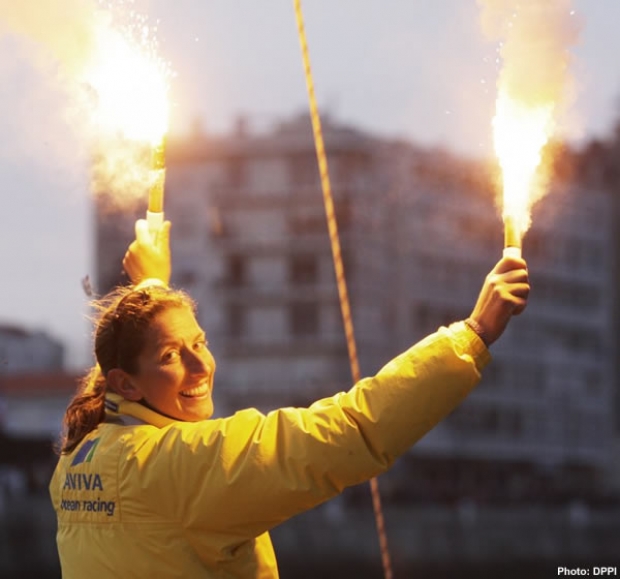
Gunning for the 2012 Vendee Globe
Thursday April 9th 2009, Author: James Boyd, Location: United Kingdom
Few, including the good lady herself, would have predicted that in the Vendee Globe earlier this year Aviva skipper Dee Caffari would end up finishing a more than respectable sixth out of 30 starters. But this is something the British skipper can now proudly state on her sailing CV, along with of course, being the first woman to have sailed around the world non-stop both westabout and now eastabout, with and against the prevailing winds.
“When I left I wanted to have been in the top half of the fleet,” admits Caffari. “I knew the boat had the potential, but I was very aware that I needed to grow into my boat. I thought I would get better on the race, but I think I surprised myself how much that progression happened. I knew there would be a bit of a war of attrition but I didn’t realise the extent and severity of it. That changed my opinion of the race half way ‘I need to survive this first and then race it second’ a little bit.”
Aviva’s Project Manager Joff Brown, who previously worked alongside Dee when they both were part of Mike Golding’s Team Group 4 shore team prior to the 2000-1 Vendee Globe, says that he is not surprised she got around, observing that there is a common thread of good seamanship that has been instilled in her as a result of having been through the ‘Challenge Business school’, something also true of Hellomoto skipper Conrad Humphries and Mike Golding.
Despite coming out with such a good result on her first attempt, for Caffari, this Vendee Globe represented a steep learning curve, as well as a major exercise in boosting her confidence as a solo Open 60 skipper.
“I had had my first depression in the south of 50 knots and experienced the boat doing its own thing at its own speed and I was like ‘wooow’ (with my eyes closed) - so the boat can do it and I don’t have to have my eyes open. At that same time there was the ‘ten day nightmare’, which I think began with Gitana’s dismasting. It got to the point where I was dreading downloading my emails because it was like ‘what’s happened today?’ Mike’s dismasting had a big effect on me because personally I was gutted for the guy and then there was the realisation that I was carrying the same mast [ Aviva and Ecover are Owen Clarke designed sisterships]. Yann [Elies]’s accident was just horrible - to me injury is one of the worst things that can happen. So I lost a lot of confidence and the wind ranges where I did all my sail changes all dropped and in my head for a while I got into a comfort zone where as long I was going faster than Akena [Verandas] in the position reports I was happy. Then we settled into this group of three – Akena, myself and Pindar, across the Pacific, which was good considering our impending doom at Cape Horn! But I snapped out of that a little bit. I think the hard thing for me was that I had that week where I lost a lot of confidence and just needed to be faster than the guy behind. Then I built my confidence again, but I had the distraction of the mainsail - that festered for a while - and in the Atlantic it was like ‘I can go now’.”
While Aviva returned to Les Sables d’Olonne in great shape, having experienced none of the keel, mast, rigging, rudder or electrical issues of her rivals, the only item that nearly scuppered Caffari’s chances were her severely delaminating mainsail. This same problem ultimately caused the retirement of Johnny Malbon and his Artemis Ocean Racing. While for Malbon it started in the south Atlantic, on Aviva it only began to come apart to the south of Australia.
“I was talking to Johnny about the progression that his sail had made and where mine had got to. And he sent me some photos through showing where his fibres were exposed and literally four or five days later I was seeing the same. Then Joffe called me to say that Johnny was retiring because his main couldn’t do any more. I was into the Pacific then and he wanted to know what my reaction would be. In fact I turned it around and I was very positive. It was like ‘right, I am going to keep working on my sail, we are going to keep going. We’ll be okay’. So he was surprised that I was so positive, but in the back of my mind I was worried about how it was going to be by the time I reached Cape Horn. But as a team we decided that once I was in the Atlantic I’d do the big repair to the worst of it – which was the top of the sail and then we’d sail the boat as normally as we could and when it fell apart, we’d deal with that then.”


The enormity of this task cannot be underestimated. Initially Dee tried to stop the rot by just putting on small patches in the middle of the sail where the mylar outer film was disintegrating. However this made matters worse as the patches would fall off, taking more mylar with them.
“Every tack I did, every time I put a reef in or out, there was confetti coming out of the back of the boat, because every time I moved the sail more stuff would come off it, because it was just spreading to the other areas. While the mainsail was up fully, it was fine because the fibres were in line and loaded in the right way and everything was okay, but as soon as it was reefed then you are loading fibres at a different angle and that is when the damage was happening.”
Eventually a patch on a grand scale, effectively covering the entire top of the sail, had to be created and on a giant Open 60 flat-topped mainsail this was no mean feat.
To get enough sail cloth, Dee was forced to sacrifice her Code 5, a sail she felt she was least likely to use coming back up the Atlantic. Joffe Brown emailed through the correct dimensions for the patch – roughly a 4 by 6 metre area. A patch of this size would have to be applied to both sides of the sail to protect the fibres in the middle.
The first major was trying to find a large enough area below to unroll the furled Code 5. Dee ended up unfurling the sail in the compartment forward of the main bulkhead, then dragging the sail through into the ‘saloon’ area to cut it. The whole unfurling/patch cutting process alone took 48 hours.
Then came the matter of fixing the patches to the sides of the disintegrating sail. Unfortunately she had used up most of her sail repair materials in the unsuccessful smaller patches she had made previously. So she dropped the main having laid the cloth alongside it, trapped in the lazyjacks.
Attempt number one involved sticking the cloth to the sail with Sikaflex. Unfortunately by the time the sail got to full hoist the patch was already peeling off. Attempt two was to use a gooey mixture of Sikaflex and epoxy. “That was better but there were still a few flappy bits after a couple of days. So when I was on the other gybe I dropped it to do the other side a couple of days later and I’d learned from my mistakes by then, so I Sikaflexed, epoxied and then I stitched. I tried just stitching the four corners and rehoisted, but the wind increased and it started flapping and it ripped through the stitching. So the next repair was to drop and stitch through all four sides and that involved a lot of running around the mast! In fact if you’d made a Carry On film about it, it would have looked hilarious. I got it down to one patch, one side from dropping to a full hoist in three hours. I drew a lot of blood, a lot of needles through hands.” Dee reckons in total she dropped and rehoisted the main eight times to make the repairs (remember this alone is a marathon job singlehanded).
Ecover’s dismasting and Aviva having an identical rig, was on Dee’s mind as she went through the sail repair as she was concerned about keeping the sail plan balanced fore and aft of the mast. Equally it was going to be a long journey home if she could only use a staysail up front.

Anyhow, the patch held and by the time Aviva reached Les Sables d’Olonne the only part of the mainsail still with the original mylar left on it was an area at the bottom of the sail with the Aviva logo on it while there was Taffeta still on about half of the sail.
“I was a good advertisement for stitching on the water. I should take up dress making! I was thinking a stapler would have been really good. Of course I didn’t have one, but I thought about the skin stapler so I went into the medical kit and tried that, but they are not as tough and they didn’t last.”
A few weeks on and Dee says that she has recovered and has even managed to find time to take a week’s skiing. The comedown after the Vendee has been a lot easier to deal with. This is her third time around the world and her second singlehanded non-stop and with the Aviva Challenge around the world the wrong way, the duration of the record attempt was six months – more than twice as long as the Vendee.
Meanwhile her yellow and blue steed is now down at Endeavour Quay in Gosport alongside Ecover and Hugo Boss. The boat has been stripped and everything has been sent back to its manufacturers – rams to Cariboni, standing rigging to Future Fibres, etc. “We haven’t found anything untoward or anything that has surprised us, which is really good. I was quite relieved.” The boat will be back together and relaunched towards the end of this month.
What lies ahead remains uncertain. Dee would like another four year program culminating in the 2012-3 Vendee Globe, using the same boat,.
“If there is one thing I learned and I could visibly see, was that to have confidence and to know exactly what your boat can do makes your life so much easier and a lot faster in the south. I went down there and learned as I went along, but just to see VM and Veolia and Roxy [skippers] being that confident and relaxed with their boats because they knew exactly what it could do – it was like ‘that’s what I want to be like’. Now I know what my boat can do and also know what I like and what I don’t like, so I have comeback with a few ideas of what modifications I would do having been down there now. I would like to keep the boat and just do the mods.”
Among the changes would be replacing the wheels with a tiller or tillers and a helming position that is more protected by the cuddy. Despite Aviva having a conventional nav area cluttering up the middle of the saloon, Dee says she has got used to moving the stack around this, so probably won’t change it.

But whether this happens remains to be seen. Aviva have yet to press the button. The company are in the middle of a giant advertising campaign at present, of which Dee’s solo IMOCA racing is just a tiny part, to reinforce their corporate name change from Norwich Union to Aviva. This includes an ad campaign on TV featuring George Clooney, Elle McPherson and other notables. However they are also at the same time shedding jobs over the course of three years and while the company is in no way in bad shape, it may be hard to ‘justify the expenditure’, although every company needs marketing, even in times of recession.
The only definite is that Aviva will be sailing around Britain. This was supposed to have been in the Calais Round Britain Race, however this event has been canned due to lack of entries (too many boats licking their wounds post-Vendee). Instead Dee is looking at making a record attempt round Britain, in order to break Sam Davies and Roxy’s time for an all-female crew set during the 2007 Calais Round Britain. The crew has been lined up for this, but has yet to be announced.
“I am actually keen to get back out sailing now. I am missing my bucket clearly, although I don’t know about sharing it with four other people mind you!”
With the Calais Round Britain canned, so IMOCA are considering rejigging the dates of their inaugural European Tour, so that it ends before Cowes Week and the Fastnet. So ultimately at present the only event in the calendar that seems definite is the Transat Jacques Vabre at the end of the year.
“It is quite a frustrating year, because for two years I have had such a tight time schedule, knowing absolutely everything I was doing, week by week for months in advance. And suddenly after June it like, ‘I don’t really know’.”
While the calendar us up in the air, so at present is the class rule with a major AGM coming up at the end of this month where the class are said to be looking to make big amendments to limit costs. (Surely major amendments to a rule, result in major expenditure?) In addition several sponsorships within the class have ended naturally following the Vendee, although some too are clearly progressing well – Dee’s Vendee rival Arnaud Boissieres has just acquired Vincent Riou’s PRB for example.
If it works out with Cowes Week and the Fastnet, then Aviva will be probably doing the European Tour that kicks off in Istanbul. “People are quite keen to make that happen and obviously the more boats in European ports, the better. So everyone is looking at it favourably and at it being a key thing to make happen. For us it would be a return to the sponsor, because it does activate their key market. They are very keen, which is understandable, because the IMOCA Open 60s generally head off into an ocean, and this is their one opportunity to go to ports of call where they can be seen and experienced.”
Looking back at the Vendee and what she learned about herself, Dee says she is a different person from the one who sailed her first solo Open 60 race a year ago in the Transat Ecover BtoB. “In that I can say that I cried pretty much the whole way and didn’t really sleep at all and I probably didn’t eat too much. And if I think about where I have gone from there in a year – it has been unbelievable and most of that is learning about myself and that management of sleeping and eating and being able to make decisions from a much better place. I was in a so much better place for the whole race that I came back having loved the Vendee and that has come from having coaching sessions and being confident with the manoeuvres, and then it was a case of making strategy decisions and what was really nice was that I recognised when I got it wrong, or where I lost miles.”
But the key thing has been getting to know, or more accurately to trust, her B&G autopilot.
Dee says she didn’t struggle with sleep deprivation. This was partly because she was already pretty well versed in this from her previous round the world voyage, but also because she kept a log of when she ate, sleep and carried out sail manoeuvres in order to have some hard data to present to the sports scientists she works with. She found herself able to bank sleep when conditions were stable and this was enough to see her through when the wind was more shifty or she was having to repair the main. She says she was also fine on the physical side (she is naturally a fitness junkie).
So where is there room for improvement? “I made some tactical errors with the islands. Aviva was like a island magnet in the Atlantic. So I made some mistakes coming south. I would look to rectify them. Pushing that bit higher for longer in the Southern Ocean, as now I have the confidence to do that. Whereas everyone was having problems and I spent a lot of my time thinking ‘that could me, that could be my boat, because I am doing the same thing’, rather than ‘well my boat is okay so I can keep going’. So it is whether you have a positive mindset or a negative mindset. Where I didn’t have the confidence or the comfort of knowing that my boat could take it, that was when it was like ‘maybe I should slow down a bit, because it is a bit scary’. So hopefully, that will development. And hopefully maybe not have a delaminated mainsail will save a bit of time... Not having to do eight extra hoists of the main and random stitching and sticking in between would be nice.”
While the IMOCA calendar is a little sparse and sporadic, Dee recognises that she must sail more and plans to link up with the likes of leading British Mini sailor Ollie Bond (also part of her shore crew) and Nigel King, who is just re-starting his Figaro career.
“One thing that hit home to the Brits, was having so many boats in the Vendee this year - we were very communicative as a group. We are all actually within 100 yards of each other on the water [ie all the boats are based in the Solent], yet we never went sailing together. Mike [Golding] and I made the biggest effort and we had 10 days that both of us were buzzing from and we were only scratched the surface of what we could have done. So it is definitely something I’d like to do more of with the 60s and as much of as I could fit into the calendar of time on the water with close proximity racing. Once a couple of people start doing it, I think everyone will come on board with it. It just making that initial push. It would be great to set up, it is just a case of keeping the momentum we have just started to get. The other side is that where in France it is part funded by the government or the local council or the region - it is supported. It is going to be very hard to get that kind of support.”
As to extra-curricular activity, Dee says she intends to do a number of ‘adventure races’ (ie cycling, running and kayaking) this year and has already completed her first. She has also be offered another land-based adventure “of an extreme nature” but won’t specify what it is other than that it is likely to involve mountains and possibly the world’s biggest.
So, fingers crossed that Aviva realise that they have a record breaking skipper on their roster, who is keen to continue – and who importantly doesn’t need to have a new boat…
Most Read
Most Commented
Comments
Businesses

Pro businesses
-
United Kingdom
-
-
-
France
Editor's choice
Member blogs
-
 Ned Collier Wakefield: MOD70 round BarbadosWell that was intense. 12 hard fought for seconds for the win. In idyllic conditions, Tony Lawsons MOD ...
 -
 Mini Transat leg 2 reportThe second leg of the Mini Transat started on 31st October, just over a month after ...
 -
Leg 1 reportI’ve been working towards the Mini Transat now for three years. In 2013 I was part ...
Business blogs
-
 The Island Sailing Club in Cowes, Isle of Wight, is delighted that Prince Michael of Kent ...
 -
Peta Stuart-Hunt chats with the 25 year-old British solo sailor Lizzy Foreman before she sets sail ...
-
The 2015 Student Yachting World Cup (SYWoC), an ISAF-recognised event hosted and run by students for ...
Editor's Choice
All time favourites...
-
 Three legs down into Ian Walker’s
 -
 Winning all but two races at
 -
 For the first time in its
Latest Comments
Add a comment - Members log in